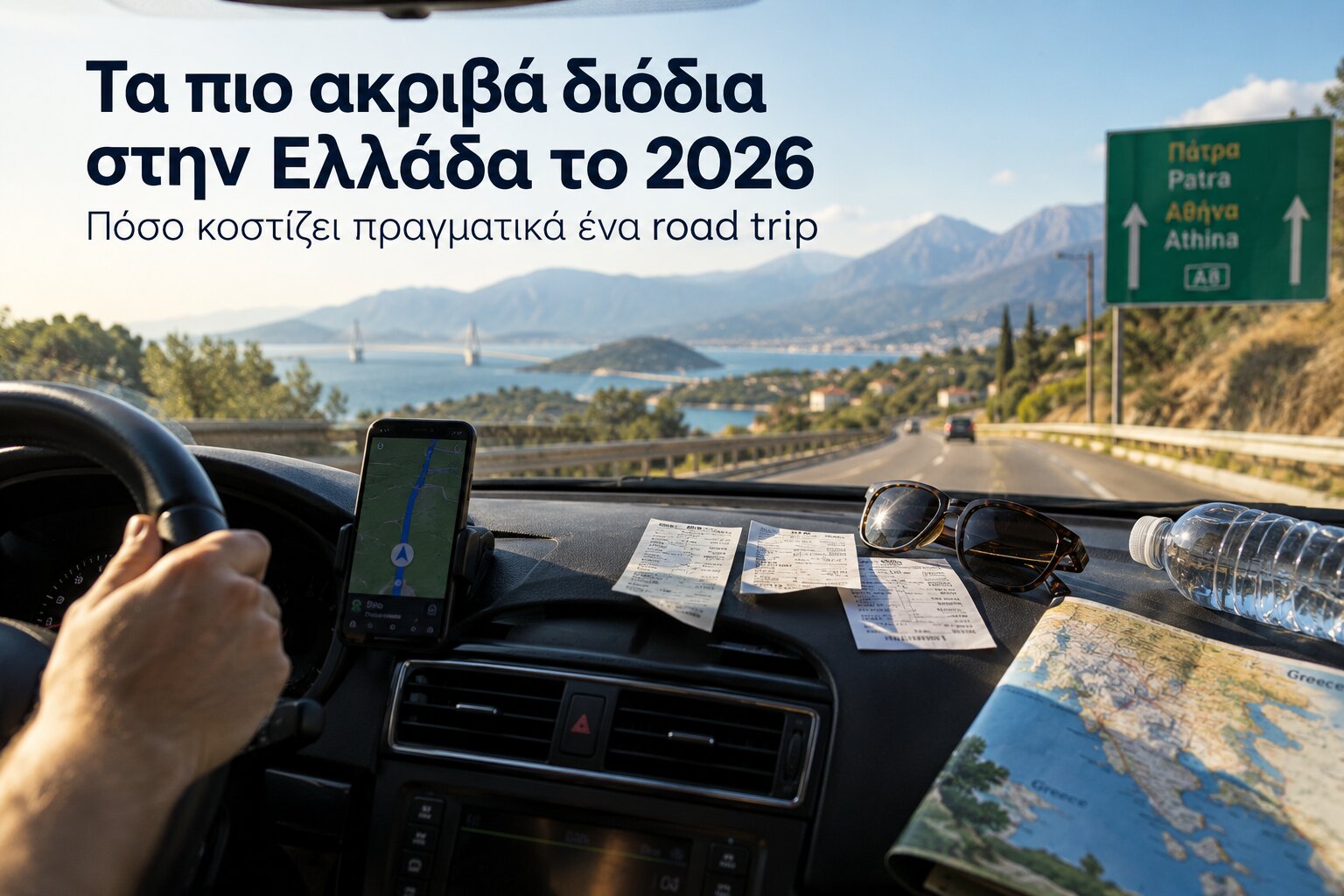
A road trip through Greece can mean coastal drives, mountain landscapes, historic towns and the freedom to change your itinerary whenever you want. But there is one expense that travellers can easily underestimate when planning their journey: road tolls.
Toll rates on Greek motorways have been adjusted for 2026, and the amount a driver pays depends not only on distance but also on the motorway, the toll stations along the route and the vehicle category.
Whether you are driving your own vehicle or renting a car in Greece, knowing these charges before departure can make your road-trip budget considerably more accurate.
Which tolls stand out in Greece in 2026?
The most striking individual charge for a standard passenger car is not found at a conventional motorway toll station.
Crossing the Rio–Antirrio Bridge costs €15.90 for a standard passenger car in 2026. However, the bridge is a major piece of dedicated infrastructure, so its toll should not be directly compared with a conventional motorway toll plaza. Special products are available for frequent users, while the Green E-pass offers a €12 crossing rate for eligible electric passenger vehicles.
On Greece’s conventional motorway network, some of the higher mainline toll charges for a passenger car in 2026 include:
- Moschochori: €4.70
- Thiva: €4.55
- Tragana: €4.55
- Oxinia (E65): €4.50
- Angelokastro (Ionia Odos): €4.20
- Pelasgia: €4.10
- Afidnes: €3.90
- Leptokarya: €3.80
- Terovo: €3.70
- Sofades (E65): €3.70
These figures demonstrate an important point: toll costs can vary considerably between different sections of the Greek motorway network.
Athens to Thessaloniki: small charges add up
The Athens–Thessaloniki route is one of the best examples of how individual toll payments can accumulate during a long-distance journey.
There is no single toll payment covering the entire trip. Instead, drivers using the main A1 corridor encounter a succession of toll stations along different motorway sections.
Using 2026 rates for a typical passenger car, the relevant mainline toll charges add up to approximately €35.55 in one direction, depending on the exact entry and exit points and route used.
A return journey can therefore exceed €70 in tolls alone, before adding a single litre of fuel.
This is why looking only at individual €2, €3 or €4 toll charges can be misleading. None appears particularly significant on its own. Over several hundred kilometres, however, they become a meaningful part of the total travel budget.
Egnatia Odos: an important change in 2026
Drivers travelling across northern Greece should pay particular attention to changes on the Egnatia Odos (A2).
From 31 December 2025, management of the Egnatia Odos and its vertical road axes transferred to a new concessionaire, introducing a new toll regime.
Under the 2026 rates, travelling the full route from Igoumenitsa to Kipoi at the Turkish border through the main toll stations costs approximately €30.45 for a passenger car, compared with €24.45 previously.
This matters for anyone planning a long road trip across northern Greece. Older travel guides, saved routes and outdated online calculations may no longer reflect the current cost.

Driving through the Peloponnese
The Peloponnese provides another good example of how toll costs vary depending on the route.
Olympia Odos covers the Elefsina–Corinth–Patras–Pyrgos corridor. Its toll rates have been adjusted for 2026, while kilometre-based charging is progressively available on parts of the network for eligible Olympia Pass users.
For journeys towards Tripoli, Kalamata and Sparta, the Moreas motorway also applies its 2026 tariff.
Indicative passenger-car charges include:
- Spathovouni: €2.95
- Nestani: €2.80
- Manari Bridge: €2.30
- Kalamata: €2.25
- Petrina: €3.45
The important takeaway for travellers is simple: two Greek destinations located at broadly similar distances from Athens do not necessarily have the same motorway cost.
What about Attiki Odos in Athens?
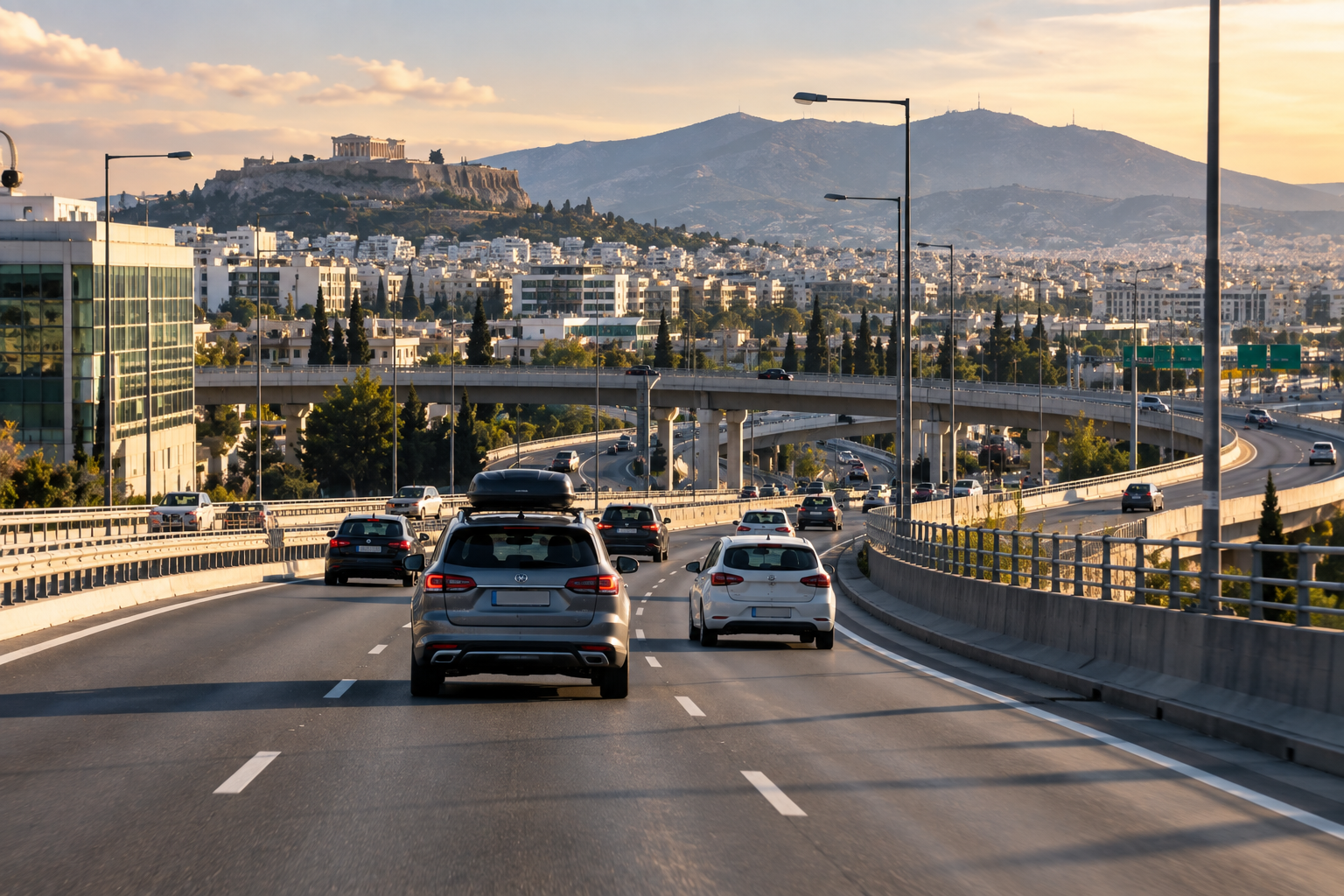
Attiki Odos operates differently from many intercity motorways because drivers normally pay when entering the motorway.
The standard toll for a typical passenger car is €2.55.
Unlike distance-based systems, the basic charge is not calculated according to how many kilometres you ultimately travel on Attiki Odos.
For travellers starting or ending a road trip in the Athens metropolitan area, it is therefore another potential cost to include in the journey budget.
Can you reduce toll costs?
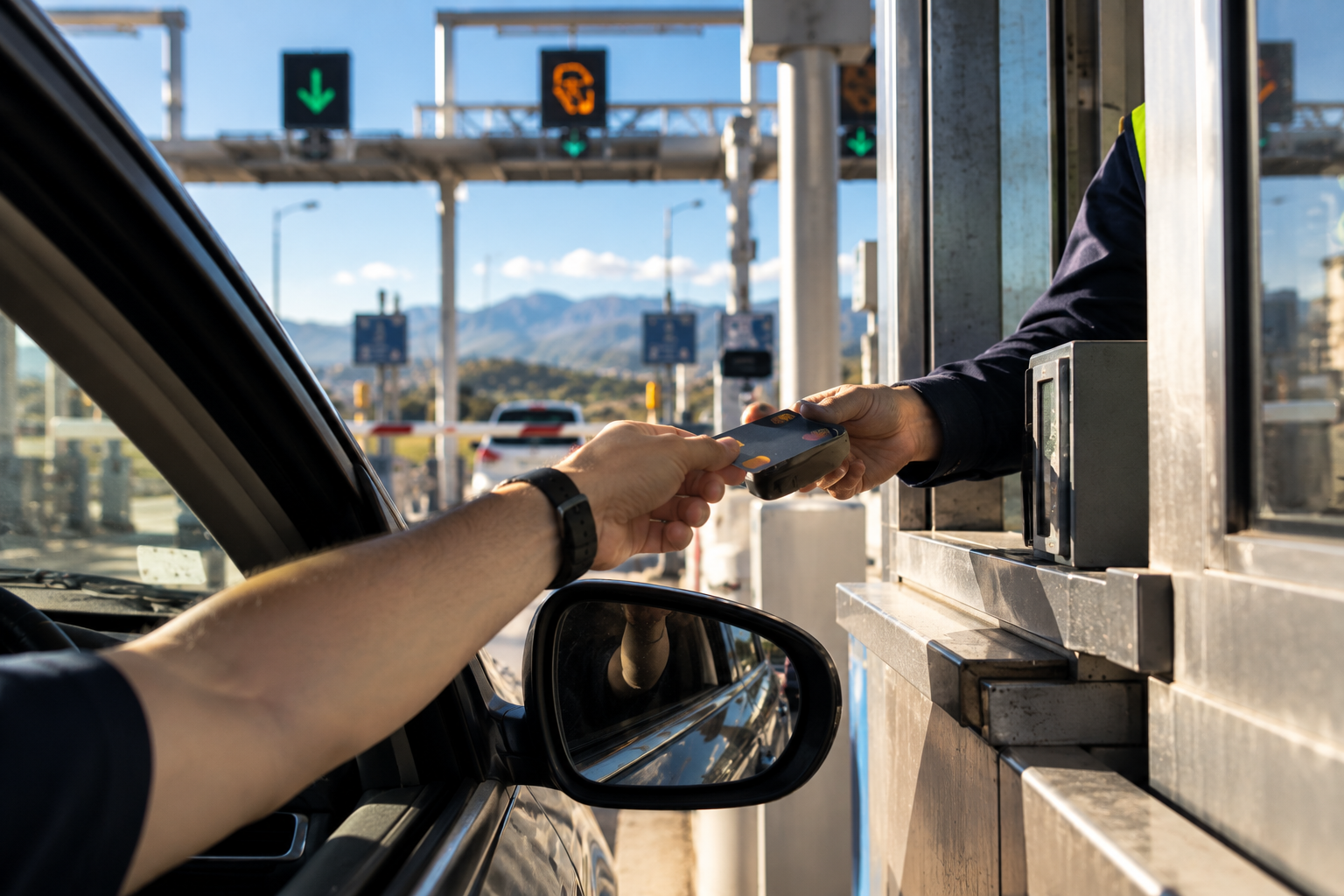
In some circumstances, yes — but simply using an electronic toll lane does not automatically mean that every journey becomes cheaper.
Greece has electronic toll systems, and interoperability allows compatible transponders to be used across participating motorway networks. This makes travelling between different motorway concessions considerably easier.
However, interoperability does not mean that every discount offered by one motorway operator automatically applies to every other motorway.
Some operators have their own discount or distance-based programmes.
Olympia Odos, for example, offers kilometre-based charging on eligible journeys, where part of the initial toll can be returned according to the actual distance travelled. Other programmes provide discounts based on usage frequency.
The Rio–Antirrio Bridge also offers specialised products for frequent users, same-day return journeys and eligible electric vehicles.
For an occasional visitor to Greece, however, the safest approach when budgeting is to calculate the standard toll price first and treat any applicable discount as an additional saving.
What if you are driving a rental car?
If you rent a car in Greece, do not automatically assume that the vehicle includes an electronic toll transponder or that motorway tolls are included in the rental price.
Before leaving the rental location, ask:
Does the vehicle have an e-pass?
How are electronic toll crossings charged?
Is there an additional administration fee?
Can I simply pay the toll directly while travelling?
Policies can differ between rental companies, so it is better to understand the procedure when collecting the vehicle rather than discovering an unexpected charge later.
This is particularly important for travellers planning long-distance itineraries involving several Greek motorway networks.

Tolls are part of the real road-trip budget
The true cost of driving around Greece is more than the daily rental rate or the amount spent at the fuel station.
A realistic road-trip budget should consider:
car rental + fuel or charging + tolls + parking + any ferry costs for transporting the vehicle.
For short journeys, tolls may represent only a small additional expense. On routes covering hundreds of kilometres, however, they can become a significant part of the total cost.
That does not necessarily mean avoiding Greek motorways.
Modern motorway routes generally provide faster and more predictable journeys between major destinations, and choosing slower toll-free alternatives purely to save money may add considerable distance or travel time.
The important thing is knowing the likely cost before setting off.
Because the best road trips combine freedom with good planning — and understanding Greece’s toll system is one small step towards enjoying the journey without unexpected costs.