
Fuel prices remain a major concern for drivers in Greece, with petrol and diesel costs continuing to put pressure on household budgets. New measures introduced in October aim to ease some of that burden by reducing the price paid at the pump.
The temporary support combines government subsidies with contributions from fuel refineries. But how much are drivers actually paying, what savings can they expect, and what happens when the measures expire?
Current Petrol and Diesel Prices in Greece
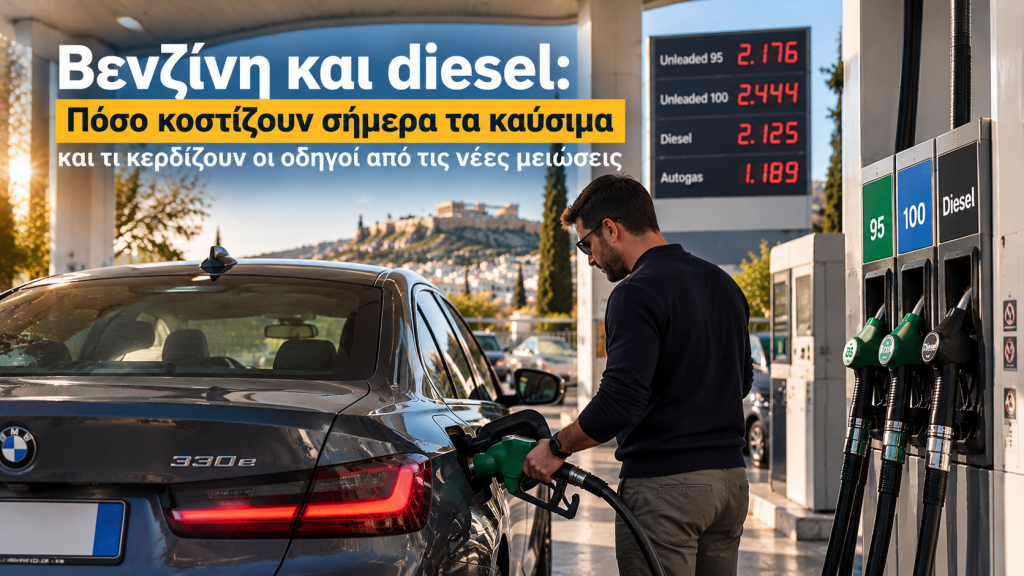
According to Greece’s official Fuel Price Observatory, the nationwide average retail prices recorded on October 21, 2026, were:
| Fuel type | Average price per litre |
|---|---|
| Unleaded petrol 95 RON | €2.176 |
| Unleaded petrol 100 RON | €2.444 |
| Diesel | €2.125 |
| Autogas (LPG) | €1.189 |
These figures show that standard unleaded petrol remains above €2.17 per litre, while diesel is also trading above €2.12.
The figures represent national averages rather than fixed prices. Actual costs vary depending on the region, individual filling station, transport expenses and local market conditions.
New Fuel Discounts Until October 31
Measures announced by the Greek government in mid-October provide temporary relief for motorists and households.
The announced reductions include:
- Unleaded petrol 95 RON: A government subsidy of €0.10 per litre, effective from October 17.
- Diesel: A total reduction of €0.20 per litre, comprising €0.15 in government support and €0.05 from refineries.
- Heating oil: A total reduction of €0.40 per litre, shared equally between the government and refineries.
The measures are scheduled to remain in effect until October 31, 2026.
For motorists, an important feature is that the reductions are applied directly to retail prices. Drivers do not need to submit an application or meet individual income requirements to benefit from the fuel discounts.
How Much Can Drivers Save on a Full Tank?
The financial impact becomes clearer when the per-litre discounts are applied to typical refuelling quantities.
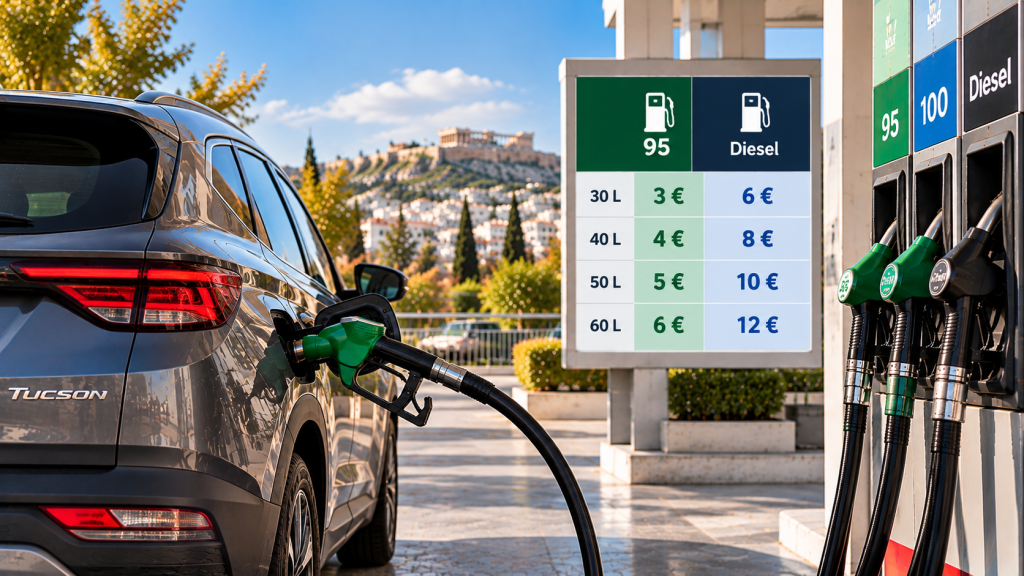
For a driver purchasing 40 litres of unleaded 95 petrol, the €0.10 subsidy represents a saving of €4. With a 50-litre fill, that rises to €5.
Diesel drivers receive a larger combined reduction of €0.20 per litre, equivalent to €8 on 40 litres or €10 on 50 litres.
| Fuel purchased | Petrol 95 savings | Diesel savings |
|---|---|---|
| 30 litres | €3 | €6 |
| 40 litres | €4 | €8 |
| 50 litres | €5 | €10 |
| 60 litres | €6 | €12 |
These are calculations based on the announced per-litre reductions. They do not guarantee that pump prices will be lower by exactly these amounts compared with any previous date, because wholesale and retail fuel prices continue to fluctuate.
How Much Does a Full Tank Cost Today?
Using the nationwide average prices recorded on October 21, filling a 50-litre petrol tank with unleaded 95 costs approximately €108.80.
The equivalent 50-litre diesel fill costs approximately €106.25.
These calculations use recorded retail prices that already reflect the market conditions at the time. The announced subsidies should not be deducted from these totals a second time.
Even with temporary support, filling a conventional passenger car remains a significant expense.
For commuters, families and professional drivers covering substantial distances each month, relatively small changes in the price per litre can make a noticeable difference to overall transport costs.
Why Don’t Pump Prices Always Fall by the Full Subsidy Amount?
A government subsidy does not necessarily mean that the displayed pump price will decrease by exactly the same amount compared with the previous week.
Retail fuel prices depend on several factors, including international oil markets, refining costs, exchange rates, transport expenses, taxation and competition between filling stations.
If the underlying cost of fuel increases while a subsidy is in effect, part of the benefit may be offset by broader market movements.
This is why drivers should evaluate the measures by comparing actual retail prices over time, rather than assuming that every announced reduction will translate into an identical week-on-week price decrease.
Practical Ways to Reduce Fuel Costs
Although temporary subsidies can help, driving habits and vehicle maintenance also influence how much motorists spend.
Smooth acceleration and braking, maintaining a steady speed whenever conditions allow, and anticipating traffic can all contribute to improved fuel efficiency.
Tyre pressure is another important factor. Underinflated tyres increase rolling resistance and may lead to higher fuel consumption, while also affecting handling and safety.
Regular servicing helps keep the engine and related systems operating efficiently. Following the manufacturer’s maintenance schedule is generally preferable to delaying essential work.
Drivers can also reduce unnecessary journeys, combine short trips and avoid prolonged engine idling when appropriate.
Finally, comparing prices at nearby filling stations can produce additional savings. Greece’s official Fuel Price Observatory allows consumers to check reported fuel prices and identify alternatives in their area.
What Happens After October 31?
The current measures are scheduled to expire on October 31, 2026.
That does not automatically mean fuel prices will rise by a specific amount on November 1. Any extension would require a further decision, while actual retail prices will continue to depend on market developments.
For drivers, the key issue is whether temporary relief can translate into a more manageable monthly transport budget.
The coming weeks will provide a clearer picture of how retail prices respond as the current support period approaches its end.

The Real Measure Is Cost per Kilometre
Fuel prices attract attention because they are highly visible at filling stations. However, the true cost of driving depends on more than the amount shown on the pump.
Vehicle efficiency, maintenance, driving style and annual mileage all influence how much a motorist ultimately spends.
The October fuel discounts provide short-term relief, but they do not eliminate the wider challenge of high motoring costs.
For drivers in Greece, monitoring local prices, maintaining their vehicles properly and adopting fuel-efficient driving habits remain practical ways to manage expenses, regardless of what happens to temporary government support.