
Picking up a rental car is often treated as a quick formality: show your documents, sign the agreement, collect the keys and drive away.
In reality, the few minutes spent at the rental desk can shape the entire rental experience.
This is when the authorised drivers are confirmed, the insurance conditions become effective, the security deposit is arranged, the car’s existing condition is recorded and the emergency procedures are explained. A rushed signature or an undocumented scratch can later become a dispute at return.
A proper check-in does not need to be complicated. It does, however, require preparation, attention and clear communication with the rental company.
This guide explains how to collect a rental car in Greece, which documents to bring, what to inspect before leaving and which parts of the agreement should never be overlooked.
The pick-up process begins before you reach the rental desk

A smooth collection starts before you arrive in Greece.
Your booking confirmation should clearly show:
- the main driver’s name,
- the pick-up date and time,
- the exact meeting point,
- the booked vehicle category,
- the rental period,
- the fuel or charging policy,
- the amount already paid,
- any balance due,
- optional extras,
- the basic insurance cover,
- the applicable excess or liability,
- the card and security-deposit requirements.
Read the confirmation and rental conditions again before travelling. Do not rely only on the headline price displayed during the original search.
EU consumer-protection principles require consumers to receive clear and understandable information about the service, the total price and the essential contractual terms. Standard contract terms must also be fair and expressed in plain, understandable language.
Confirm the exact collection point
“Pick-up at Athens Airport” or “Heraklion Airport” does not always mean that the rental desk is located inside the terminal.
Collection may take place:
- at an in-terminal desk,
- in an airport parking area,
- through a representative waiting in arrivals,
- through a meet-and-greet service,
- at an off-airport station reached by shuttle,
- at a hotel, port or other agreed location.
Check for meeting instructions, an emergency contact number and information about any shuttle transfer.
Inform the company about delays
For airport rentals, provide the correct flight number whenever possible. This can help the rental company see that the flight has been delayed and that the customer is still travelling to the collection point.
A flight number does not replace direct communication. If you expect to arrive substantially later than the agreed time, contact the company.
Some reservations may be treated as no-shows if the customer fails to arrive within the time allowed by the rental terms.
Check the opening hours
A flight landing at 11:30 p.m. does not automatically mean that a 12:15 a.m. collection is included in the original price.
There may be:
- an out-of-hours fee,
- restrictions on late collections,
- a special key-delivery procedure,
- a requirement to collect the car the next morning.
Confirming this before departure prevents problems after a tiring journey.
Documents to bring
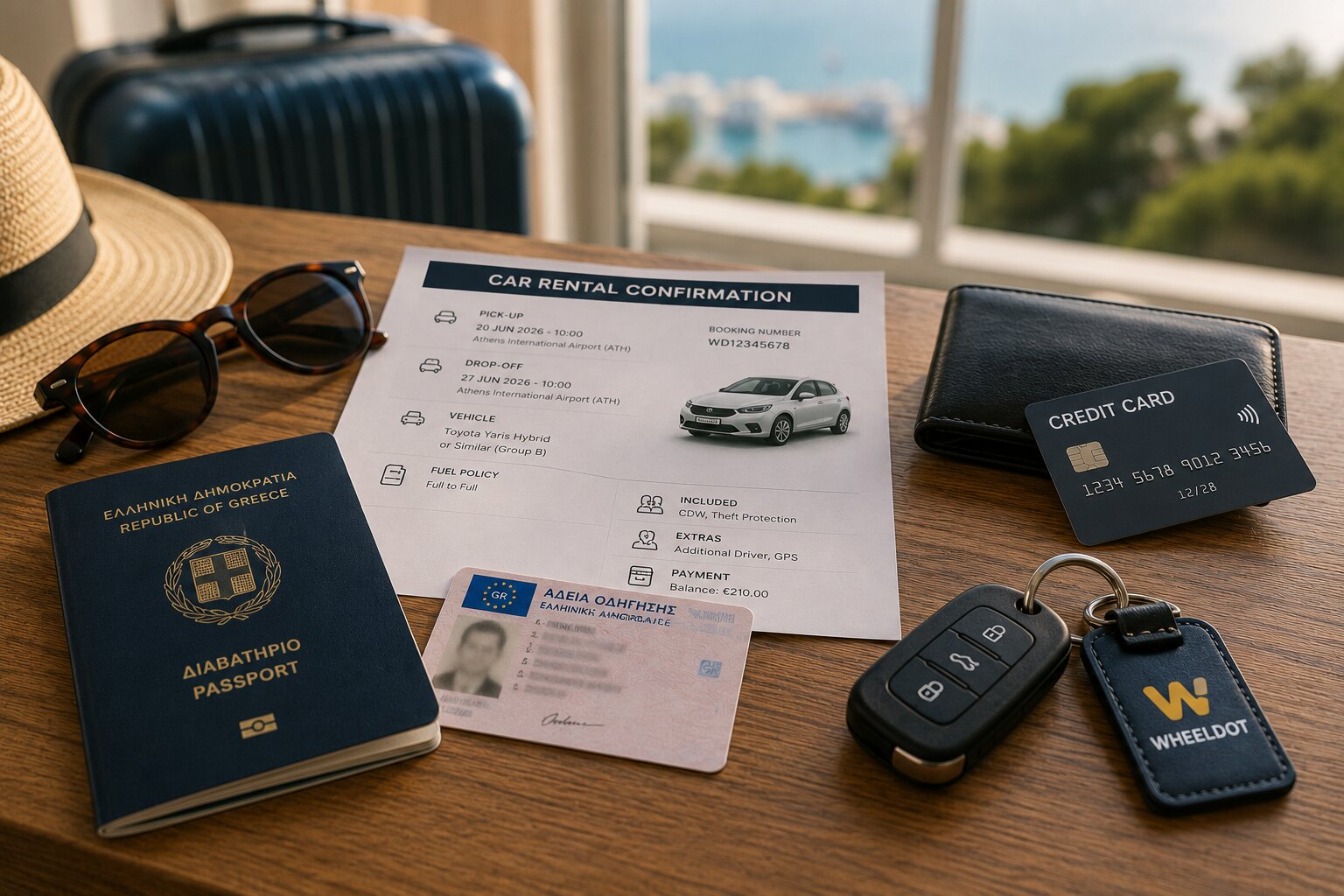
Four basic items are normally required:
- a valid driving licence,
- a passport or national identity card,
- a suitable payment card in the main driver’s name, where required,
- the booking number or confirmation.
Digital copies are useful as backups. They should not be assumed to replace the original documents unless the rental company has explicitly confirmed that they are accepted.
Driving licence
The licence should be:
- original,
- valid,
- suitable for the rented vehicle category,
- clearly readable,
- held for the minimum period required by the company.
Driving licences issued by EU countries are generally recognised throughout the European Union, provided they are valid and have not been suspended, restricted or withdrawn.
For licences issued outside the EU, recognition depends on the country of issue, international agreements, Greek requirements and the rental company’s conditions. Official EU guidance advises non-EU licence holders to confirm the rules with the authorities of the country they are visiting or with the relevant embassy or consulate.
Is an International Driving Permit required?
An International Driving Permit, or IDP, does not replace the national licence. It acts as a standardised translation and must be carried together with the original driving licence.
Whether it is required depends on:
- the issuing country,
- the document’s format and language,
- applicable recognition agreements,
- the rental company’s conditions.
If your licence was issued outside the EU or does not use Latin characters, check the requirement before travelling.
Passport or national identity card
A driving licence is not a travel document. EU citizens need a valid national identity card or passport for travel, subject to the applicable entry requirements.
The rental company uses identification to verify:
- the driver’s identity,
- date of birth,
- consistency with the booking and card,
- the details entered in the rental agreement.
The main driver’s payment card
One of the most common check-in problems is presenting a card belonging to somebody else.
Many companies require the card to:
- be in the main driver’s name,
- be physically present,
- be active,
- have sufficient available funds,
- support a pre-authorisation or security hold,
- be an accepted card type.
Some companies accept debit cards, while others require a credit card. Prepaid or virtual cards may not be accepted for the security deposit, even if they were used to pay for the reservation.
The decisive rules are the conditions attached to your specific booking.
Understanding the security deposit
The security deposit is not always an actual charge.
It is commonly a temporary pre-authorisation or hold placed on the payment card. The amount becomes unavailable for a period and is released after the rental, provided that no additional charges arise.
The deposit may secure amounts relating to:
- the damage excess,
- missing fuel,
- late return,
- lost keys or documents,
- excessive cleaning,
- excluded damage,
- tolls, fines or administration fees,
- breaches of the rental agreement.
Ask whether it is a hold or a charge
Before entering your PIN or signing, confirm:
- the exact amount,
- whether it is a pre-authorisation or completed charge,
- the transaction currency,
- the circumstances in which money may be retained,
- when the company requests release of the hold.
The time needed for the amount to reappear as available funds may also depend on the bank or card issuer.
Keep sufficient available credit
A rental can fail at the desk if the card does not have enough available capacity for the deposit.
Before travelling:
- check the available limit,
- notify the bank about international travel if necessary,
- make sure you know the PIN,
- check for restrictions on foreign transactions,
- allow room for other hotel or travel deposits.
A card may have an adequate total limit but insufficient available balance because of other active pre-authorisations.
Read the rental agreement before signing
The collection agreement defines the actual contract between you and the rental company.
Do not look only at the total price.
Check that the following are correct:
- main driver’s name,
- additional drivers,
- pick-up and return dates and times,
- return station,
- vehicle category,
- registration or vehicle details,
- insurance cover,
- excess amount,
- security deposit,
- fuel policy,
- starting fuel level,
- mileage,
- existing damage,
- optional products,
- total price and taxes.
The European Commission and national consumer authorities have previously acted in the car-rental sector to improve price transparency, fuel policies, vehicle-inspection procedures and the evidence provided before consumers are charged for damage.
Do not sign conditions you do not understand
Ask for an explanation of unclear terms, including:
- excess,
- deductible,
- pre-authorisation,
- deposit,
- CDW,
- theft protection,
- roadside assistance,
- loss of use,
- administration fee,
- out-of-hours fee,
- one-way fee.
Time pressure does not make an unclear condition unimportant.
Understand the insurance and excess
The statement that “the car is insured” does not explain the real level of protection.
You need to know:
- what is covered,
- what is excluded,
- the maximum financial liability,
- which actions invalidate the cover,
- what procedure must be followed after an incident.
What is the excess?
The excess or deductible is the maximum amount for which the renter may remain liable for covered damage, subject to the rental conditions.
For example, if the excess is €900 and covered damage amounts to €600, the renter’s liability may reach €600. If the covered damage costs €2,000, the renter’s liability may be capped at €900.
Coverage applies only when the contractual requirements have been followed.
Common exclusions
Even enhanced protection may exclude:
- tyres,
- wheels,
- windscreen and glass,
- mirrors,
- the underside of the car,
- the interior,
- the roof,
- lost or damaged keys,
- incorrect fuel,
- personal belongings,
- damage caused by an unauthorised driver,
- use on prohibited roads,
- breaches of traffic or rental conditions,
- failure to report an incident correctly.
Exclusions differ between providers. Ask to see them in writing.
Third-party protection
You may have purchased separate cover from a broker, booking platform, insurer or credit-card provider.
The rental company may still place its normal deposit and charge damage under its own agreement. The customer then applies for reimbursement from the third-party provider.
This differs from protection that directly reduces the excess under the rental company’s own contract.
Confirm that the car matches the booking
Rental bookings are normally made for a vehicle category rather than a guaranteed model, unless the reservation explicitly states otherwise.
“Or similar” means the model may differ, but the essential characteristics should be comparable.
Check:
- transmission,
- seating capacity,
- number of doors,
- luggage space,
- fuel or powertrain,
- air conditioning,
- agreed equipment,
- child seats or extras.
Automatic and manual transmission
If you booked an automatic vehicle, do not casually accept a manual one as equivalent, especially if you are not experienced or comfortable with a manual gearbox.
The same principle applies to accessibility, luggage capacity and passenger requirements.
Test the luggage space
A vehicle category does not guarantee that every suitcase will fit in the boot.
Load the main luggage before completing the handover. It is better to identify a space problem at the rental station than outside the hotel.
Exterior inspection: the most important part of check-in
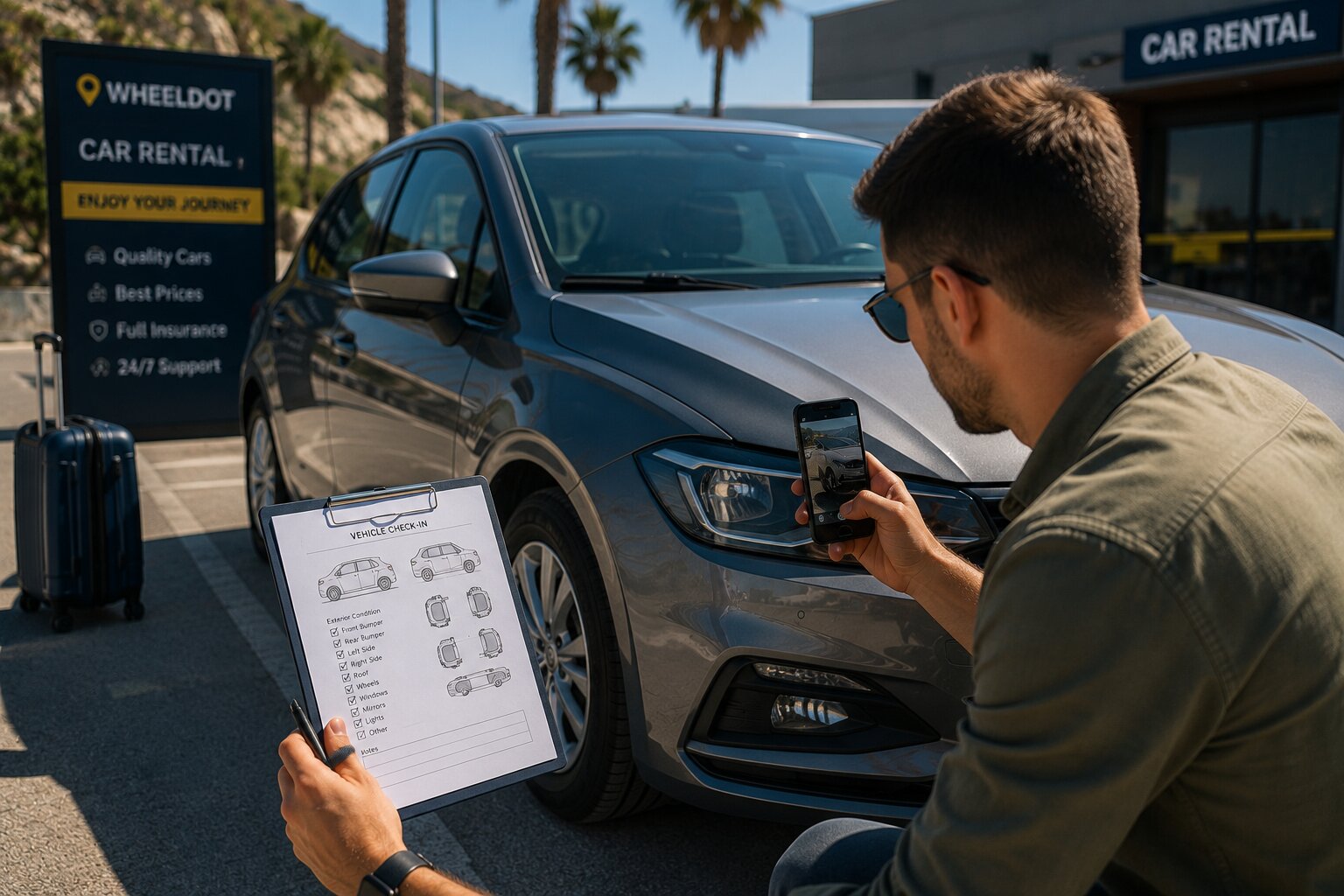
Do not rely solely on the damage diagram provided.
Walk around the car with the representative whenever possible and compare its actual condition with the handover report.
Inspect:
- front and rear bumpers,
- doors and wings,
- mirrors,
- side skirts,
- roof,
- bonnet and boot,
- windscreen and windows,
- headlights and rear lights,
- wheels,
- tyres,
- lower bumper edges,
- areas around the door handles,
- loading area.
Look for:
- scratches,
- dents,
- chips,
- cracks,
- wheel damage,
- tyre damage,
- interior stains or burns,
- loose parts.
Take photographs and video
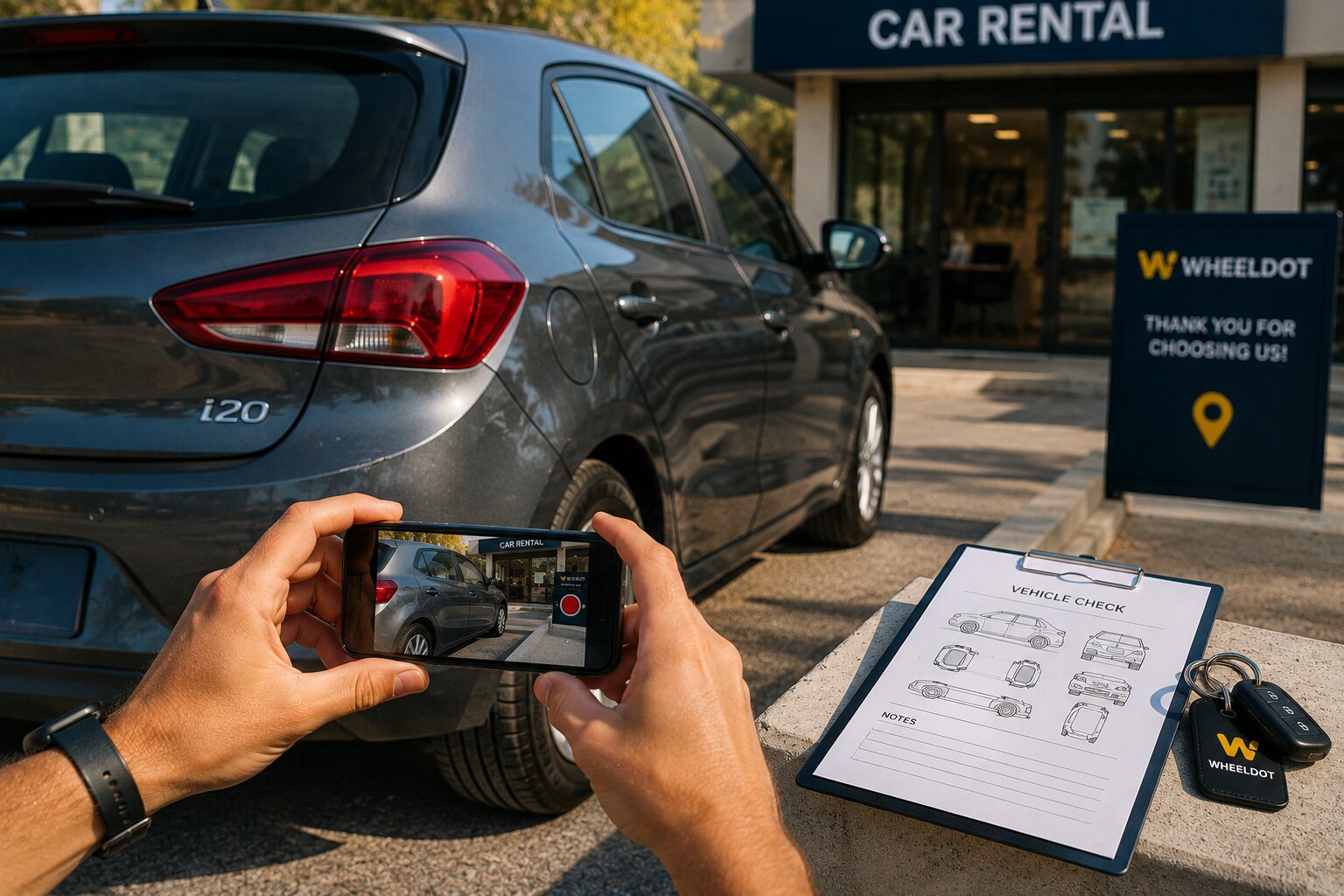
Record the car before it is moved.
A continuous walk-around video can be more useful than isolated close-ups because it shows the position and overall condition of the vehicle.
Add photographs of:
- every existing mark,
- all four corners,
- each wheel,
- the windscreen,
- the roof,
- the interior,
- the dashboard,
- the fuel level,
- the mileage.
Preserve the original date and time metadata.
EU consumer-enforcement work in the sector has emphasised clear inspection procedures and the provision of reasons and evidence before a damage charge is taken.
Night-time collection
In a dark parking area:
- use the phone flashlight,
- move to a brighter location if permitted,
- note in writing that the inspection took place in limited lighting,
- repeat the inspection the following morning,
- report any existing damage immediately.
Do not wait until the return.
Request written recording
If you find damage missing from the report:
- show it to the representative,
- ask for it to be added,
- photograph the amended document,
- retain a copy or electronic confirmation.
A verbal statement that “we already know about it” is not equivalent to written evidence.
Check the tyres and windscreen
Many customers inspect doors and bumpers but overlook areas that often become disputed.
Tyres
Look for:
- an apparently underinflated tyre,
- cuts or bulges,
- visible wheel damage,
- a tyre-pressure warning.
You are not expected to perform a mechanical inspection. If something appears wrong, ask for it to be checked before leaving.
Windscreen
Small chips may be difficult to see on a dusty or wet windscreen. Inspect it from different angles and record any existing marks.
Interior inspection
After the exterior, sit in the driver’s seat without immediately driving away.
Check:
- seats and upholstery,
- seat belts,
- dashboard,
- steering-wheel controls,
- infotainment screen,
- air conditioning,
- electric windows,
- central locking,
- mirrors,
- wipers,
- lights,
- horn,
- charging sockets,
- child seat,
- luggage compartment.
Record any:
- stains,
- tears,
- burns,
- broken trim,
- strong smells,
- missing equipment.
Child seats
If you requested a child seat, confirm that:
- it is the correct category,
- it has no obvious damage,
- the required components are present,
- it can be installed correctly in the vehicle.
The driver or parent remains responsible for ensuring that it is safely installed before departure.
Start the car and check the warning lights
Some warning lights illuminate briefly when the car starts and then switch off. If a warning remains active, ask for an explanation.
Pay particular attention to warnings relating to:
- engine,
- oil,
- temperature,
- brakes,
- ABS,
- airbags,
- tyre pressure,
- battery,
- stability control.
Do not simply accept that a warning light “is always on” unless the matter is checked and documented.
Test the air conditioning
In Greece, particularly during summer, air conditioning is not a minor comfort feature.
Turn it on before leaving and make sure it works effectively. Also test windscreen demisting when travelling outside the summer period.
Confirm fuel, mileage and return policy
The fuel policy must be clear before departure.
Common arrangements include:
- full to full,
- same level to same level,
- prepaid fuel,
- return at a specified level.
European consumer authorities have highlighted the need for transparent fuel policies and clear information about the actual cost.
Photograph the dashboard
Before departure, photograph:
- the fuel or charge level,
- the odometer,
- any active warning lights.
Ask for the contract to be corrected if the displayed level does not match the document.
Mileage policy
Confirm whether the rental includes:
- unlimited mileage,
- a daily limit,
- a total limit,
- a charge per additional kilometre.
This can make a substantial difference on a road trip across mainland Greece.
Collecting an electric or hybrid vehicle
When collecting an electric car, do not leave without confirming:
- the starting charge,
- the required return level,
- which cables are included,
- where the cables are stored,
- supported charging types,
- how to open the charging port,
- whether an app or provider card is required,
- the fee for returning it below the required charge.
Make sure that the charging cable is listed as supplied equipment and is physically present.
For a plug-in hybrid, ask for a brief explanation of the available driving modes.
Safety equipment and tools
Ask the representative to show you:
- warning triangle,
- reflective vest,
- first-aid kit where supplied,
- spare wheel or repair kit,
- jack and tools where applicable,
- vehicle documents,
- roadside-assistance number.
Many modern cars have a puncture-repair kit rather than a spare wheel. Ask what to do if a tyre is damaged.
Make sure every driver is authorised
Only people named in the rental agreement should drive the vehicle.
An additional driver will normally need to:
- attend check-in,
- present a driving licence,
- present identification,
- meet the age and licence requirements,
- be formally added to the agreement.
Allowing an unauthorised person to drive may breach the agreement and affect insurance protection.
A spouse or partner is not automatically covered.
Check geographical restrictions
Greece includes islands, ferry routes, mountain roads and international borders. This does not mean that every rental vehicle can be taken everywhere without permission.
Check whether the agreement permits:
- ferry transport,
- travel to particular islands,
- leaving Greece,
- driving on unpaved roads,
- access to remote beaches,
- cross-border travel,
- international ferry transport.
Taking the vehicle on a ferry may require written permission or additional cover.
An unpaved road may still be prohibited
Many beaches and rural properties are reached by low-quality roads. Driving a conventional car over unsuitable terrain may damage the underside, tyres or suspension and affect the cover.
Ask the rental company when your itinerary includes difficult access.
Know what to do after a breakdown or accident
Before leaving, save:
- the rental company’s number,
- the roadside-assistance number,
- the out-of-hours number,
- the booking reference,
- the vehicle registration.
Ask:
- whom to contact first,
- whether you may arrange repairs yourself,
- which documents are required,
- how to report an accident,
- how replacement vehicles are handled,
- what to do about a tyre or lost key.
Do not arrange repairs without approval unless an immediate emergency requires action.
Emergency number 112
In the event of immediate danger, a serious accident, fire or urgent need for assistance, call 112 free of charge in Greece and throughout the European Union. The service connects callers with the appropriate emergency authority and may assist in locating the caller where technically possible.
Do not leave until you are comfortable with the car

An unfamiliar vehicle requires a few minutes of adjustment.
Before entering traffic:
- adjust the seat,
- adjust the steering wheel,
- adjust the mirrors,
- locate the lights,
- locate the wipers,
- find the parking brake,
- understand the gear selector,
- set the navigation,
- connect the phone before moving.
Ask for a brief demonstration of an automatic gearbox, electronic parking brake or keyless-start system if necessary.
Your first lesson in the vehicle should not take place while leaving a busy airport.
Contactless and self-service collection
Some rentals use a key box, mobile application or self-service procedure.
In that case:
- read all digital instructions,
- confirm how the vehicle is unlocked,
- photograph it before moving,
- check that the documents are inside,
- report damage immediately through the specified channel,
- save screenshots of the report,
- do not rely only on a telephone conversation.
Automation reduces waiting time but increases the customer’s responsibility to document the handover.
What to do if the vehicle has a serious defect

Do not accept a vehicle with an obvious issue affecting safety or legal use.
Examples include:
- brake warning light,
- visibly damaged tyre,
- serious windscreen crack in the driver’s field of vision,
- defective seat belt,
- faulty lights,
- overheating,
- inability to lock properly,
- severe abnormal noise.
Ask for an inspection or replacement and keep a written record of the communication.
Receiving a different vehicle category
A substitute may be an upgrade, downgrade or simply a different category.
Do not assess it only by size or market value.
Consider:
- passenger and luggage space,
- automatic or manual transmission,
- suitability for the destination,
- fuel consumption,
- ease of use on narrow roads,
- required equipment.
A large SUV is not always a practical upgrade on a small Greek island or in a historic centre with limited parking.
If the replacement is a downgrade, request clarification about the price difference or remedy.
Additional charges at check-in
Before accepting a new charge, ask:
- whether it is compulsory,
- whether it appeared in the original booking,
- what it covers,
- whether it is daily or one-off,
- whether taxes are included,
- whether it changes the deposit,
- whether it is optional.
Common charges may relate to:
- young or senior drivers,
- additional drivers,
- out-of-hours service,
- one-way rentals,
- child seats,
- navigation equipment,
- additional cover,
- ferry permission,
- cross-border permission,
- special equipment.
The final agreement should be clear before signature.
Documents to keep
Do not leave without:
- a copy of the rental agreement,
- payment receipt,
- deposit confirmation,
- vehicle-condition report,
- contact details,
- return instructions,
- insurance conditions,
- roadside-assistance information.
Keep both paper and digital copies.
Create a folder containing:
- booking confirmation,
- rental agreement,
- photographs,
- videos,
- receipts,
- written communications.
This simple record can save considerable time in a dispute.
The final ten-minute check
Before driving away, confirm that:
- Every driver is named in the contract.
- You understand the deposit and excess.
- Every existing mark has been recorded.
- You have photographs and video.
- The fuel or charge level is correct.
- The mileage matches the agreement.
- No unexplained warning light is active.
- The air conditioning works.
- You have the roadside-assistance number.
- You know where and when to return the car.
Resolve any uncertainty before leaving.
Common pick-up mistakes
Signing too quickly
Fatigue after travelling can cause customers to sign without reading. The signature confirms acceptance of the presented agreement.
Taking no photographs
A car that appears new can still have minor existing damage.
Bringing the wrong card
A partner’s card may not be accepted even when that person is present.
Failing to add the second driver
A brief change of driver can become a major issue if an accident occurs.
Assuming everything is covered
Basic insurance, an excess and exclusions are separate concepts.
Ignoring the fuel policy
Returning the car with the wrong fuel level can result in fuel and service charges.
Relying on verbal assurances
Important clarifications should be written in the contract or confirmed electronically.
What to do if a disagreement arises at pick-up
If you believe the booking is not being honoured:
- Remain calm.
- Ask for a specific explanation.
- Refer to the booking confirmation and terms.
- Request the proposed solution in writing.
- Keep receipts, photographs and messages.
- Do not sign acceptance of a disputed condition without recording your objection.
- Contact the broker or platform if the booking was made through a third party.
For cross-border consumer disputes within the EU, Norway or Iceland, the European Consumer Centres Network may provide information and assistance. A complaint should be supported by the identities of the parties and the relevant documentation.
Good documentation from the beginning is therefore not excessive. It is the foundation of any effective claim.
Frequently Asked Questions
How long does collection take?
A straightforward collection may be completed quickly. During peak periods, at major stations or when additional checks are required, it can take longer. Allow time to inspect the vehicle properly.
Can I collect without a credit card?
It depends on the provider, vehicle category and booking conditions. Some accept debit cards, while others require a credit card for the deposit.
Can the card belong to another passenger?
Often not. Many companies require a card in the main driver’s name.
Is a photograph of my licence sufficient?
Do not assume that it is. The original, valid licence is normally required.
Should I photograph minor scratches?
Yes. Record every visible mark, however small it appears.
What if I discover damage after leaving?
Stop safely and notify the company immediately in writing, providing photographs and your location. Delayed reporting makes it harder to show that the damage was pre-existing.
Can I take the rental car to a Greek island?
Only when permitted by the conditions or when the necessary approval has been granted. Ferry transport may be restricted or require additional cover.
Can an unnamed person drive?
They should not. Ask for them to be added as an authorised driver.
Must the car be washed before return?
Normal use does not usually require professional cleaning. Excessive dirt, sand, stains, smoking or pet hair may lead to a charge under the agreement.
Is the deposit released immediately?
The rental company may request release promptly, but the time needed for the funds to become available also depends on the bank or card issuer.
Conclusion: a careful pick-up protects both the journey and the driver
Collecting a rental car is not simply the moment you receive the keys.
It is the point at which you confirm that the booking, the contract, the insurance conditions and the actual state of the vehicle all match.
A traveller who spends a few additional minutes on check-in:
- understands exactly what has been agreed,
- reduces the risk of unexpected charges,
- can prove the vehicle’s starting condition,
- knows what to do after a breakdown or accident,
- begins the journey with less stress.
The best handover is one that leaves no unanswered questions.
Inspect, photograph, ask and retain your documents. Then you can leave the rental station behind and enjoy Greece as planned.