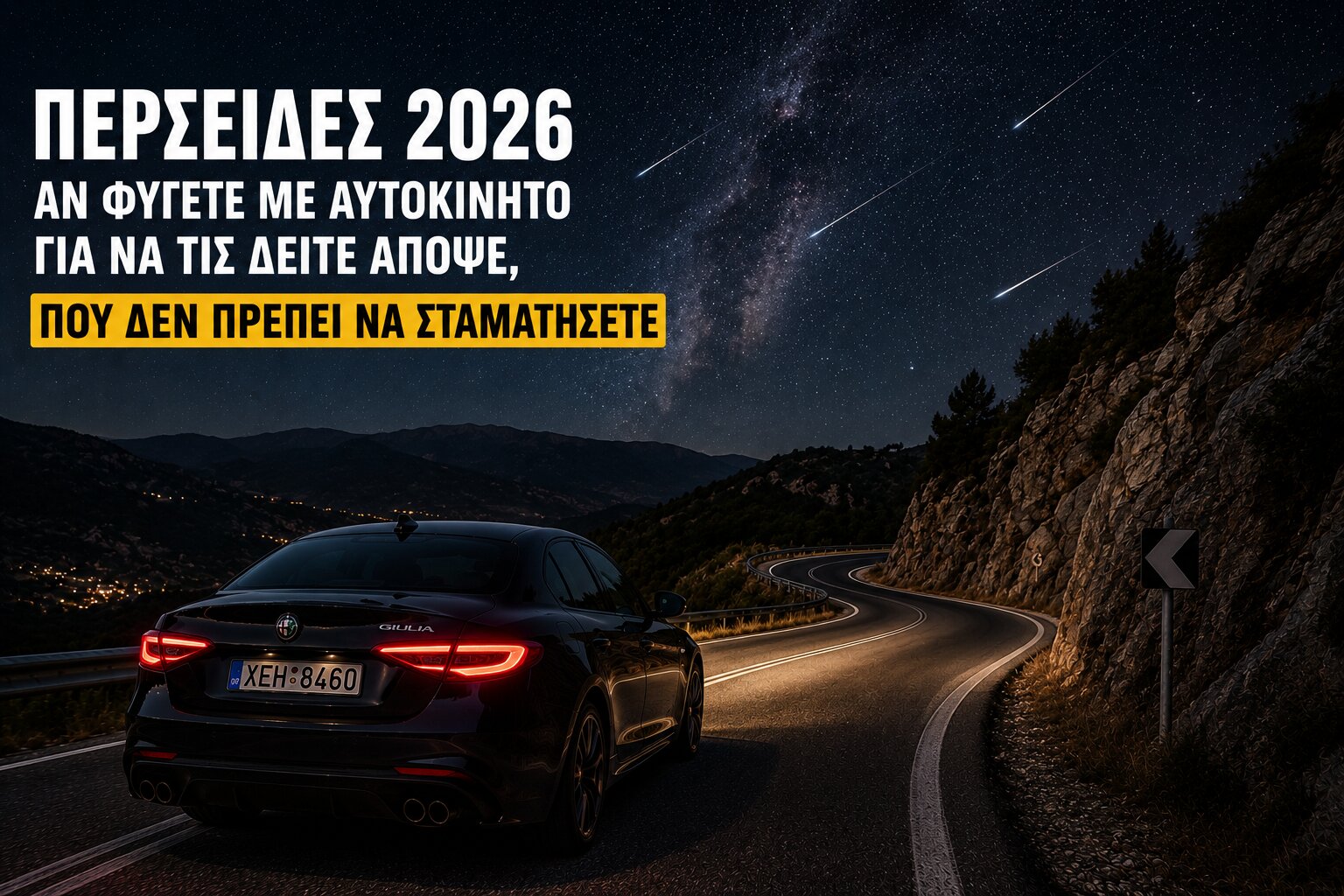
The Perseid meteor shower returns tonight under particularly favourable viewing conditions. The shower peaks overnight from August 12 into the early hours of August 13, 2026, coinciding with a new moon and therefore offering a much darker sky without significant moonlight interference. NASA describes the Perseids as one of the most popular meteor showers of the year, known for their fast, bright meteors.
For many people in Greece, watching them means a short nighttime drive away from city lights.
But there is one detail worth considering before searching for the darkest possible sky: where are you going to leave the car when you get there?
A location can be excellent for stargazing and completely unsuitable for stopping or parking.
Don’t Decide Where to Stop at the Last Minute
Driving along an unfamiliar rural road at night while simultaneously searching for a dark viewing location is not a good strategy.
In darkness, it can be harder to judge the shape of the road, the visibility around a bend, the actual width of the roadside or whether what appears to be an empty area is an entrance or access point.
A better approach is to identify a legitimate parking area or another suitable place where the vehicle can be safely removed from moving traffic before you set off.
Under Greece’s current Road Traffic Code, stopping and parking outside built-up areas are subject to specific rules, while additional restrictions apply wherever a stationary vehicle could create a hazard or obstruction. The current code is Law 5209/2025, published in Government Gazette A’ 100/13.6.2025.
In other words, “this looks dark enough” is not a parking criterion.
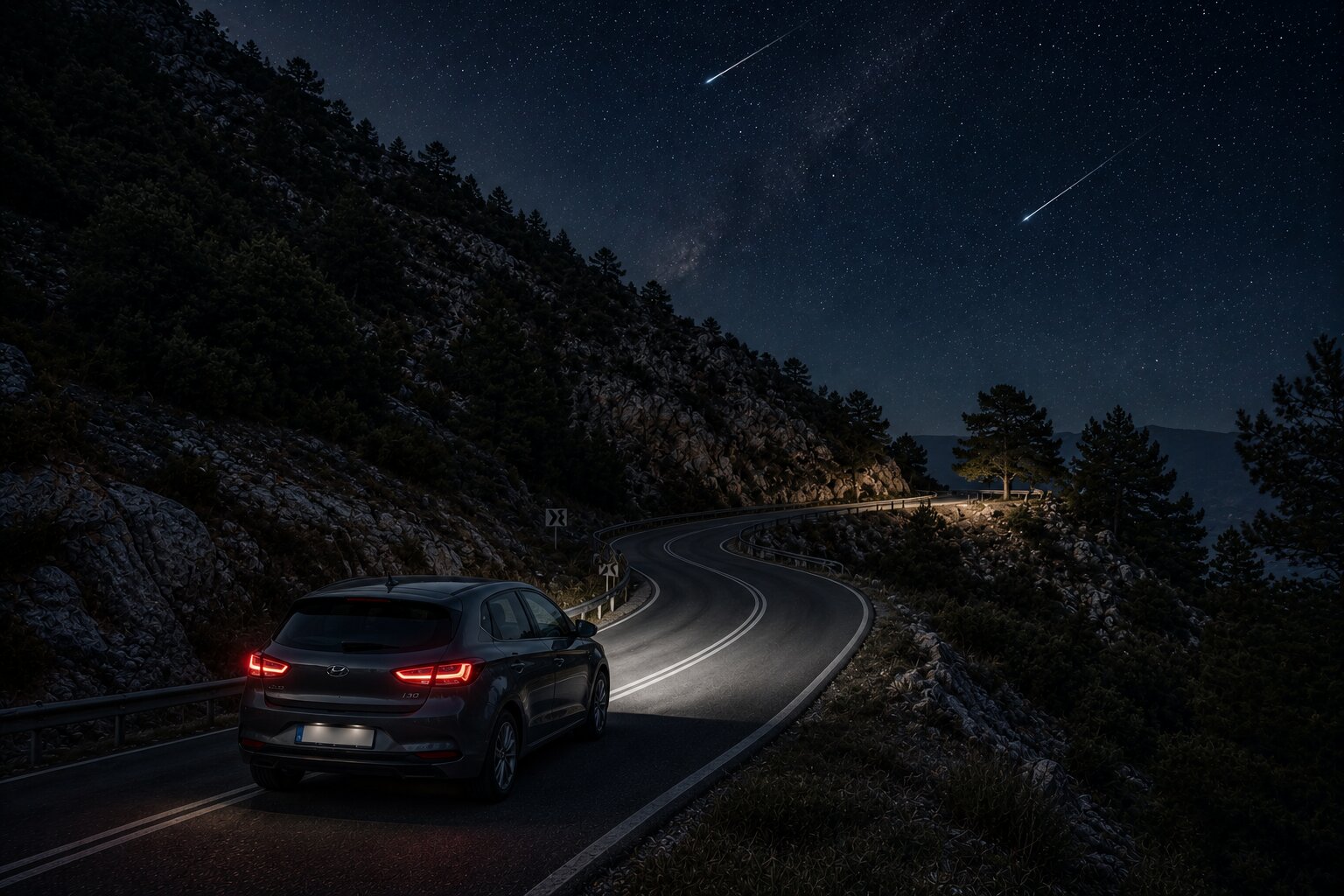
Don’t Stop on a Bend Just Because the View Is Better
A bend in a rural or mountain road may provide an impressive open view of the sky.
For traffic, however, limited visibility makes exactly these locations problematic.
Your parked vehicle needs to be visible to approaching traffic early enough for other drivers to recognise it and react safely.
The important question is therefore not simply whether you can see the road.
Can other drivers see you?
The same principle applies around crests and other locations where the geometry of the road prevents approaching drivers from seeing what is ahead.
Finding a slightly less spectacular viewing point with proper parking is a much better trade-off than leaving a vehicle where it becomes an unexpected nighttime obstacle.
A Bridge Is Not an Observation Deck
A bridge can look perfect for stargazing: open sky, few trees and a wide horizon.
That does not make it a suitable observation point.
Greek road rules restrict stopping and parking in locations where doing so creates hazards or interferes with traffic, including specifically regulated infrastructure and low-visibility locations.
Even if a road appears almost empty late at night, it remains a road.
If there is no properly designated place to leave the vehicle, continue until you find one.
The Perseids will still be there a few minutes later.
Never Stop on a Motorway to Watch the Sky
This should be particularly clear.
If the sky suddenly looks spectacular while you are travelling on a motorway or high-speed road, do not stop simply to watch the meteor shower.
Continue to a legitimate parking or rest area, or leave the motorway and find a suitable location elsewhere.
Emergency infrastructure is there for emergencies, not sightseeing.
This distinction matters tonight because the Perseids can appear unexpectedly. A bright meteor may be spectacular, but it is not a reason to turn an active traffic lane or emergency stopping area into an observation point.
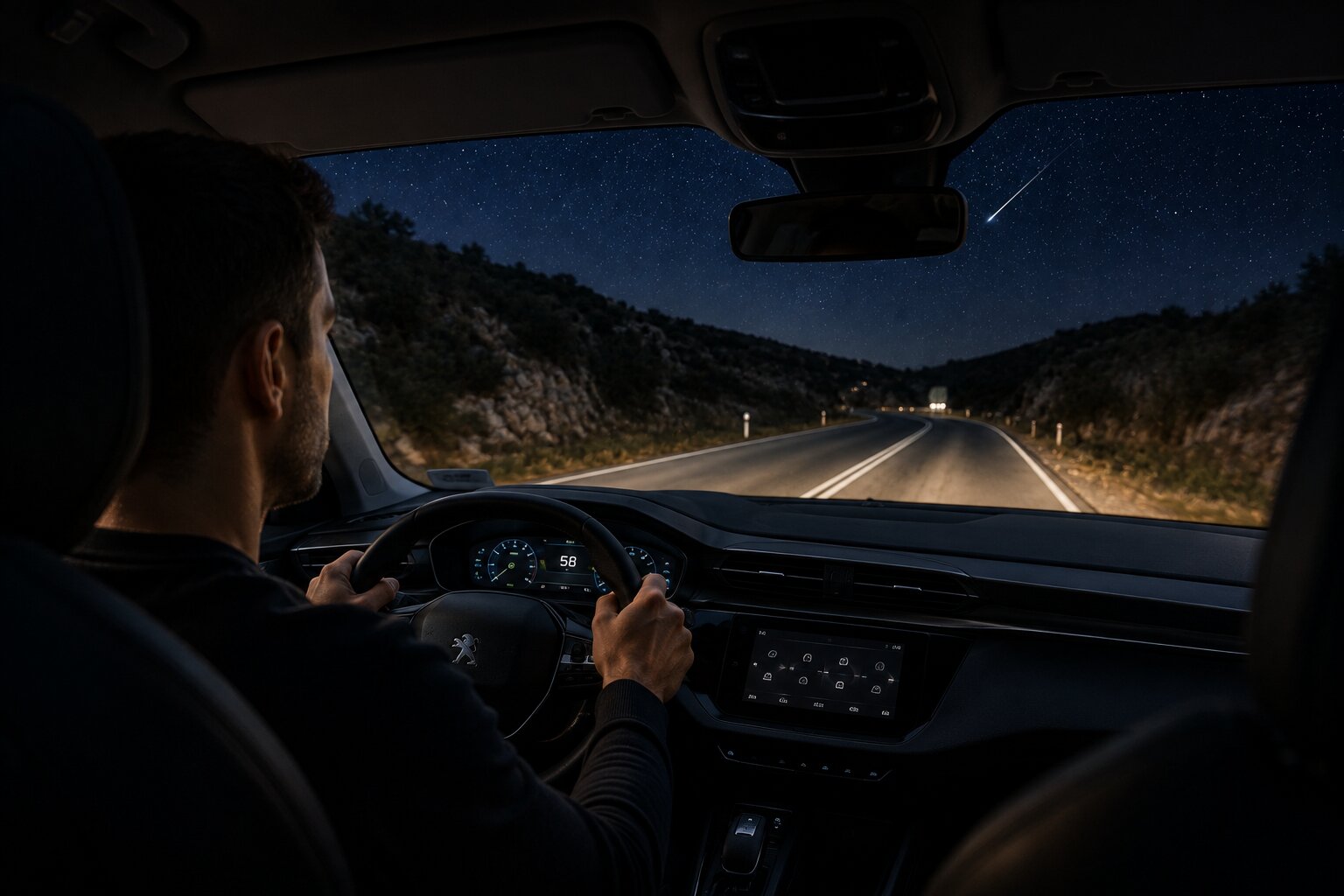
Don’t Watch the Meteors While Driving
Perseid meteors can appear across a broad area of the sky.
That is precisely why trying to spot them while driving is a bad idea.
The driver’s attention needs to remain on the road.
If you want to watch the shower properly, reach your destination first, park safely and legally, switch off the vehicle and move to a suitable location away from moving traffic.
Once there, you do not need complicated equipment. NASA notes that the Perseids are best enjoyed under dark skies and are visible to the naked eye.
The windshield is not your observatory while the car is moving.
Give Your Eyes Time to Adjust
Dark adaptation matters when observing a meteor shower.
Moving from a brightly illuminated car interior, phone screen or roadside facility into genuine darkness does not immediately give you the best possible night vision.
This is another reason to park first and then settle into the viewing location rather than repeatedly moving the vehicle in search of a marginally darker spot.
Reduce unnecessary bright light once you are safely parked and give your eyes time to adjust.
The same principle works in reverse when leaving.
Return to the vehicle, get organised and prepare for the drive before setting off. Stargazing and driving should remain two completely separate activities.
Think About the Journey Home Before You Leave
The outward journey may happen relatively early in the evening.
The return journey is different.
The Perseids are particularly attractive late at night and into the pre-dawn hours, meaning an evening that starts as a simple excursion can end with a drive home at two, three or four in the morning. The 2026 peak runs overnight into the pre-dawn hours of August 13.
That makes fatigue part of the journey.
Official road-safety guidance warns that driving while tired increases collision risk and that natural alertness is particularly low during the overnight hours.
If you become genuinely sleepy, trying to “push through” the remaining distance is not a sensible plan.
Plan the return before leaving home. Consider how long you intend to stay, who will drive back and whether that person will realistically be rested enough to do so.
The most dangerous part of a meteor-watching trip may not necessarily be the unfamiliar road into the countryside.
It may be the familiar road home several hours later.
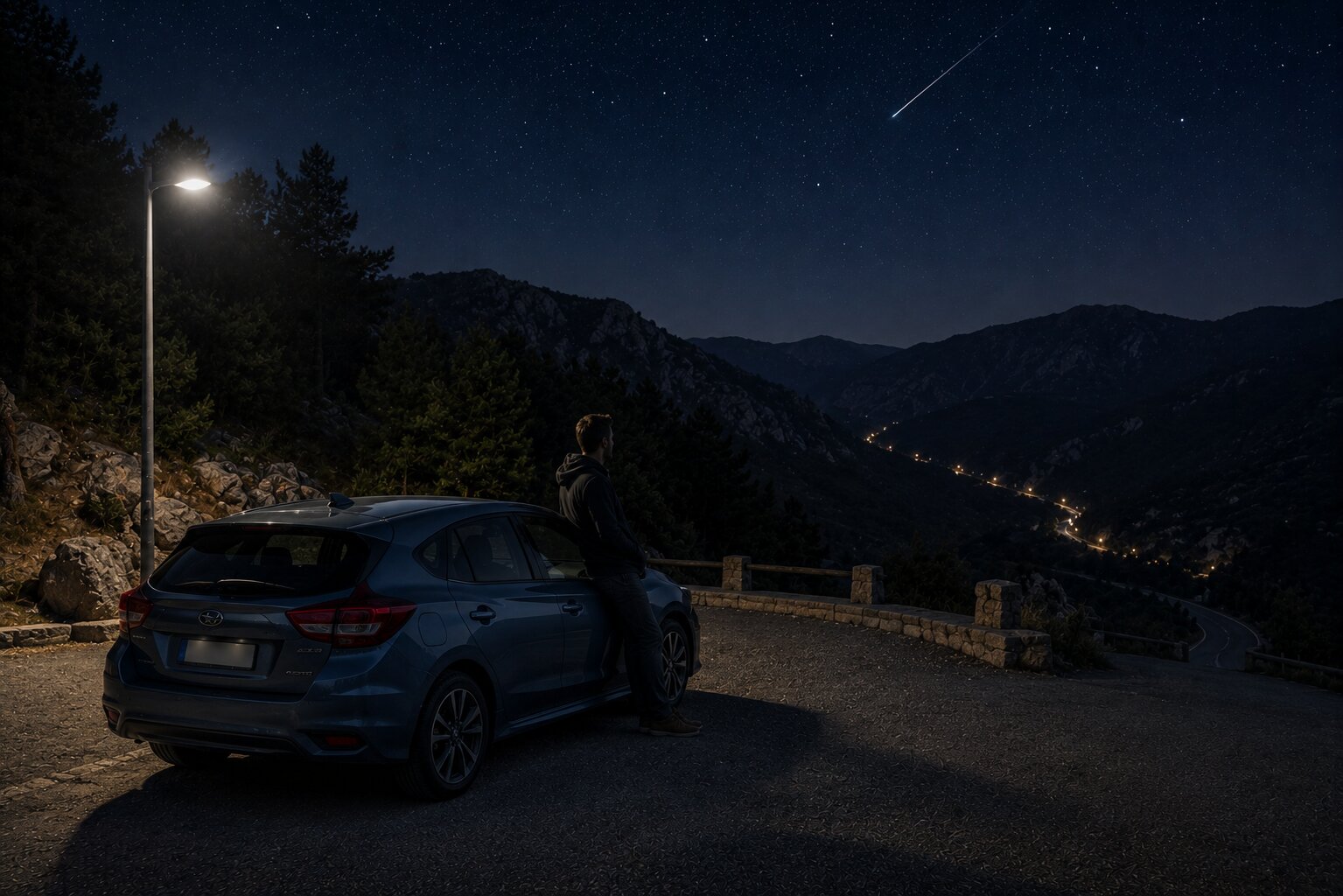
The Best Viewing Spot Is Not Necessarily the Most Remote One
You do not need to find the most isolated road in Greece to enjoy the Perseids.
What you primarily need is a sufficiently dark sky, a broad view and enough time to watch.
That means an organised parking area, recreational area or another legitimate location away from strong urban lighting may be a far better choice than an extremely remote roadside with nowhere appropriate to leave a vehicle.
There is also a practical advantage.
A known destination allows you to concentrate on driving while you are on the road instead of constantly scanning the roadside for somewhere to stop.
The darker location is not automatically the better location.
The better location is one where you can reach it, park safely, enjoy the sky and leave again without creating a road-safety problem.
Tonight, Look Up — But Only After You Have Stopped Properly
The 2026 Perseids offer unusually favourable conditions.
The peak arrives tonight, August 12–13, with the new moon providing the dark skies meteor watchers hope for.
If you are planning to drive somewhere to watch them, organise the part of the evening that happens on the ground before thinking about what happens in the sky.
Know where you intend to park.
Do not stop on a bend, bridge, motorway or another location with inadequate visibility simply because the view appears perfect.
Get away from moving traffic before looking up.
And think about the drive home before a late night turns into an early morning.
Tonight’s objective is to enjoy one of the summer sky’s most memorable spectacles.
Finding the perfect dark sky should never require creating a dangerous situation on the road.