
The meltemi winds are a familiar part of the Greek summer. For people travelling by car, however, strong northerly winds are not only something that affects beaches or ferry services.
On certain sections of the road network, a sudden crosswind can be clearly felt even inside a modern passenger car.
During periods when Greece’s National Meteorological Service forecasts strong northerly winds, drivers need to understand where and when those winds are most likely to affect the stability and direction of their vehicle.
That does not mean every journey becomes dangerous when the meltemi blows. It means drivers should be prepared for sudden changes in wind exposure, particularly on bridges, open roads and when passing large vehicles.
What Does a Crosswind Actually Do to a Car?
When wind hits a vehicle from the side, it applies force across the vehicle’s lateral surface.
With relatively steady and moderate wind, drivers will usually compensate without much difficulty. Sudden gusts and abrupt changes in wind exposure are more important.
The UK’s official Highway Code warns that strong gusts can affect the course of not only high-sided vehicles but ordinary cars as well.
Particular care is required on exposed sections of road, bridges and locations where the protection provided by buildings, vegetation or the surrounding landscape suddenly disappears.
In practical terms, a car may travel for some distance relatively sheltered from the wind and then suddenly encounter much stronger lateral force.
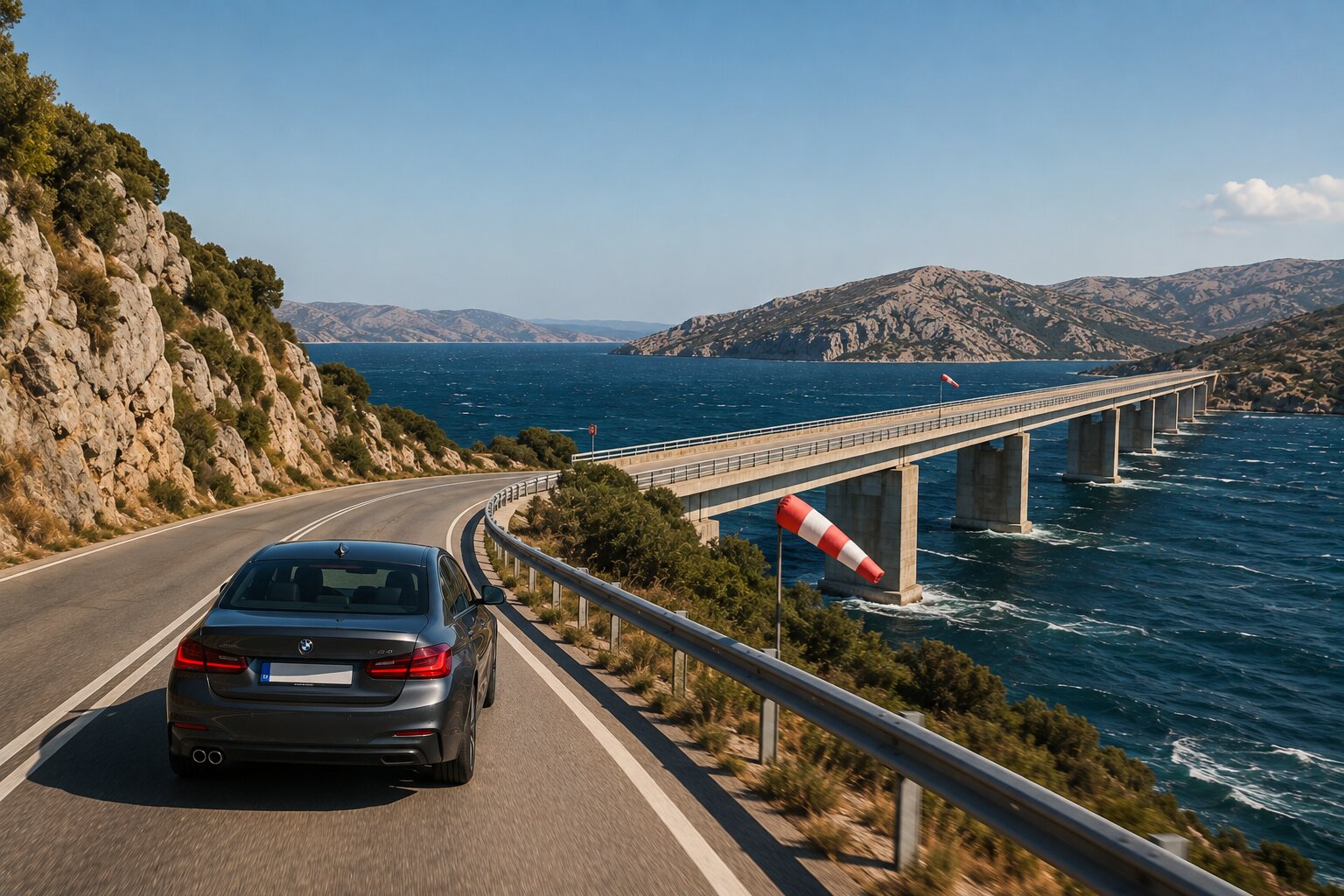
Bridges and Exposed Roads Require Extra Attention
A road running between buildings, hillsides or dense vegetation may provide temporary shelter from strong winds.
That protection can disappear as soon as the vehicle reaches a bridge, an open plain or an exposed coastal section.
The Highway Code specifically identifies open stretches of road and bridges as places where crosswinds can affect a vehicle’s direction more noticeably.
A driver may experience this as a sudden push towards one side of the lane.
The important thing is not to allow that initial movement to trigger an excessive steering reaction.
Anticipating the possibility of a gust makes it much easier to respond calmly and progressively.
Take Extra Care When Overtaking Trucks
One particularly noticeable change in wind pressure can occur when overtaking trucks, coaches and other large vehicles.
While driving alongside a large vehicle, your car may be temporarily shielded from a crosswind.
As you move ahead of it, the vehicle can suddenly become exposed to the full force of the wind again.
The driver may therefore feel an abrupt change in lateral pressure.
Official Met Office guidance recommends particular care when overtaking high-sided vehicles during strong winds for precisely this reason.
The same principle applies when a large vehicle passes you in the opposite direction on an exposed road.

SUVs and Vans Can Be More Affected
The larger the side area exposed to the wind, the greater the potential effect.
Vans, large SUVs, motorhomes and other high-sided vehicles therefore require additional care.
The Highway Code specifically warns that high-sided vehicles are particularly affected by strong winds.
That does not mean lower passenger cars are immune. A sufficiently strong gust can also alter the course of a conventional car.
Vehicle shape, size, weight, speed and the direction of the wind all influence how noticeable the effect becomes.
What Should You Do When Driving in Strong Winds?
Speed is one of the first considerations.
The Met Office recommends slowing down in strong winds. Lower speed gives the driver more time to react and can reduce the consequences of a sudden gust.
Both hands should remain securely on the steering wheel, particularly when approaching bridges, open sections of road or large vehicles.
Steering corrections should be controlled and progressive.
A sudden, excessive steering movement can potentially create more instability than the original gust.
Drivers should also leave additional space around other road users.
Motorcyclists and cyclists are particularly vulnerable to crosswinds. If you need to overtake them, allow substantially more room and be prepared for them to move unexpectedly sideways.
What If the Car Suddenly Feels Like It Is Being Pulled Sideways?
A momentary sideways movement does not necessarily mean there is something mechanically wrong with the vehicle.
If it happens during strong crosswinds — particularly on a bridge or exposed section of road — a gust may be responsible.
Stay focused, keep a secure grip on the steering wheel and reduce your speed progressively if conditions require it.
Avoid sudden reactions.
If, however, the car consistently pulls towards one side even when there is no significant wind, that is a different issue and may justify a technical inspection.
The important distinction is between a temporary reaction to the environment and persistent behaviour from the vehicle itself.
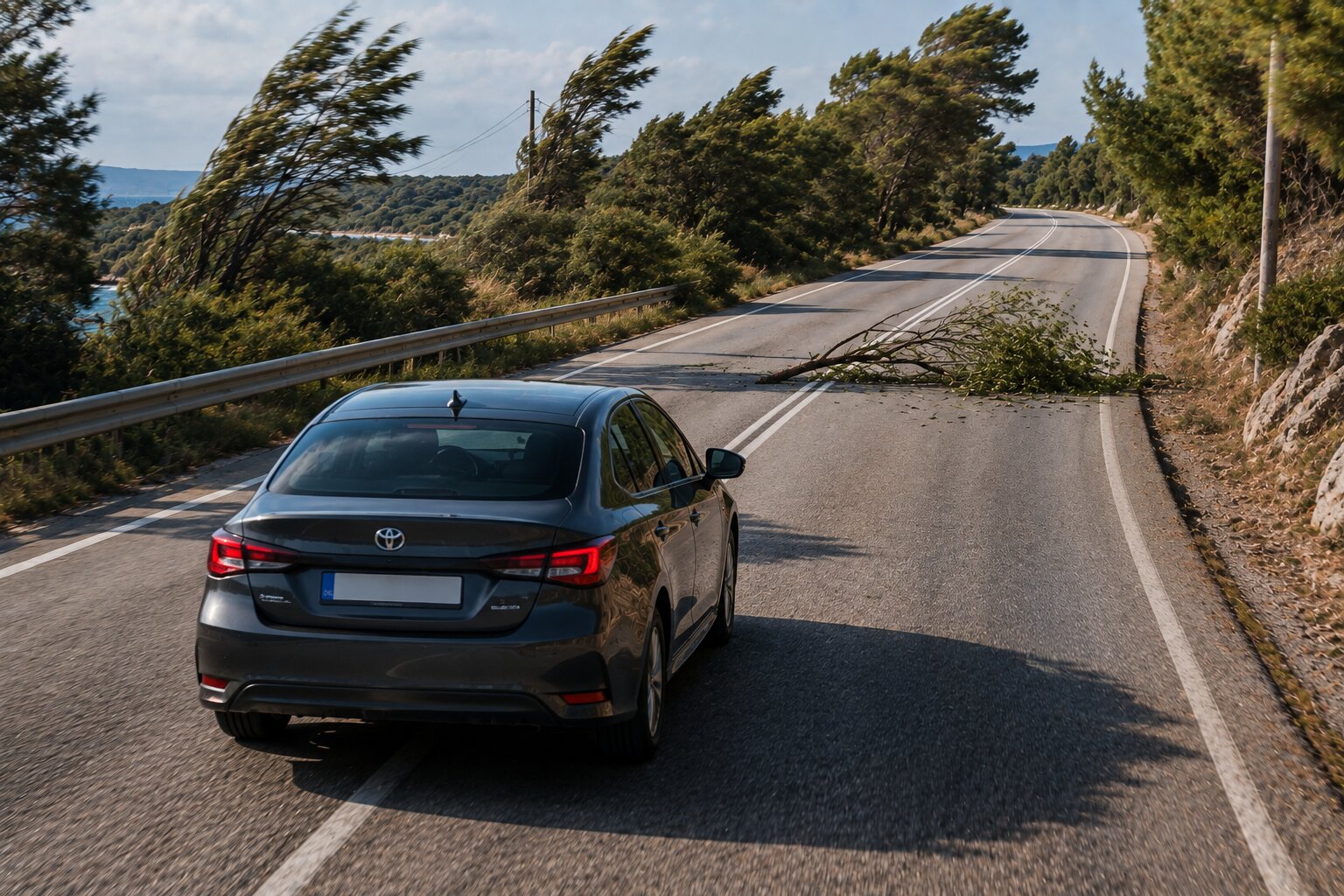
The Wind Can Put Objects on the Road Too
Strong winds do not only affect vehicles.
Greece’s Civil Protection authorities advise people to avoid passing beneath large trees, signs and locations where objects could become detached and fall.
For drivers, this means paying attention to more than the behaviour of the car itself.
Branches, unsecured objects and other debris can suddenly enter the carriageway.
Extra visibility and distance from the vehicle ahead become valuable because they provide more time to react if an obstacle appears.
Check the Weather Before Setting Off
One of the simplest precautions is also one of the most useful: check the official weather forecast before starting a long journey.
Greece’s National Meteorological Service provides forecasts covering both wind strength and direction.
Knowing that strong northerly winds are expected along your route can influence how you plan the journey, when you leave and how you drive once conditions become more exposed.
Weather conditions can also change considerably between different parts of Greece.
Calm conditions at your departure point do not guarantee that an exposed coastal road, mountain pass or bridge later in the journey will feel the same.
Meltemi Winds Do Not Require Panic — They Require Adjustment
The meltemi is a normal feature of the Greek summer, and countless journeys take place safely while these winds are blowing.
The important factor is preparation for the moments when wind exposure changes suddenly.
A bridge, the end of a sheltered stretch of road or the moment you complete an overtake beside a truck can be enough for the force acting on the vehicle to change within seconds.
The response is straightforward: reduce speed when conditions require it, maintain controlled steering, leave more space around other road users and pay particular attention on exposed sections of road.
There is no need to fear the wind.
Drivers simply need to recognise when it may affect their car more than they expect.