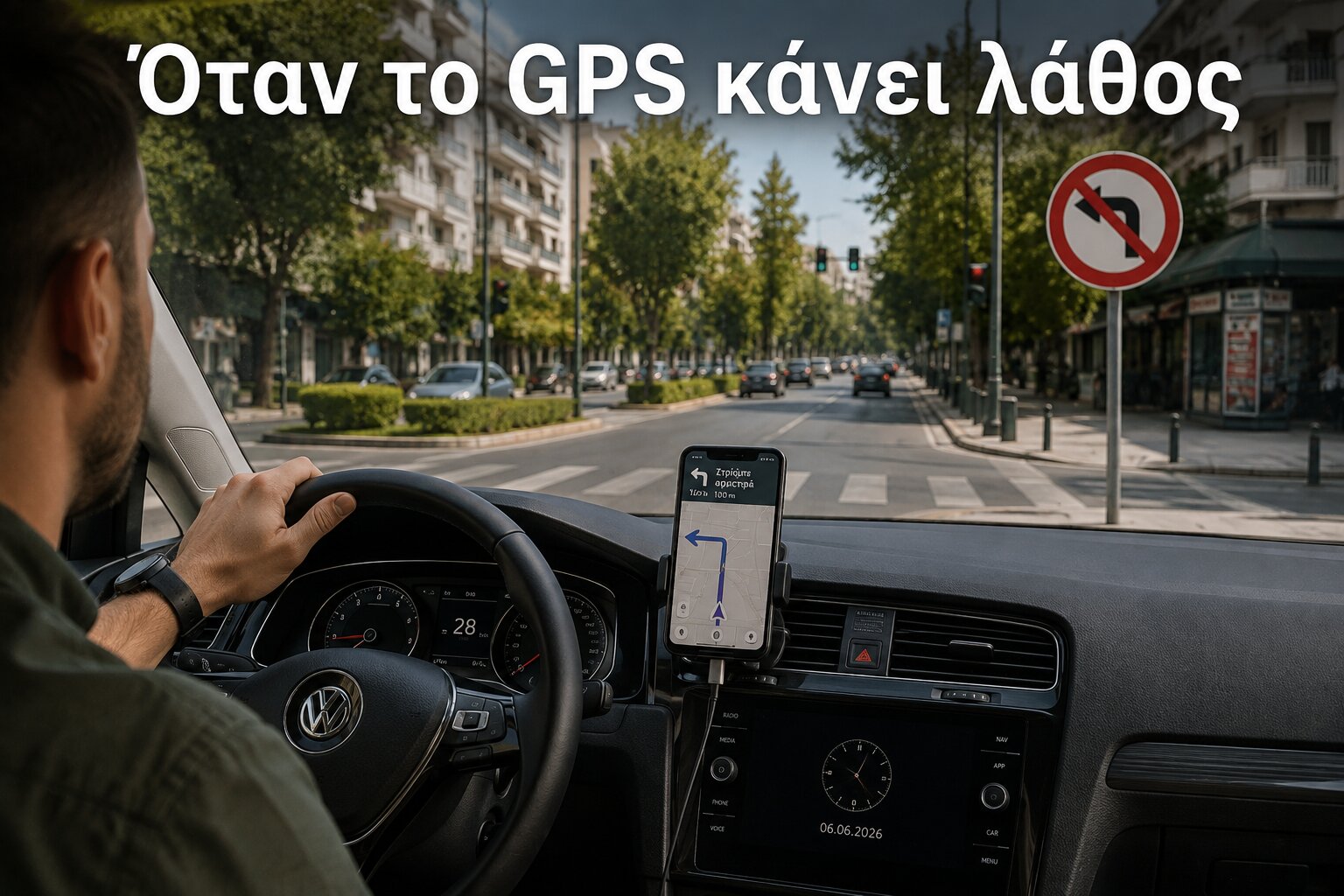

You have reached the airport, your luggage is already outside the car and your flight leaves in a few hours. In theory, all that remains is to hand back the keys.
This is exactly where many return mistakes happen.
The car may be left in the wrong parking area, refuelling may have been postponed until the final moment, or the vehicle’s condition may not be recorded at all. If the rental company later identifies a fuel shortage, fresh damage or a late return, the traveller may have no evidence showing how the car was actually handed back.
Returning a rental car correctly does not require suspicion or unnecessary stress. It requires a little preparation and a clear process: return the vehicle on time, at the correct location, under the agreed conditions and with adequate evidence of its final condition.
This is the last essential stage of the rental.
The return process begins before you reach the rental station

The first mistake is to think about the return only after you have already started driving towards the airport or port.
The day before, review the booking confirmation or rental agreement. Focus only on the information that affects the final stage:
- return date and time,
- exact return location,
- fuel or charging policy,
- any mileage restriction,
- after-hours return instructions,
- equipment that must be handed back,
- the rental company’s contact number.
The same rules do not apply to every company or booking. The European Union does not have one sector-specific law governing every detail of car rental. General consumer-protection rules apply, but the practical return procedure is primarily determined by the rental agreement and the company’s terms.
A procedure followed during a previous rental should therefore not automatically be assumed to apply to the next one.
Confirm exactly where the car must be returned
The collection and return locations are not always the same.
At a Greek airport, a company may use:
- a dedicated rental-car facility,
- an outdoor car park,
- a meeting point near the arrivals area,
- an off-airport station connected by shuttle.
On islands and in tourist destinations, the return may take place at a port, hotel, local office or designated parking area.
Do not rely solely on the first company listing shown by a navigation app. Use the exact location supplied in your booking instructions. Where the information is unclear, request written confirmation before your departure day.
A difference of only a few hundred metres can become important when traffic, luggage and time pressure are involved.
Do not plan the return down to the last minute
The time shown in your rental agreement is the time by which the vehicle should be at the agreed location and ready to be handed over. It is not the time at which you should begin looking for the station entrance.
Allow time for:
- traffic,
- refuelling or charging,
- finding the correct parking area,
- unloading luggage,
- vehicle inspection,
- shuttle transport to the terminal, where required.
European consumer guidance notes that a late return can result in an additional charge and, depending on the agreement, may even be calculated as another rental day.
When you know that you will be delayed, contact the company before the agreed return time. Do not assume that a grace period automatically applies.
Return the agreed amount of fuel
Fuel policy is one of the details most likely to generate an additional charge.
Under a full-to-full agreement, the tank must be returned full. Under a same-level policy, the gauge should be as close as possible to the level recorded at collection.
A personal judgement that the car contains “roughly the same amount” does not replace the contractual requirement.
Use a petrol station reasonably close to the return location and keep the final receipt. The receipt does not prove the final gauge reading by itself, but it shows when and where the vehicle was refuelled.
Once you reach the station, photograph the instrument panel. The image should clearly show:
- the fuel gauge,
- the mileage,
- any warning lights.
Unclear or disproportionate fuel charges have been examined by European consumer authorities. EU consumer rules require contractual terms and additional fees to be transparent and fair.
Check the charging policy for an electric rental car
There is no single battery percentage at which every electric rental car must be returned.
A rental company may require:
- approximately the same charge level as at collection,
- a stated minimum percentage,
- return with a predetermined recharging fee.
Charging requires more planning than conventional refuelling. A charging point may be occupied, out of service or incompatible with the payment method available to you.
Before leaving the car, photograph the battery percentage and make sure you have returned:
- charging cables,
- adapters,
- company charging cards or devices,
- any equipment stored beneath the luggage-compartment floor.
A charging cable is part of the vehicle’s equipment. Its loss may result in a replacement charge where this is provided for in the rental terms.
Empty the car before the final inspection
The last minutes of the return are not the right time to search hurriedly for passports, chargers or accommodation keys.
Check:
- beneath the front and rear seats,
- door pockets,
- glove compartment,
- cup holders,
- seat-back pockets,
- luggage compartment,
- the space beneath the boot floor,
- USB ports.
Remove rubbish, food packaging and personal belongings.
A rental car does not normally need professional detailing before return unless the agreement specifically requires it. There is, however, a difference between ordinary travel dust and a condition that requires specialist cleaning, such as severe stains, smoke odour, excessive sand or pet hair.
The applicable rules and charges should be stated in the individual rental terms.
Inspect the car in suitable light

Before handing over the keys, walk slowly around the vehicle.
You are not expected to act as a damage assessor or determine whether every small mark is chargeable. The purpose is to know the condition in which you are leaving the car.
Check:
- front and rear bumpers,
- bodywork corners,
- doors and mirrors,
- windscreen,
- wheels and tyres,
- roof,
- seats and interior trim,
- luggage compartment.
In Greece, wheels and the lower parts of the bodywork deserve particular attention after driving through narrow streets, island villages, steep parking entrances or unpaved access roads.
When you notice a new mark, inform the company and ask for it to be recorded. Do not attempt an improvised repair without prior approval.
Useful return photographs are not holiday photographs

One distant photograph of the car is not an adequate condition record.
Your final evidence should show four things:
- the condition of the vehicle,
- the fuel or battery level,
- the mileage,
- the place where the car was returned.
Photograph:
- the front and rear,
- both sides,
- all four corners,
- the wheels,
- the windscreen,
- the roof where practical,
- the interior,
- the luggage compartment,
- the instrument panel,
- the parking space and a recognisable sign identifying the location.
A slow video around the vehicle can be useful as additional evidence, but it should not be your only record. Still photographs make individual areas easier to examine.
European consumer guidance recommends a clear record of the vehicle’s condition, particularly where no joint inspection takes place or where the car is returned outside normal opening hours.
Take the final photographs where you actually leave the vehicle, not only at the petrol station several kilometres away.
A joint inspection is the clearest way to complete the return
Where the rental desk is open, ask for the car to be inspected in your presence.
The representative can confirm:
- return time,
- fuel or battery level,
- mileage,
- returned equipment,
- final vehicle condition.
Request a written or electronic return record. It does not necessarily have to state that no later charge could ever arise, because tolls, fines or other contractual matters may remain outstanding. It should, however, record the vehicle’s condition and the main return details as clearly as possible.
European consumer authorities have required major companies in the sector to improve their inspection processes and provide reasons and evidence before applying a damage charge.
When the return form records damage or another issue with which you disagree, do not sign without understanding it. Ask for:
- the exact area to be shown to you,
- a specific written description,
- your own comment to be added,
- a copy or photograph of the document.
A recorded disagreement is more useful than an informal verbal discussion.
After-hours return requires the greatest care
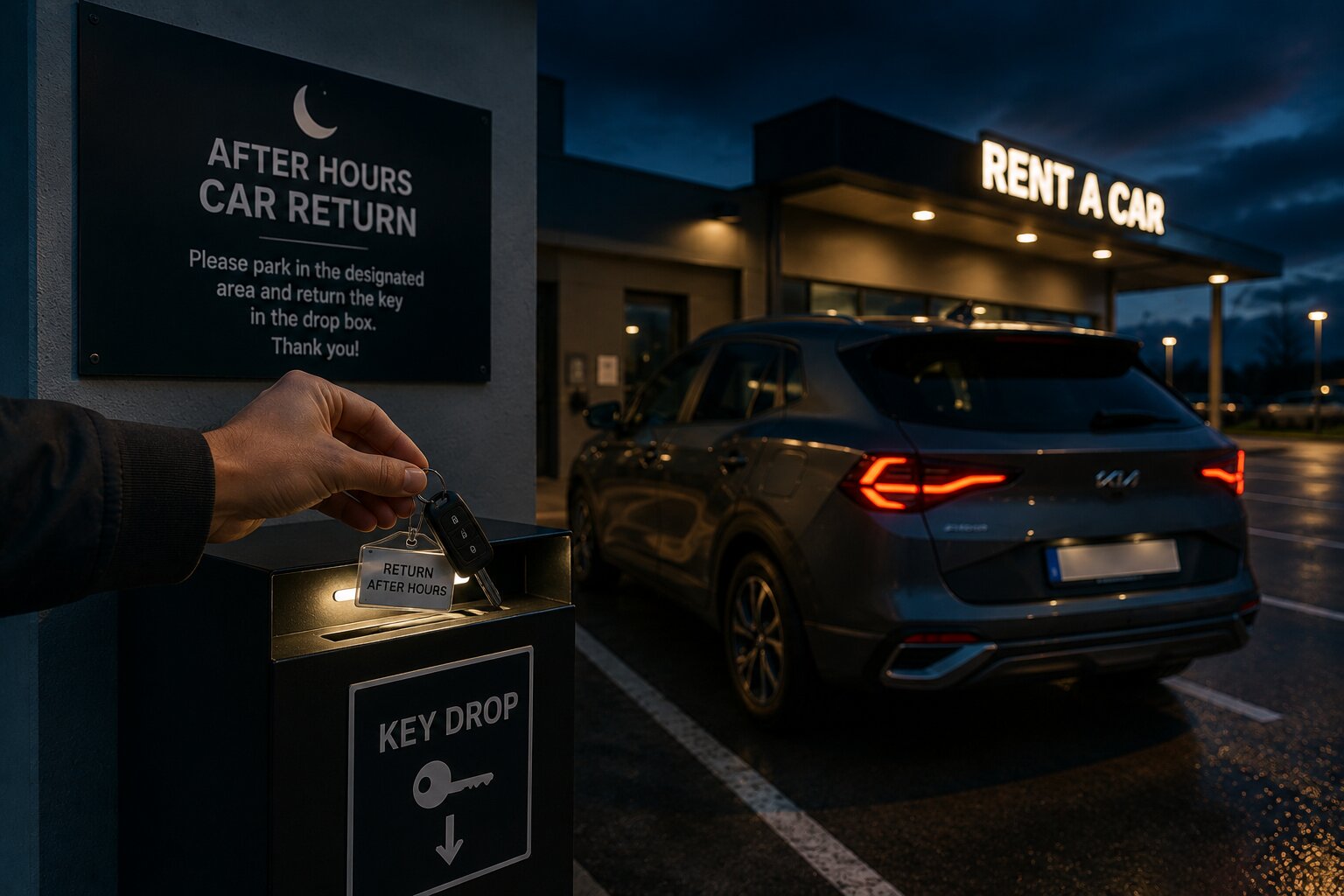
Early flights, late ferry services and the limited opening hours of smaller stations make after-hours returns common in Greece.
The procedure is convenient, but it has one important disadvantage: the vehicle will usually be inspected later, without you being present.
Before using a key drop or unattended return, confirm:
- that the procedure is authorised,
- the exact parking space,
- where the keys must be left,
- whether you must send a message,
- when the inspection will take place,
- which time legally or contractually counts as the return time.
Do not leave the vehicle in a random area because you cannot locate the correct car park. Contact the company and keep the message or call record.
The safest sequence
- Park in the agreed space.
- Remove your personal belongings.
- Photograph the exterior, interior and dashboard.
- Record the parking location.
- Return the keys according to the instructions.
- Send the company a written message immediately.
- Keep the original files on your device or in secure storage.
A short message is enough:
“Vehicle for booking [booking number] was returned today at [time] in [location]. The keys were placed in the designated drop-off point. I have retained photographs of the final condition and dashboard.”
The wording does not need to be complicated. It needs to create a clear record of time and place.
What counts as fair wear and tear
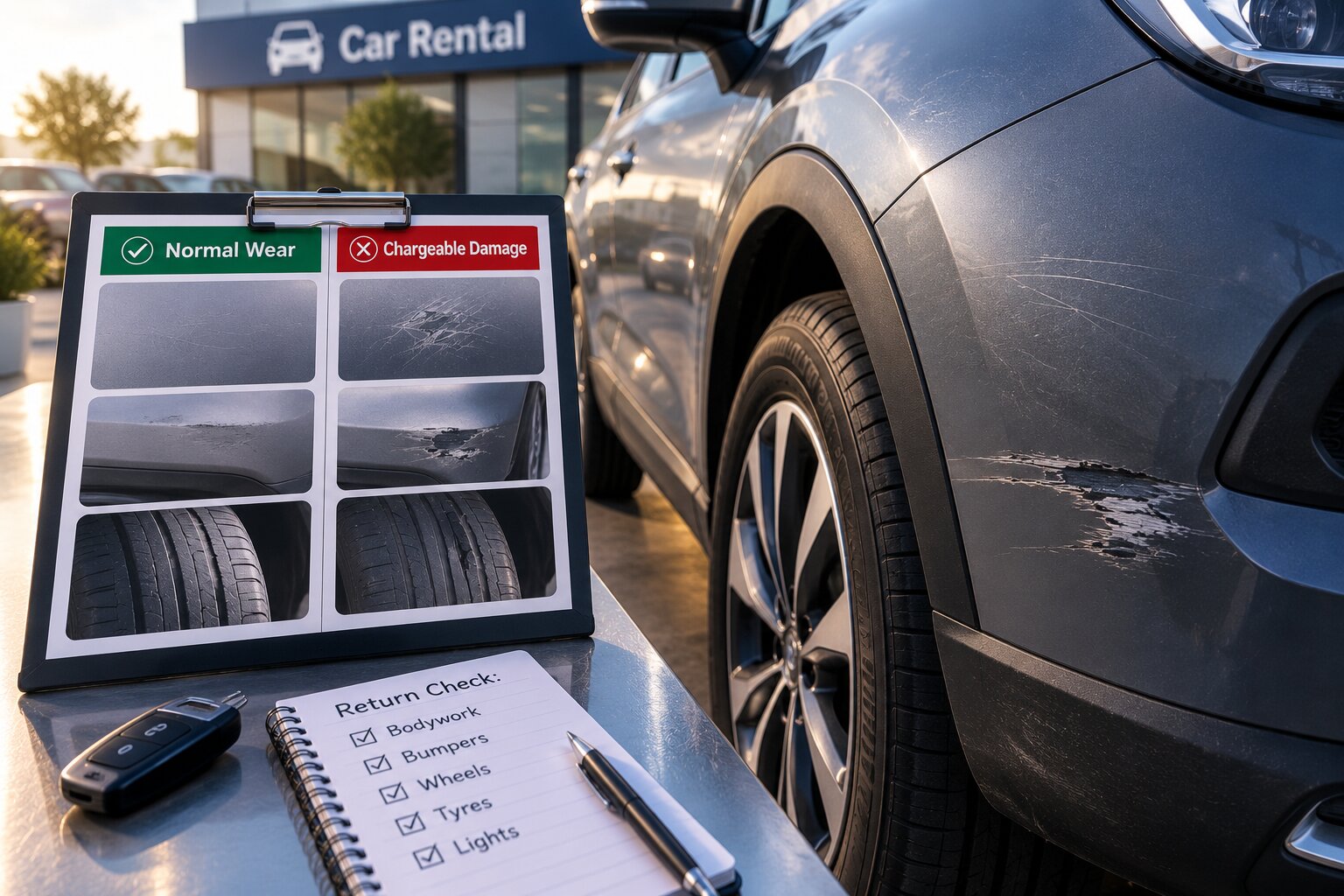
Fair wear and tear is not the same as fresh damage.
In general, fair wear and tear describes gradual deterioration resulting from normal and permitted use. A deep wheel impact, broken light unit or new pronounced scratch would not usually be assessed in the same way.
There is no single European table binding every rental company and defining exactly which mark is acceptable. The assessment depends on:
- the rental agreement,
- the original condition report,
- the company’s damage guide, where available,
- the size and location of the mark,
- evidence from before and after the rental.
The traveller does not need to decide alone whether a mark is “small enough.” The important step is to request specific recording and a clear explanation.
Return the equipment as well as the car
Before completing the handover, make sure that everything supplied by the company has been returned:
- all keys,
- child seats,
- toll device,
- parking or charging cards,
- cables and adapters,
- removable navigation unit or mount,
- roof equipment,
- company document folders.
A missing accessory can result in an additional charge even where the vehicle itself is undamaged.
Record the return of valuable equipment on the return form or in your photographs.
When a charge appears after the return

A later charge is not automatically correct or incorrect. The first step is to establish exactly what it concerns.
It may relate to:
- new damage,
- missing fuel or low battery level,
- late return,
- specialist cleaning,
- missing equipment,
- tolls or a traffic fine,
- a contractual administration fee.
Ask in writing for:
- a clear explanation,
- photographs or other evidence,
- inspection date,
- an itemised calculation,
- the contractual clause on which the charge is based.
Compare the company’s evidence with:
- your final photographs,
- the return document,
- fuel or charging receipt,
- messages,
- the recorded return time and location.
The European Commission has recognised damage charges, fuel policies and insurance terms as frequent sources of disputes in the car-rental sector. Consumers should receive understandable terms and a genuine opportunity to challenge a claim.
How to complain without becoming lost in the process
Your first step should be written communication with the company that supplied the vehicle.
Include:
- booking number,
- date and place of return,
- a concise explanation of the disagreement,
- supporting evidence,
- a specific request, such as cancellation or reconsideration of the charge.
Where the booking was made through an intermediary, you may also inform it, but a dispute about the car’s condition will normally need to be addressed first with the company that handed over and received the vehicle.
Where no solution is reached:
- for a cross-border dispute within the EU, Norway or Iceland, you may seek guidance from the European Consumer Centre in your country of residence,
- for a dispute with a business in Greece, you may contact the Greek Consumer Ombudsman,
- you may also submit a consumer complaint through the Greek General Secretariat for Commerce and Consumer Protection.
Greek official services allow consumers to submit complaints concerning services and matters affecting their financial interests, together with the relevant supporting documents.
A card-payment dispute may be considered in some cases, but it does not replace a prior written complaint and does not guarantee reimbursement.
The short checklist before leaving the keys
Before walking away from the vehicle, make sure that:
- you are at the correct location,
- the car is returned within the agreed time,
- fuel or charge level complies with the agreement,
- personal belongings have been removed,
- all company equipment has been returned,
- exterior and interior photographs have been taken,
- mileage and dashboard have been recorded,
- you have requested or received return confirmation,
- the company has been informed in writing when the return took place after hours.
If these points are covered, you have dealt with the essential parts of the process.
Frequently asked questions
Do I have to wash the rental car before returning it?
Usually not, provided it shows only normal use and the agreement does not state otherwise. Remove rubbish and anything likely to require specialist cleaning.
Is leaving the keys in the drop box enough?
No. You must also use the correct parking location, comply with the return time and record the vehicle’s final condition.
What should I do if I notice a new scratch just before the return?
Photograph it and inform the company. Ask for it to be recorded during the return. Do not arrange a repair without prior authorisation.
Can I be charged after I have left?
Yes. A later charge may arise for damage, fuel, tolls, fines or another contractual fee. You are entitled to ask for a clear explanation and supporting evidence.
How long should I keep my photographs?
Keep them at least until the rental has been fully settled and there is no outstanding communication or dispute.

Conclusion
Returning a rental car is not difficult. It becomes difficult when it is handled in a rush.
The correct process is built around five simple elements:
- the correct time,
- the correct place,
- compliance with the fuel or charging policy,
- a clear final inspection,
- adequate evidence.
When a representative is available, a joint inspection and return document provide the clearest ending. When the car is returned after hours, photographs and immediate written notification become even more important.
You do not photograph the car because you expect a problem. You do it because a properly documented return protects both the traveller and the rental company.
It also allows you to finish your journey without leaving unanswered questions behind