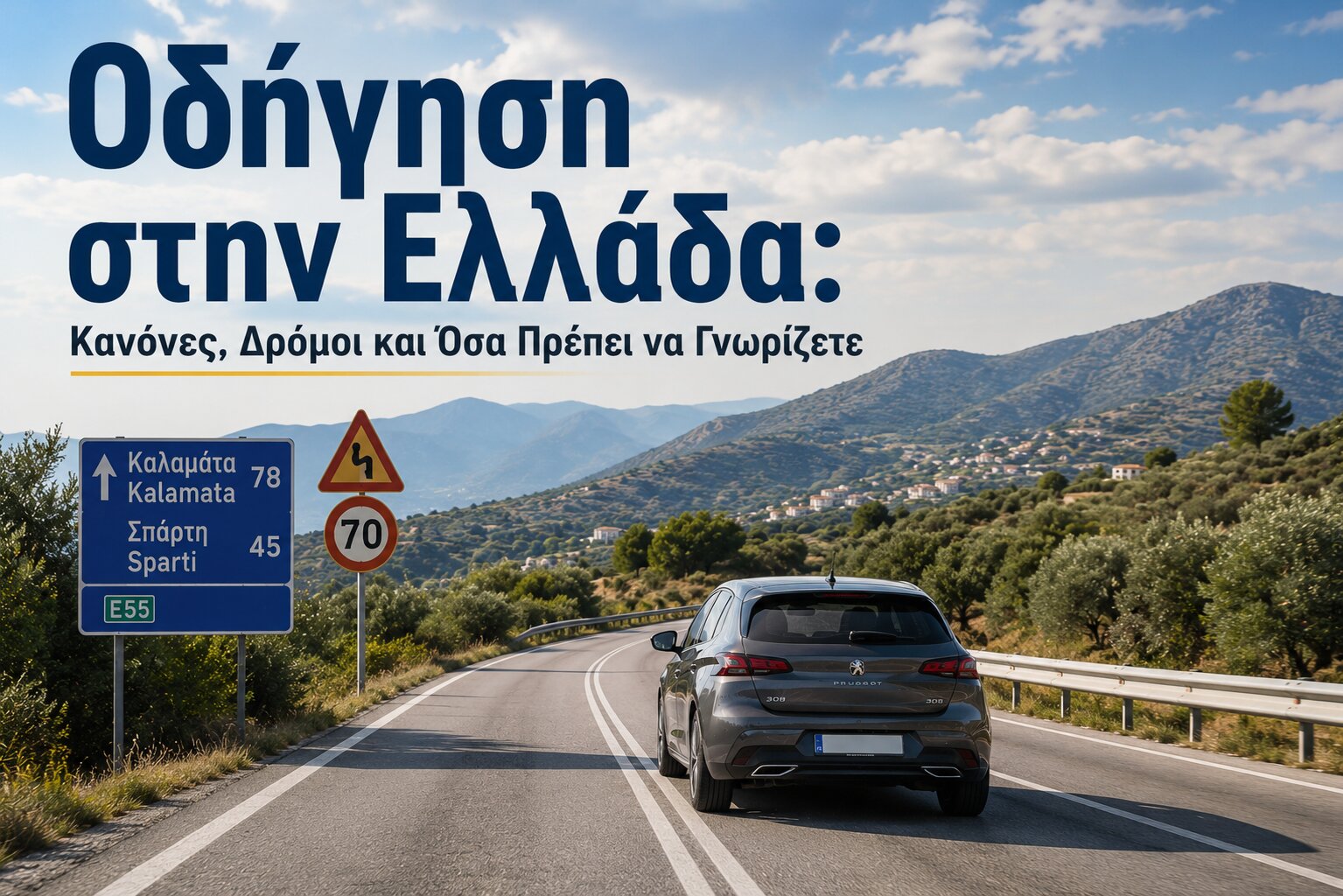
You leave the airport, set the navigation system and begin driving towards your hotel. The road signs look familiar, traffic moves on the right and, for the first few minutes, the experience feels much like driving in many other European countries.
Then a scooter appears between two lanes. The road ahead suddenly narrows, a car stops briefly with its hazard lights on, and the navigation app suggests turning into a passage that looks more like an alley than a normal street.
For many visitors, this is their first real introduction to driving in Greece.
Driving here is not necessarily difficult. It is, however, less uniform than some international drivers expect. A modern motorway can become a winding regional road within minutes. A quiet island route can suddenly fill with scooters, pedestrians and tour buses. A journey covering only a few dozen kilometres may take much longer than the map initially suggests.
The most useful principle is simple:
Driving safely in Greece is not only about knowing the rules. It is about adapting to the road, the location and the conditions around you.
Is driving in Greece difficult?
For most visitors, it is not.
Greece has modern motorways, road signs based on familiar European standards and road connections reaching much of the mainland and the islands. Traffic moves on the right, and overtaking is normally carried out on the left.
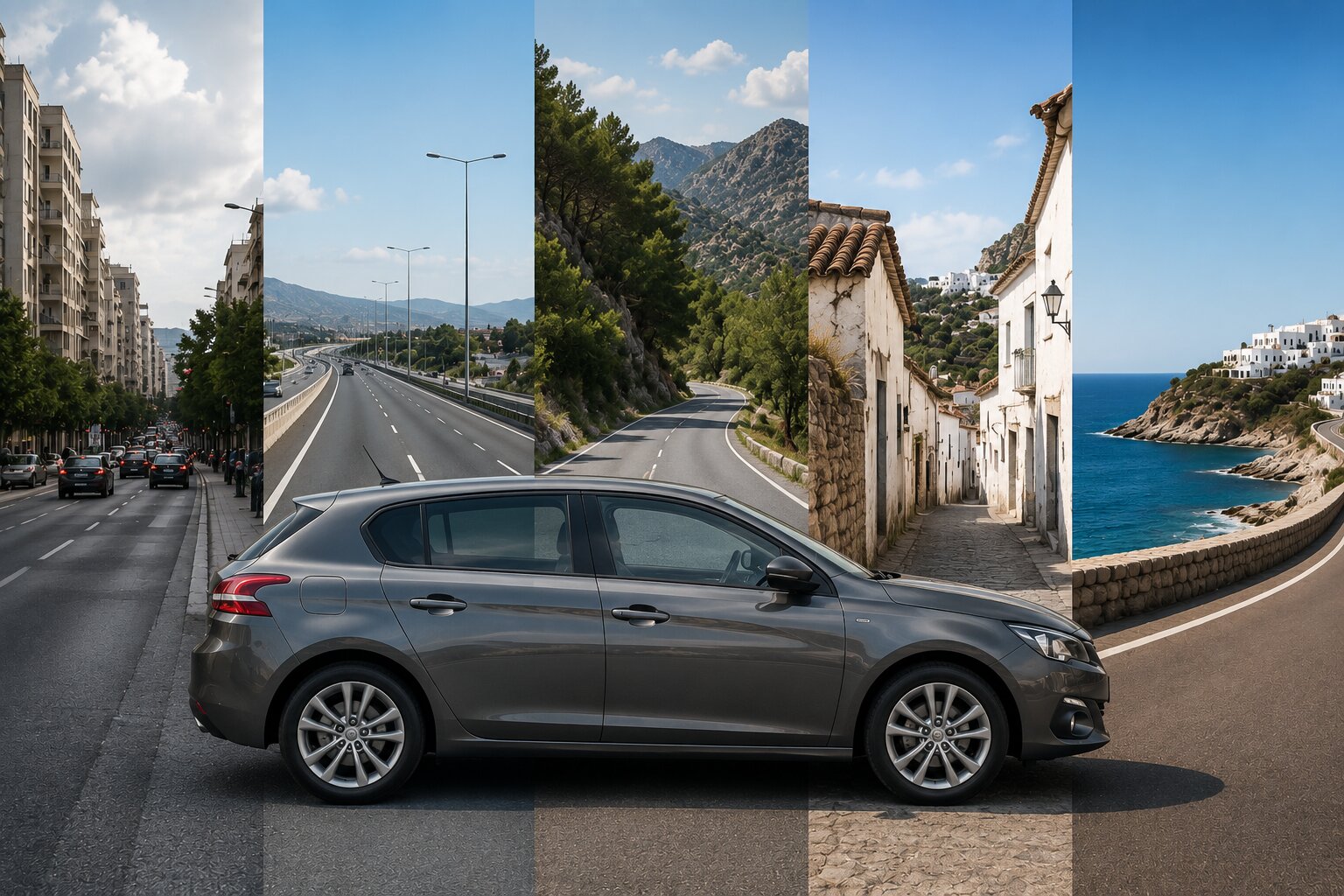
The real challenge is not an entirely different set of driving rules. It is the speed at which the driving environment can change.
During the same day, you may drive:
- along a busy avenue in Athens,
- on a multi-lane motorway,
- beside the coast on a road with limited visibility,
- through a village with narrow passages,
- and finally along a small local road leading to a beach.
Driving becomes easier when you do not try to maintain the same pace everywhere. Slow down whenever the character of the road changes, and do not allow drivers who know the route better to determine your speed.
What surprises first-time drivers most
Motorcycles and scooters are a constant part of traffic
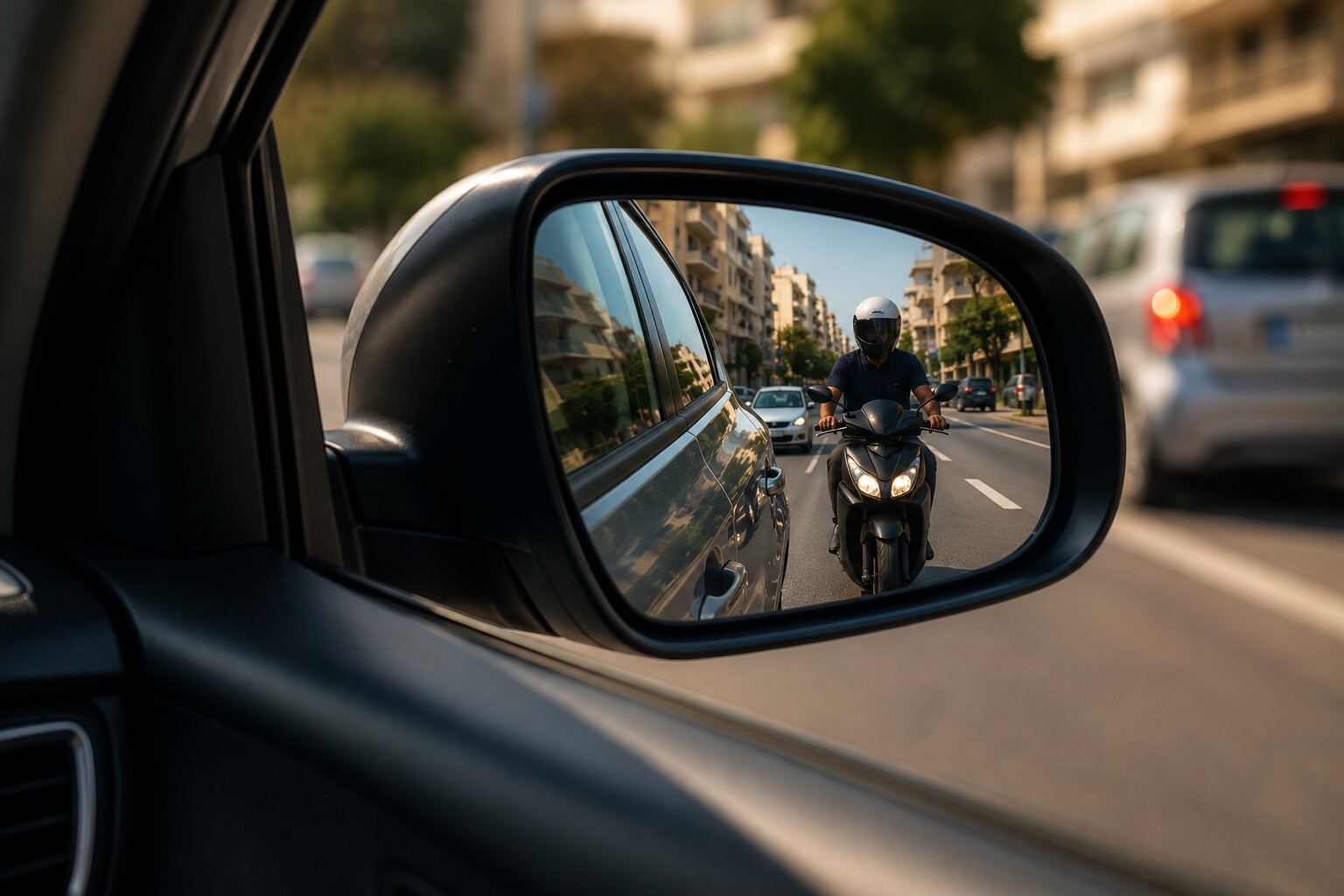
In Athens and Thessaloniki, motorcycles and scooters often move between lines of cars, pull up beside vehicles at traffic lights and appear in blind spots shortly before a lane change.
You do not need to drive nervously. You do, however, need to develop one reliable habit:
Mirror, indicator, blind-spot check, then move.
The same check is essential before opening the door of a parked vehicle.
On the islands, the situation is different but still requires caution. Many scooters and ATVs are used by visitors who may be unfamiliar with both the vehicle and the road. Leave additional space and be prepared for sudden braking or changes of direction.
A road can become narrow very quickly
In old towns, villages and many island settlements, roads were not designed for modern volumes of traffic.
A road that appears comfortable at first may:
- narrow between buildings,
- have parked cars on both sides,
- pass beneath a low balcony,
- lead into a sharp bend,
- or reach a point where two cars cannot pass at the same time.
Do not follow the navigation system blindly through historic settlements. The app may know that a road exists, but it may not know whether it is practical for the size of your vehicle or whether access is blocked.
When in doubt, park outside the narrowest section of the settlement and continue on foot.
Kilometres do not always reveal the real journey time
Forty kilometres on a motorway is entirely different from forty kilometres in Crete, the Peloponnese, Pelion or the Cyclades.
Bends, villages, agricultural vehicles, summer traffic and limited overtaking opportunities can significantly reduce average speeds.
This matters when you have to catch:
- a flight,
- a ferry,
- an organised activity,
- or a scheduled rental-car return appointment.
Do not rely solely on the most optimistic time shown by the navigation app. Add a buffer, particularly during the summer.
The road rules visitors genuinely need to remember
The current Greek Road Traffic Code is Law 5209/2025, published in Government Gazette 100 A on 13 June 2025.
Drive on the right
Vehicles travel on the right-hand side of the road, and overtaking is normally carried out on the left.
On a multi-lane road, use the left lane for overtaking and return to the right when the manoeuvre is complete and it is safe to do so.
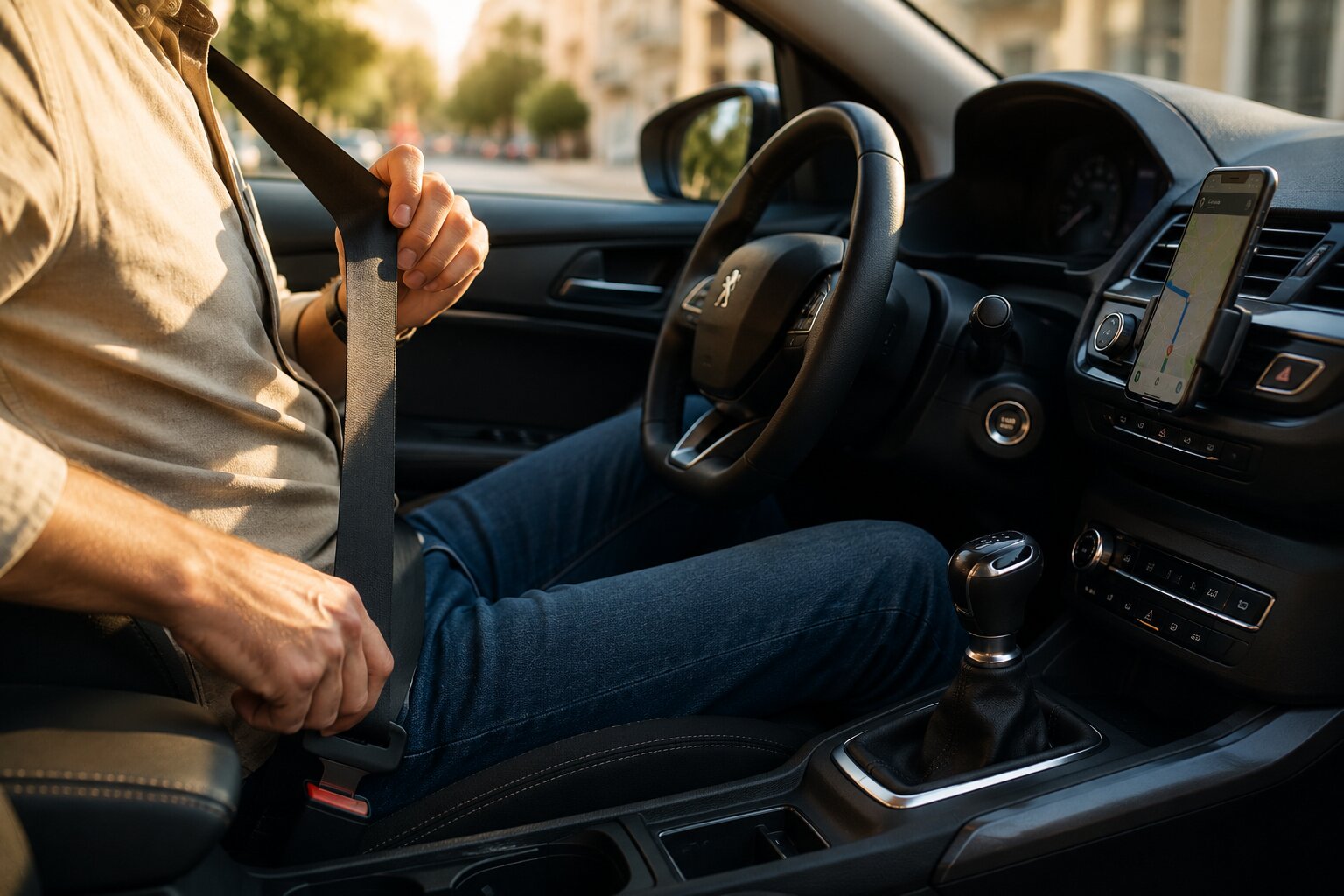
Seat belts and child restraints are compulsory
Passengers must wear seat belts, and children must use an appropriate child-restraint system. The requirement also applies to rear-seat passengers.
Before setting off, make sure:
- everyone is wearing a seat belt correctly,
- the child seat is suitable for the child,
- and it has been installed in accordance with the manufacturer’s instructions.
Do not hold a mobile phone while driving
Drivers may not use a mobile phone without an appropriate hands-free system.
Set the route before you start driving. When you need to change the destination, read a message or operate the screen, stop in a legal and safe place.
A dashboard mount does not make prolonged interaction with the screen safe. Your attention must remain on the road.
The safest alcohol limit is zero
Greece has legal alcohol limits, with lower thresholds applying to certain categories of drivers.
These limits should not be treated as targets. The effects of alcohol vary according to body composition, food, medication and the amount of time that has passed.
The simplest and safest rule is:
Do not drink when you are going to drive.
Speed limits in Greece
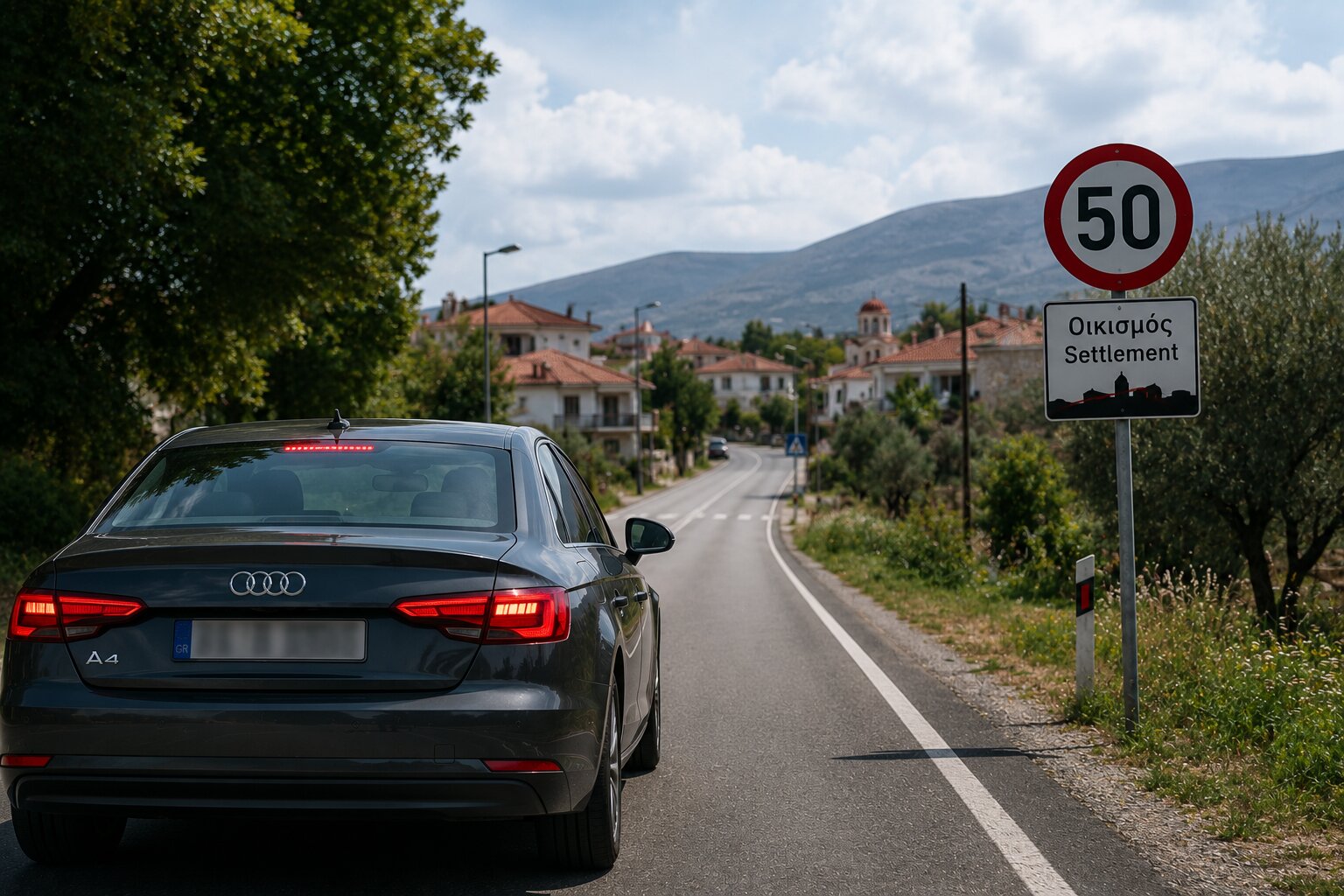
The new Road Traffic Code introduced a general 30 km/h limit on many roads within built-up areas from 1 January 2026. It also provides exceptions for certain categories of larger urban roads and allows different locally approved limits.
For passenger cars, the general maximum limits depend on the road:
| Driving environment | General maximum limit |
|---|---|
| Many roads within built-up areas | 30 km/h |
| Ordinary roads outside built-up areas | up to 90 km/h |
| Expressways | up to 110 km/h |
| Motorways | up to 130 km/h |
Roadside signs always take priority over the general limits.
The practical lesson for visitors is straightforward:
Do not guess the limit from the width or appearance of the road. Read the signs.
The legal limit is not always a safe speed. Wet surfaces, strong crosswinds, pedestrians in villages and limited visibility on mountain roads may require you to travel much more slowly.
Priority rules and roundabouts
Priority is determined first by:
- instructions from a traffic officer,
- traffic lights,
- vertical and road-surface signs,
- and, where no different instruction applies, the general traffic rules.
At an unsigned junction, the general rule is normally to give priority to traffic approaching from the right.
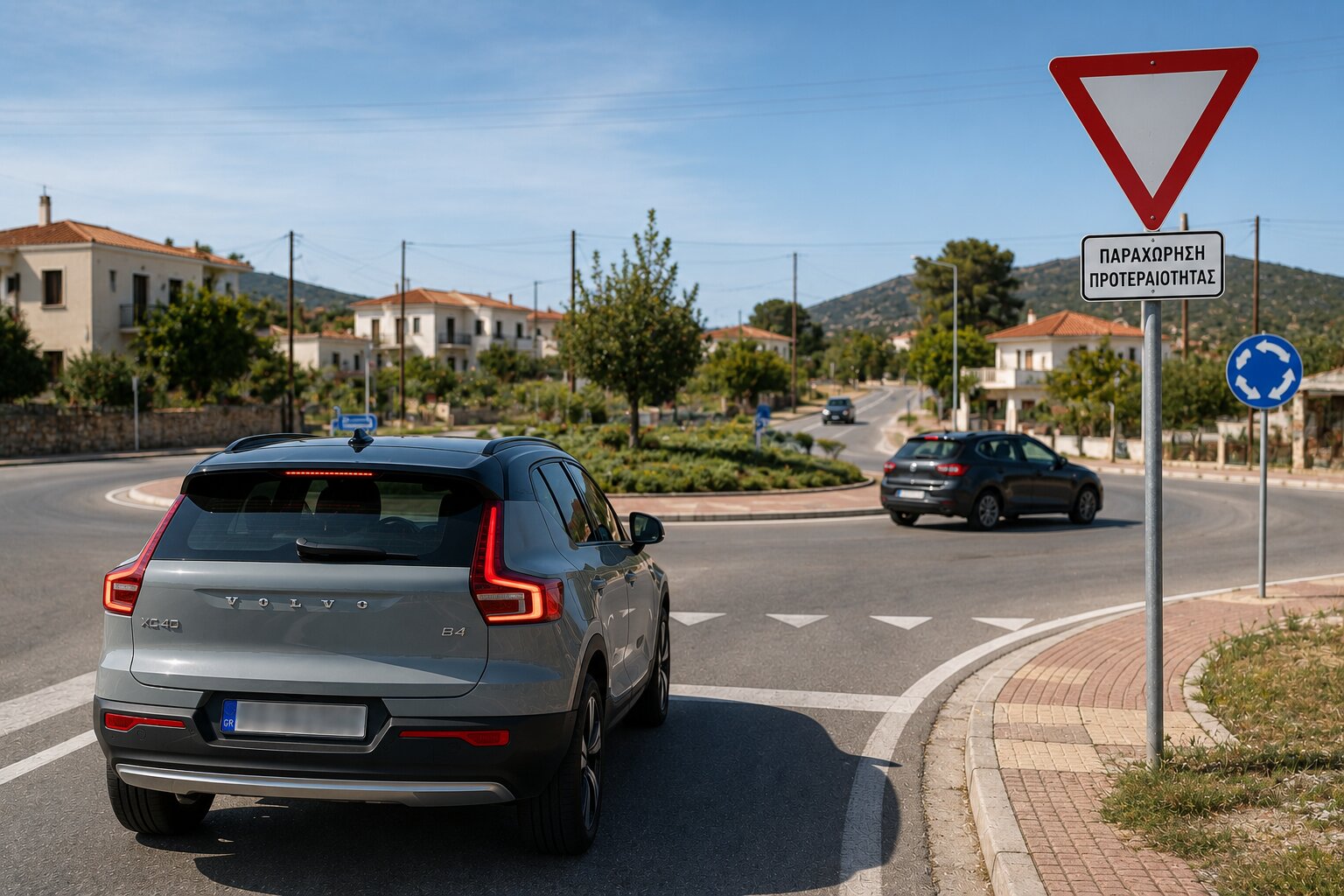
This is particularly important at roundabouts. In many countries, drivers assume that traffic already circulating inside the roundabout always has priority. In Greece, you must inspect the signs at the entrance.
When a Give Way or STOP sign is present, vehicles already inside the roundabout have priority. Without such signage, the general right-hand priority rule may apply.
The safest approach is to:
- slow down before entering,
- look for a Give Way or STOP sign,
- avoid simply following the vehicle ahead,
- signal when leaving,
- and avoid unnecessary lane changes inside the roundabout.
Driving on Greek motorways
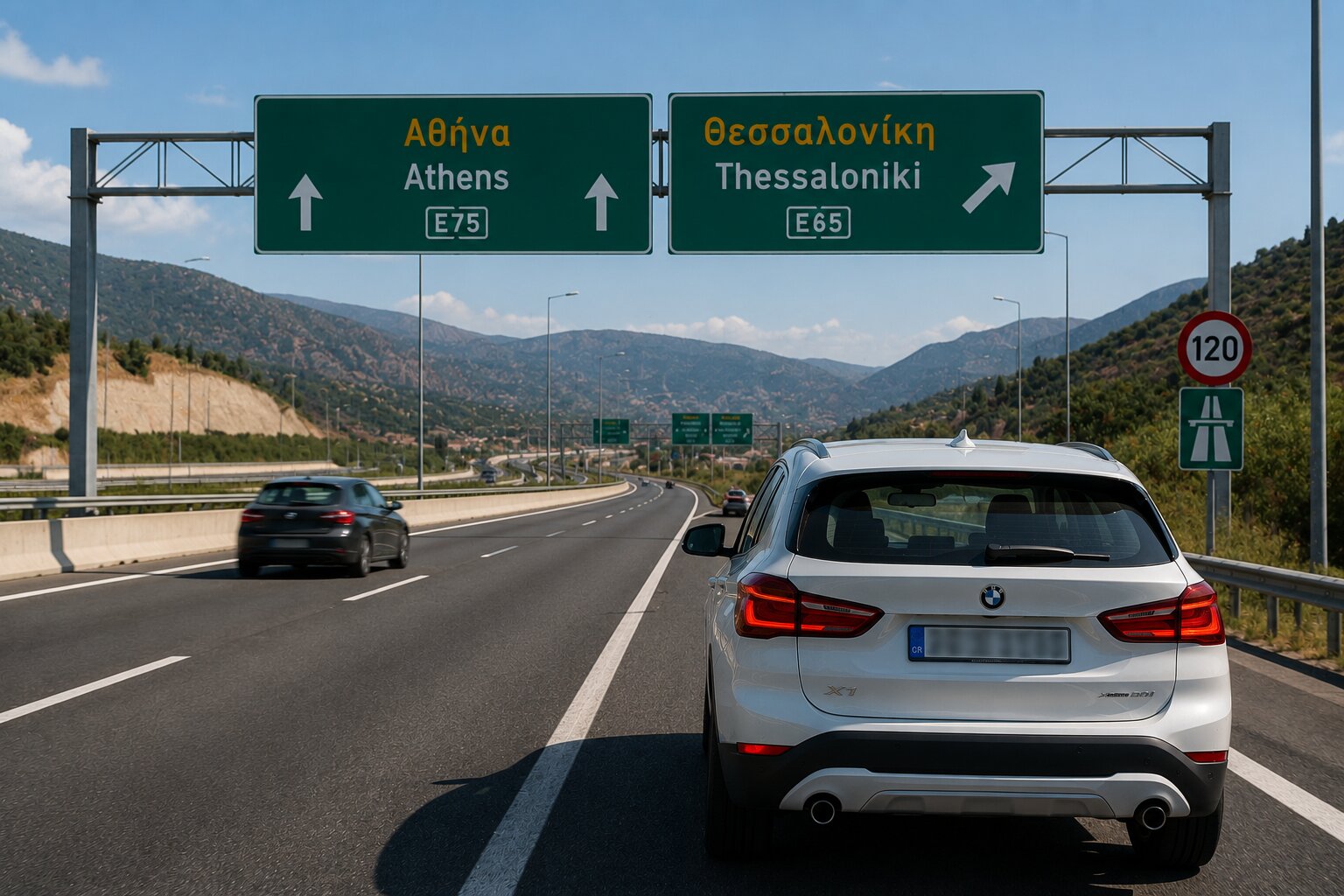
Motorways are usually the easiest part of a Greek road trip. They connect Athens with the Peloponnese, western Greece, Thessaly, Epirus and Macedonia, while the Egnatia corridor serves much of northern Greece.
The quality of the road, however, should not lead to reduced attention.
Keep to the right
The right lane is the normal driving lane. Use the left lane for overtaking and return to the right when it is safe.
Do not allow faster drivers or vehicles remaining in the left lane to determine your pace. Predictable driving is safer than trying to match them.
The emergency lane is not an additional traffic lane
The emergency lane is reserved for genuine emergencies. It should not be used for overtaking, avoiding congestion or making an unnecessary stop.
When the vehicle breaks down:
- move as far to the right as possible,
- switch on the hazard lights,
- do not remain in an active traffic lane,
- leave from the side away from traffic when it is safe,
- wait behind the safety barrier,
- and contact roadside assistance or the rental company.
Take extra care in tunnels
A number of Greek motorways include long tunnels.
Before entering:
- make sure the lights are on,
- follow the posted speed limit,
- maintain sufficient distance,
- avoid unnecessary lane changes.
During a serious incident, follow the illuminated signs, emergency exits and instructions from the motorway operator. Never make a U-turn or drive against the direction of traffic.
Toll roads: what visitors should know
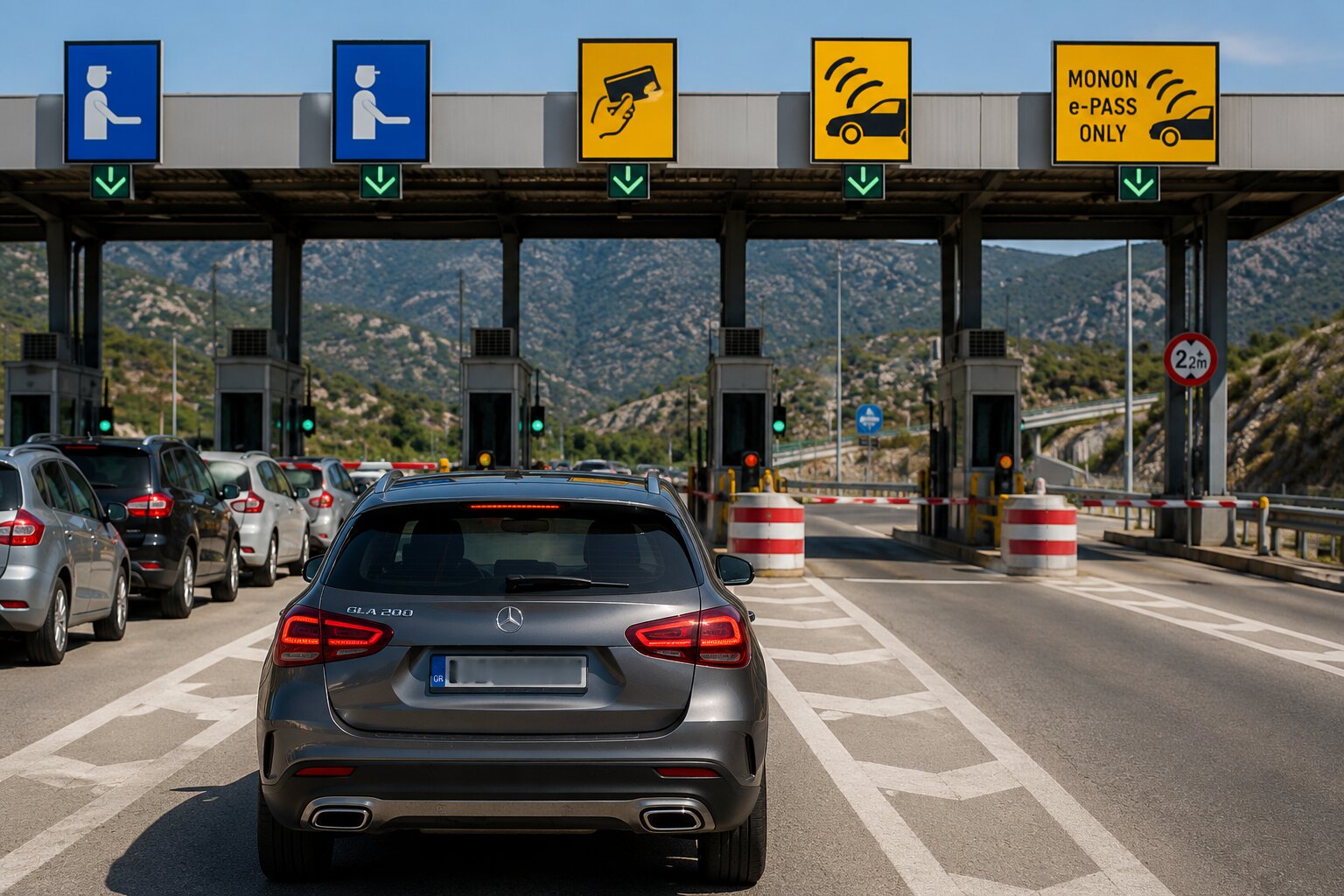
Most major Greek motorways have toll stations. The amount charged depends on the route, toll station and vehicle category.
Depending on the operator and station, you may find:
- staffed payment lanes,
- automatic payment machines,
- electronic-transponder lanes.
Prices and accepted payment methods can change. Before a long journey, check the official website of the motorway you intend to use.
Carry a bank card and a small amount of cash. Do not enter a transponder-only lane unless you know that the rental car has a compatible device.
Ask the rental company:
- whether the vehicle has a toll transponder,
- how crossings are recorded,
- when the charges are collected,
- and whether an administration fee applies.
Do not assume motorway tolls are included in the rental price.
Fuel and electric charging
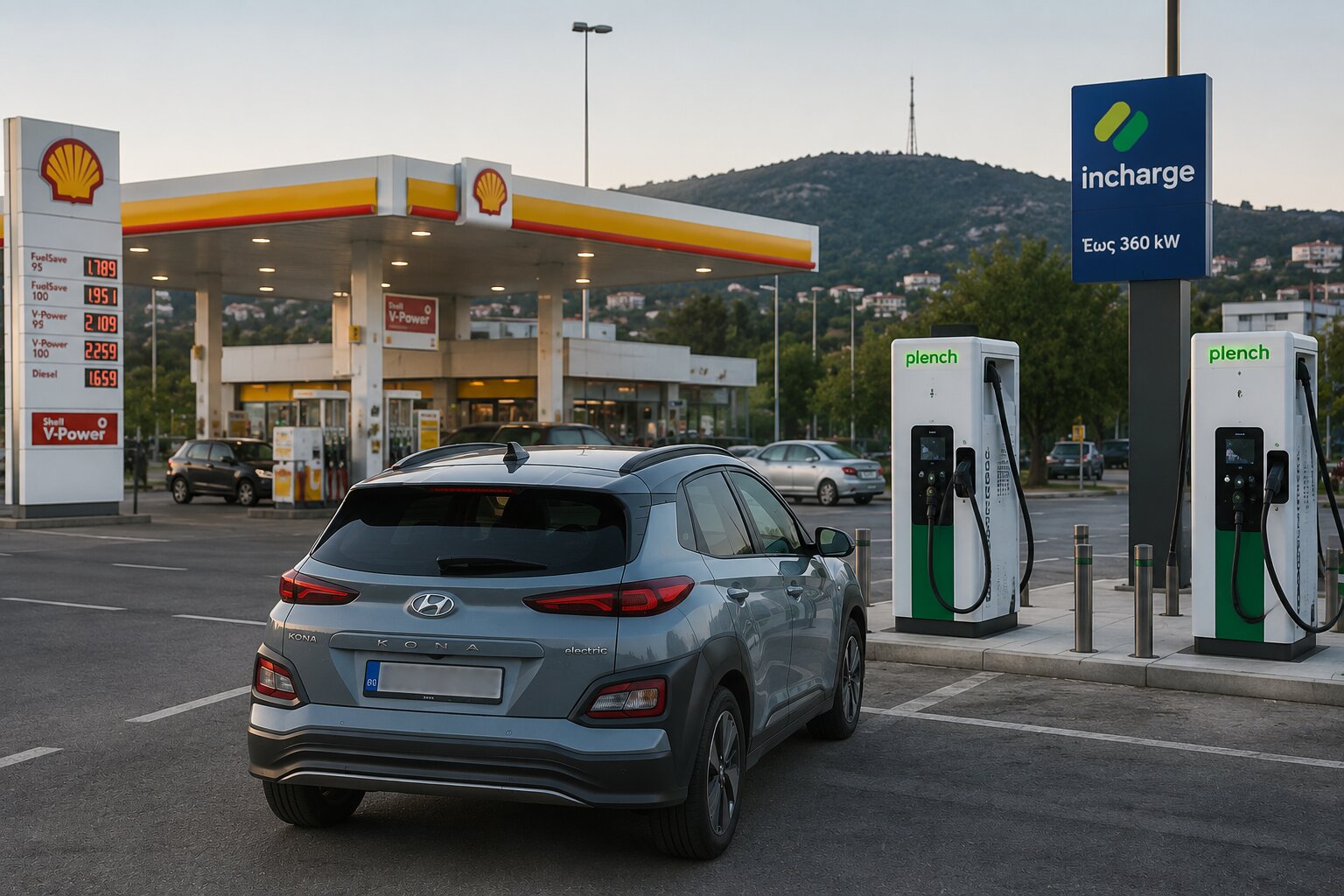
Petrol stations are generally easy to find in large cities, on motorways and in popular destinations.
On smaller islands, in mountainous regions and along remote routes, stations may be fewer or operate restricted hours.
Do not wait for the low-fuel warning light before looking for a station.
Check the required fuel carefully:
- unleaded petrol: often marked as unleaded or petrol,
- diesel: marked as diesel.
When uncertain, inspect the label near the fuel cap or contact the rental company. Filling the vehicle with the wrong fuel can cause serious mechanical damage.
Driving an electric car
With an electric vehicle, it is not enough to know the distance to the next charger. You also need to consider the complete route and what will be available at your destination.
Before a long journey, check:
- charger locations,
- how they are activated and paid for,
- charging power,
- your estimated remaining range on arrival,
- and at least one alternative charger.
Do not regard a charging point as guaranteed until you have checked its status through the relevant app or provider.
On smaller islands and in remote destinations, charging should be planned before departure, not after the battery has already fallen to a low level.
Parking: do not simply copy other drivers
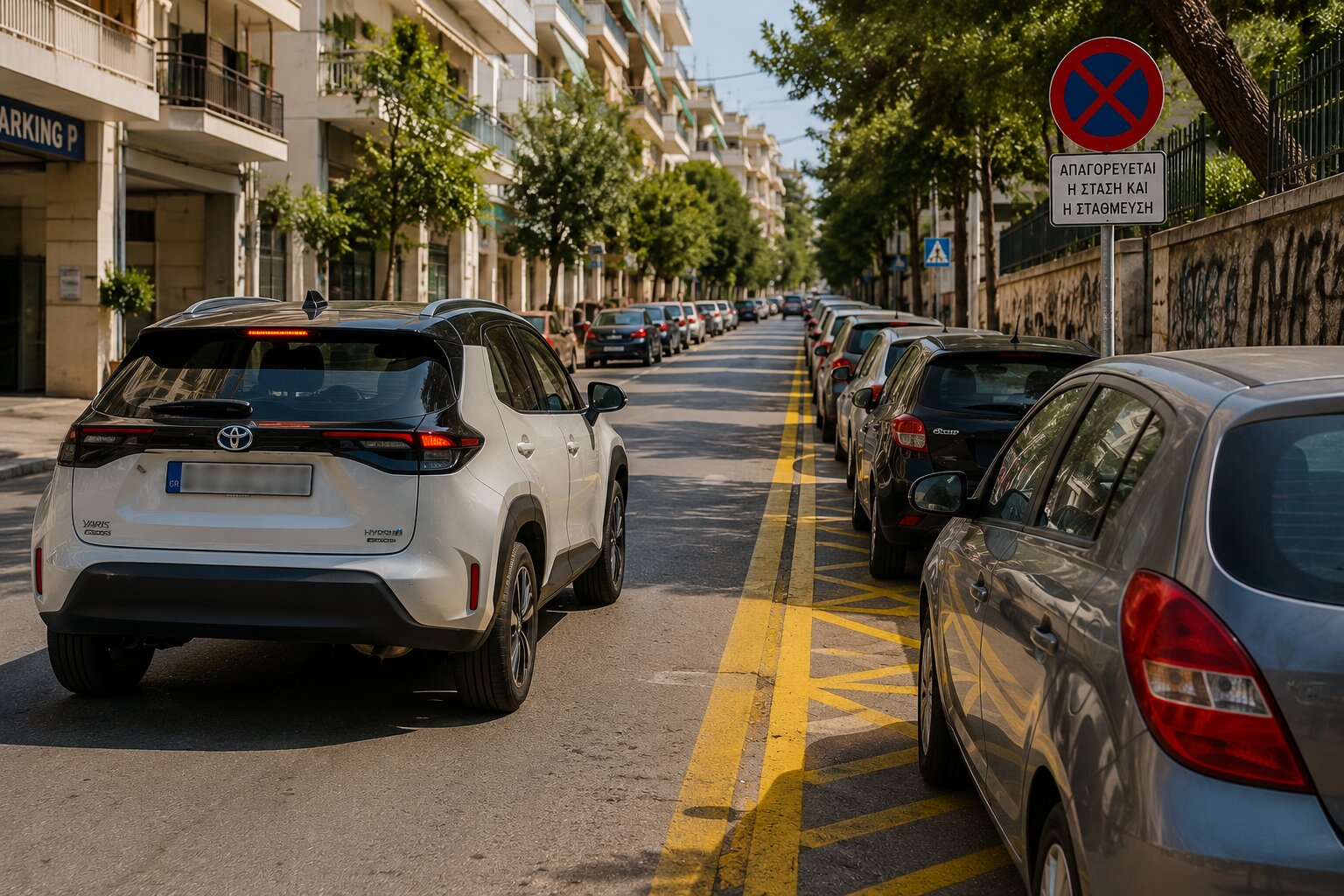
Parking is often more difficult than driving itself, especially in historic centres and busy summer destinations.
The presence of other parked vehicles does not prove that parking is permitted.
Before leaving the car, inspect:
- prohibition signs,
- road markings,
- disabled-access ramps,
- bus stops,
- garage entrances,
- pedestrian crossings,
- and the space remaining for larger vehicles.
In a narrow village, your car may leave enough room for a small vehicle but block a bus, refuse truck or ambulance.
Controlled-parking zones operate differently from one municipality to another. Payment may require an app, parking meter or another local system. Read the signs rather than assuming that the same rules apply throughout Greece.
In central Athens, Thessaloniki and busy island towns, an organised car park is often the safest and most practical option.
Driving in Athens
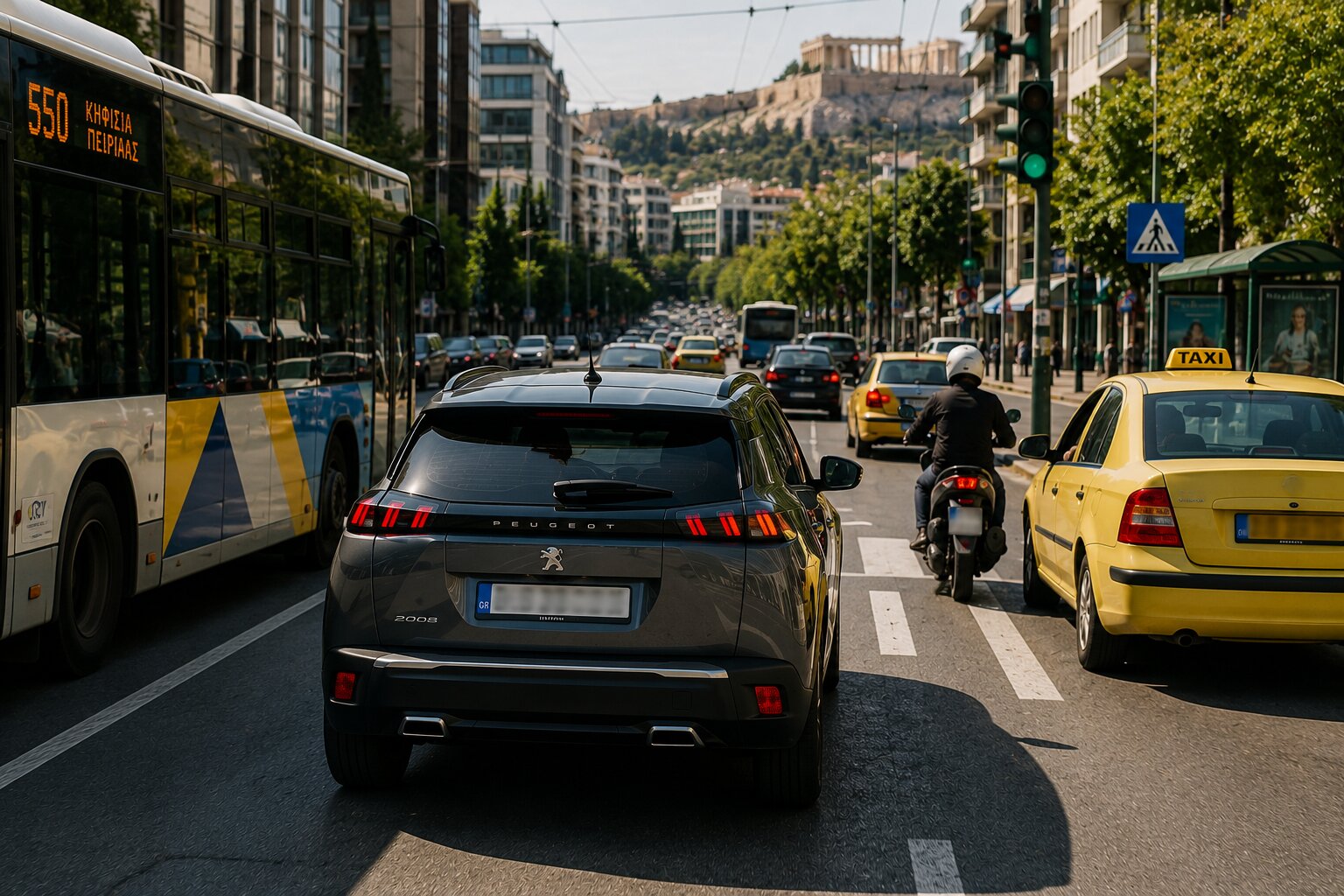
Athens may initially appear intense: multiple lanes, motorcycles, buses, frequent traffic lights and local drivers who know precisely where they are going.
The main mistake is trying to match their pace.
Your objective should be to remain predictable:
- stay in your lane,
- signal early,
- check blind spots,
- avoid last-second changes of direction,
- and when you miss an exit, continue until the navigation system calculates a new route.
Do not stop suddenly because you have spotted the hotel, car park or rental return office.
During busy periods, the journey to Athens International Airport or Piraeus can take much longer than the original estimate. Leave a substantial buffer when catching a flight or ferry.
For a visit to the historic centre, it is often more practical to park legally and continue on foot or by public transport.
Driving in Thessaloniki
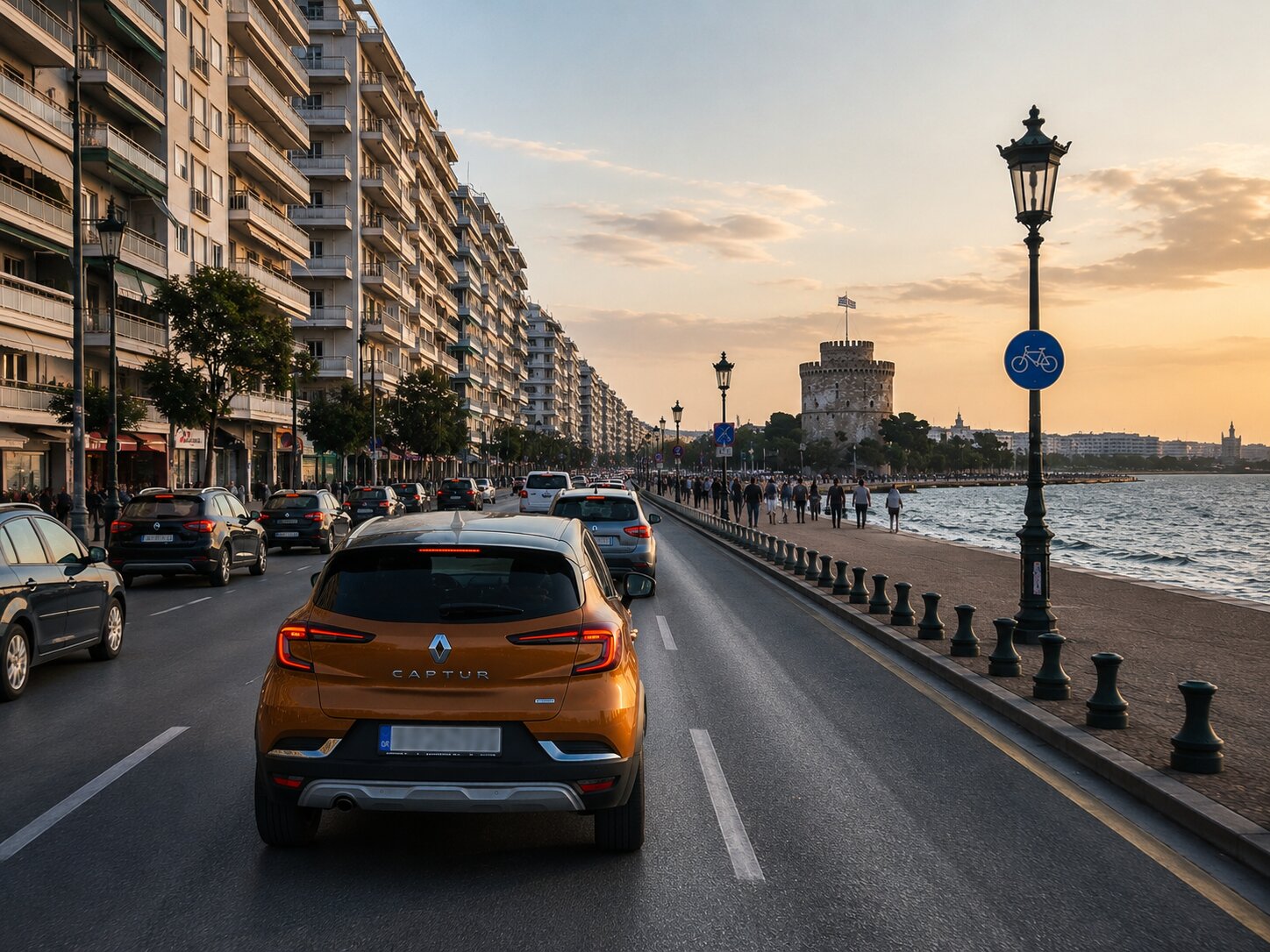
Thessaloniki is more compact than Athens, but its centre carries a large amount of traffic within a limited area.
Major streets can move slowly, while parallel roads are often narrow and lined with parked vehicles. Finding a space may take longer than the drive itself.
For destinations in the city centre, an organised car park is usually the easier option. When travelling towards Halkidiki, expect heavier traffic during mass departure and return periods, particularly on summer weekends.
A smaller city does not necessarily guarantee quick journeys. Congestion, roadworks and temporary traffic arrangements can significantly change journey times.
Driving on the Greek islands
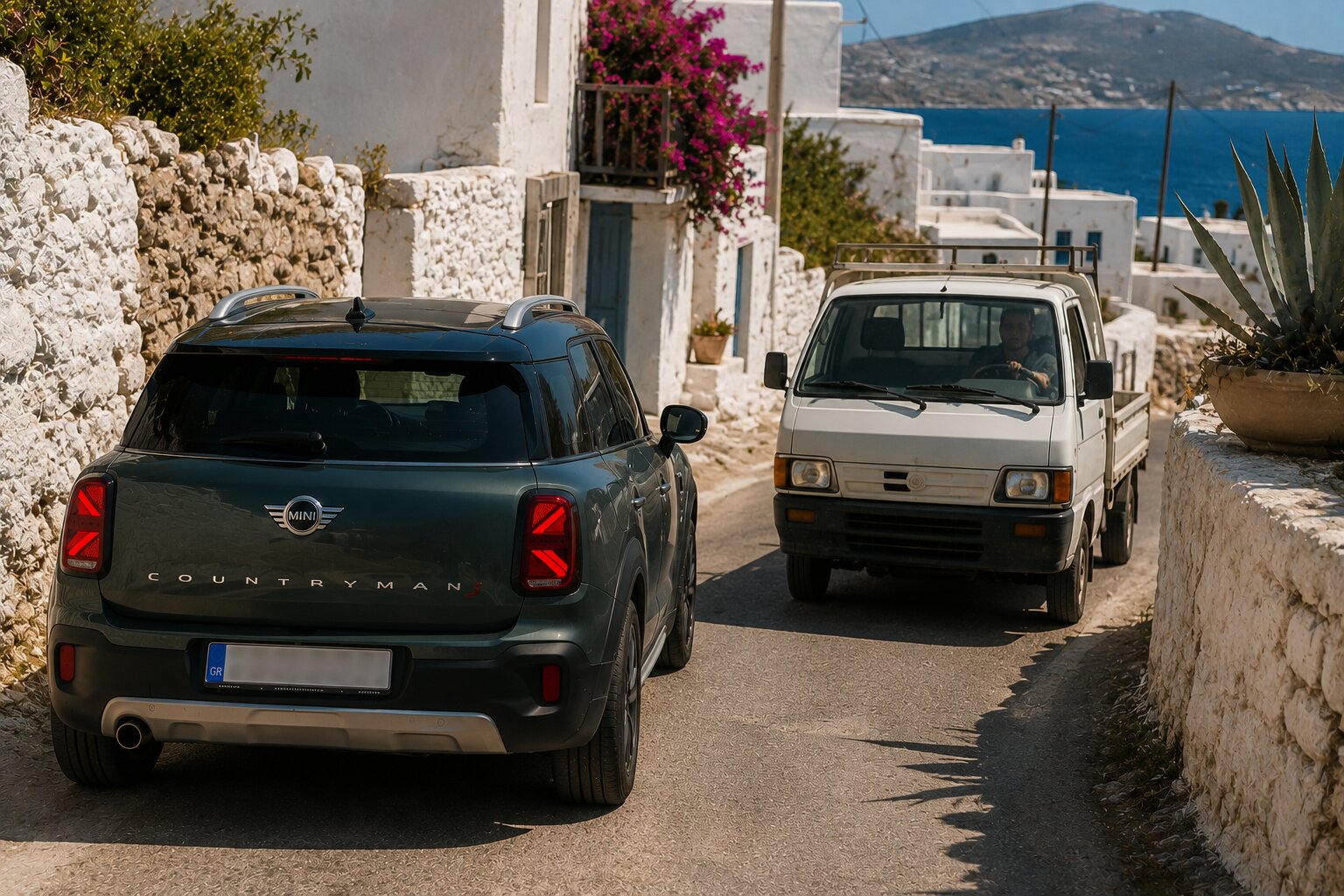
Short distances on the islands can create a false sense of simplicity.
A beach may be only 15 kilometres away, but the route may include:
- narrow passages,
- repeated bends,
- tour buses,
- scooters and ATVs,
- pedestrians,
- and strong crosswinds.
In the Cyclades, crosswinds can noticeably affect a small car on exposed sections, especially when a larger vehicle passes in the opposite direction.
On the Ionian islands, dense vegetation and frequent bends can restrict visibility.
In Crete, distances are longer and the road may change quickly from a modern route to a demanding local road.
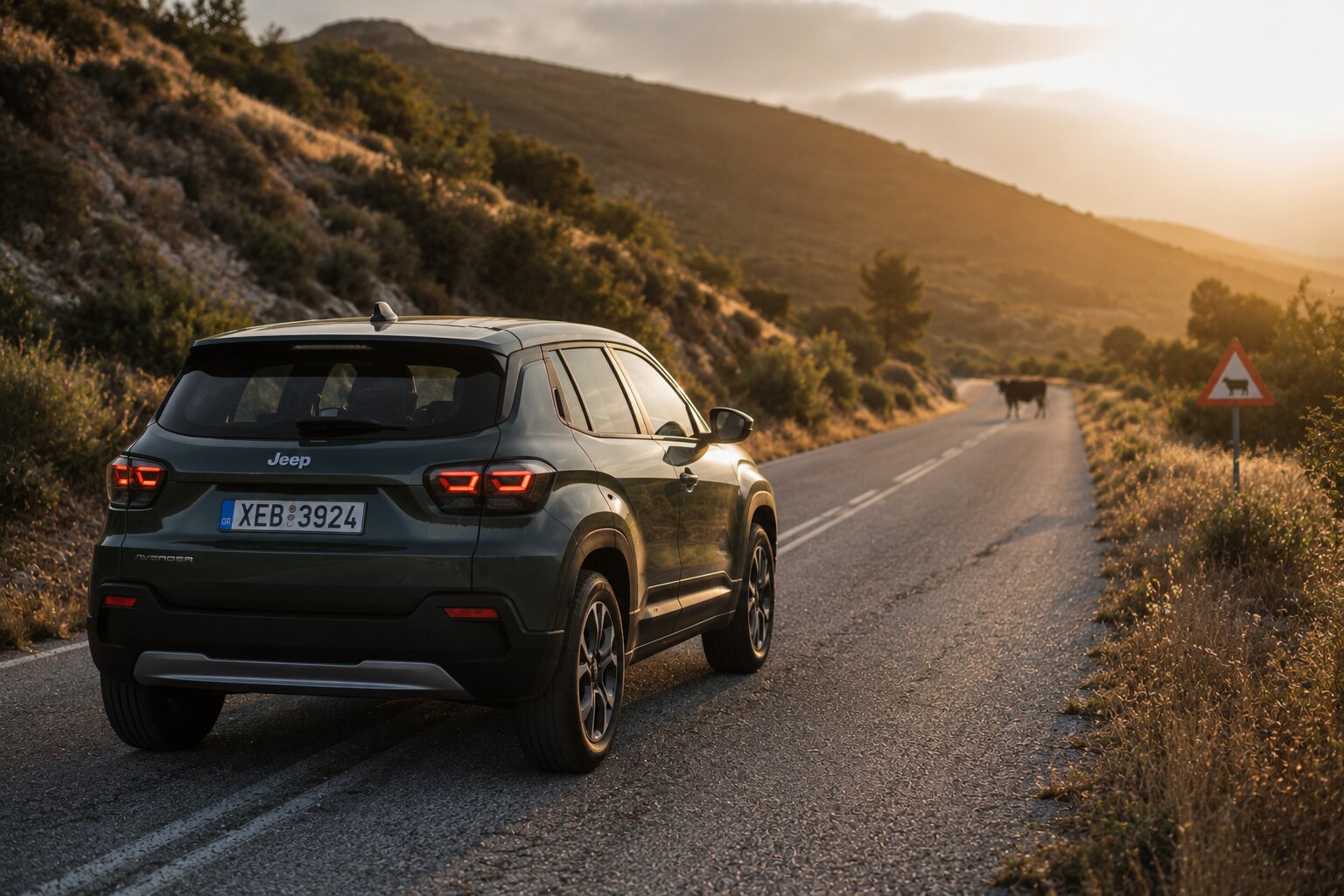
Do not stop in the road to take photographs. Find a safe area where the vehicle can move fully outside the traffic lane. A beautiful view does not make a blind bend safe.
Driving in the mountains and countryside
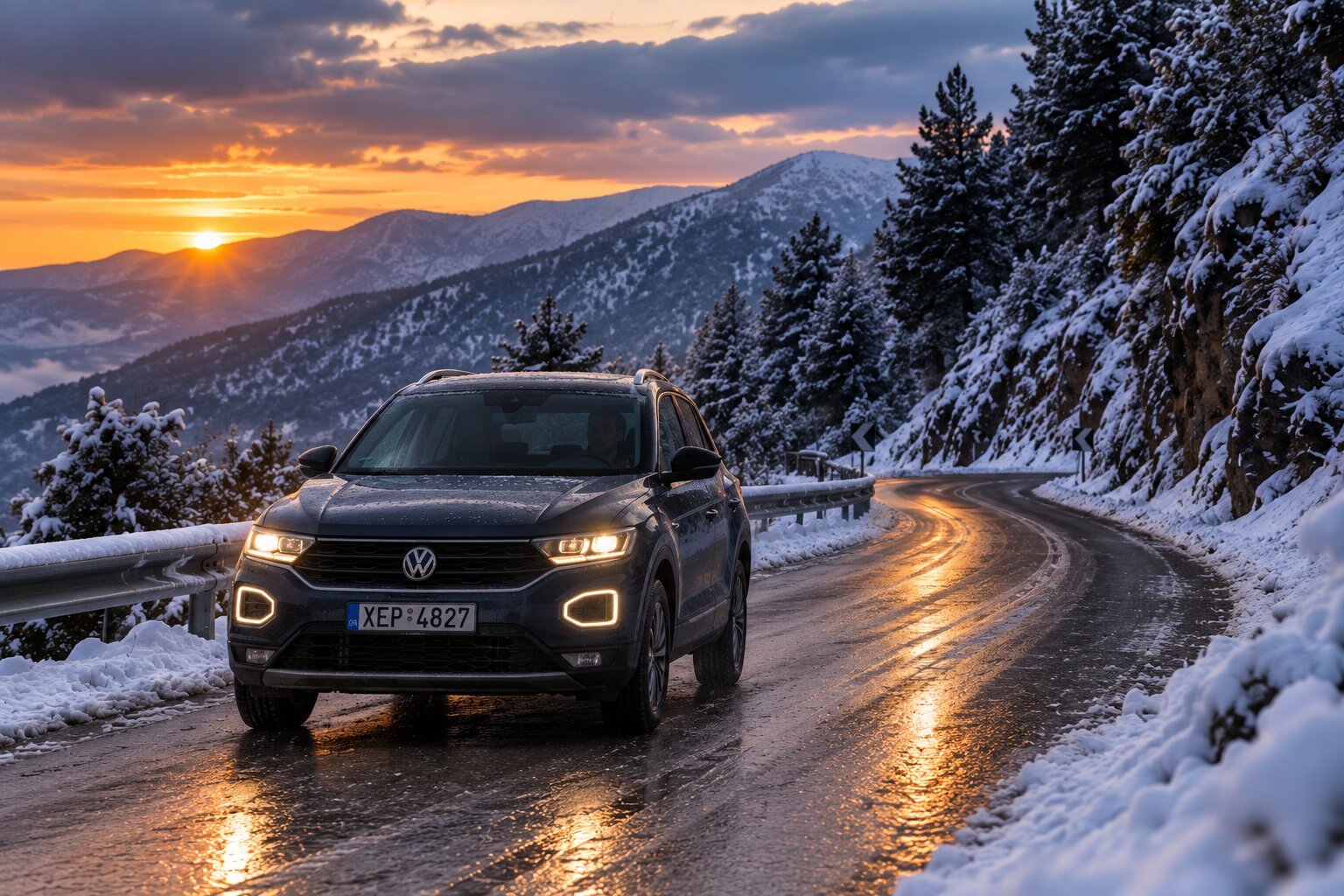
Greece’s mountain routes can be among the most rewarding parts of a road trip, but they require patience.
In Pelion, Epirus, Zagori, Evrytania and the mountainous Peloponnese, you may encounter:
- repeated bends,
- steep gradients,
- limited visibility,
- agricultural vehicles,
- animals,
- stones or soil on the surface,
- fog or ice depending on the season.
Slow down before the bend
Reduce speed before entering a bend. Do not wait until the car is already turning before braking sharply.
Travel at a pace that allows you to stop within the section of road you can see clearly.
Use the gearbox on long descents
In a manual car, select a lower gear so that engine braking helps control the speed.
In an automatic vehicle, use the appropriate mode or manual gear selection when available.
Keeping continuous pressure on the brake pedal during a long descent can lead to overheating and reduced braking performance.
Check official information during winter
During snow or icy conditions, check road conditions and official instructions before setting off. Greek Civil Protection advises using snow chains when travel by car is absolutely necessary under such conditions.
The Road Traffic Code also includes a sign requiring the use of snow chains on driven wheels.
Before travelling to a mountain destination:
- check the weather,
- look for official road-closure announcements,
- make sure the vehicle carries the appropriate equipment,
- and learn how to install it before it is needed.
Four-wheel drive is not a substitute for suitable tyres, snow chains or experience in snow.
Heat, wildfires and severe weather
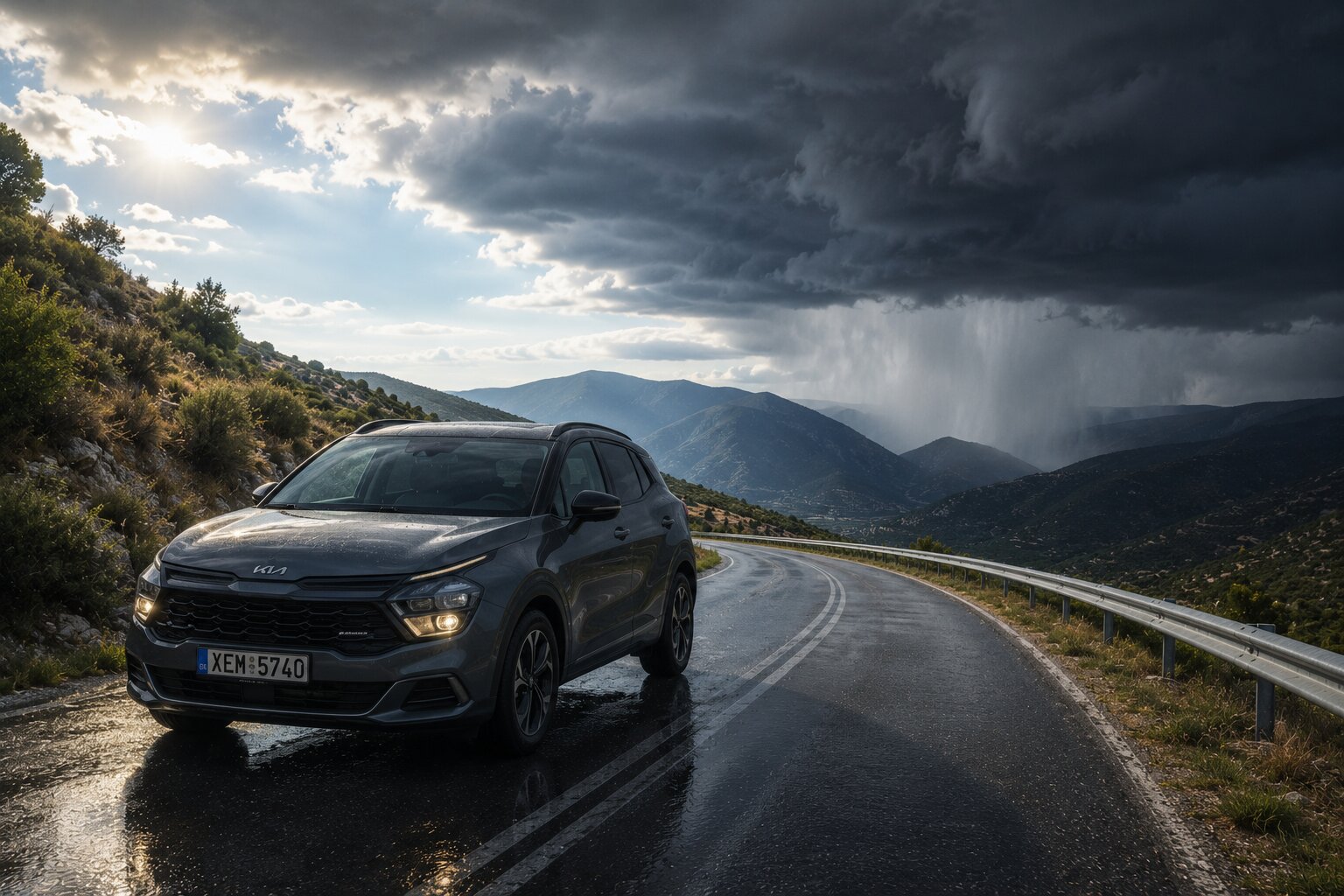
High temperatures increase fatigue and can reduce concentration. Take breaks, drink water and never leave children, elderly passengers or animals inside a parked car, even for a few minutes.
During periods of high wildfire risk:
- never enter a closed road,
- do not follow unofficial diversions through forested areas,
- and do not ignore a 112 alert.
112 is the single European emergency number. Calls are free, and in Greece the system connects callers with services including the police, fire service, emergency medical service and coastguard. It is also used to send public-warning messages during dangerous situations.
When you receive a 112 warning, read the complete message and follow the instructions from the authorities. Do not assume that the navigation app knows which roads have closed or which evacuation route is safe.
What to do when stopped by the police
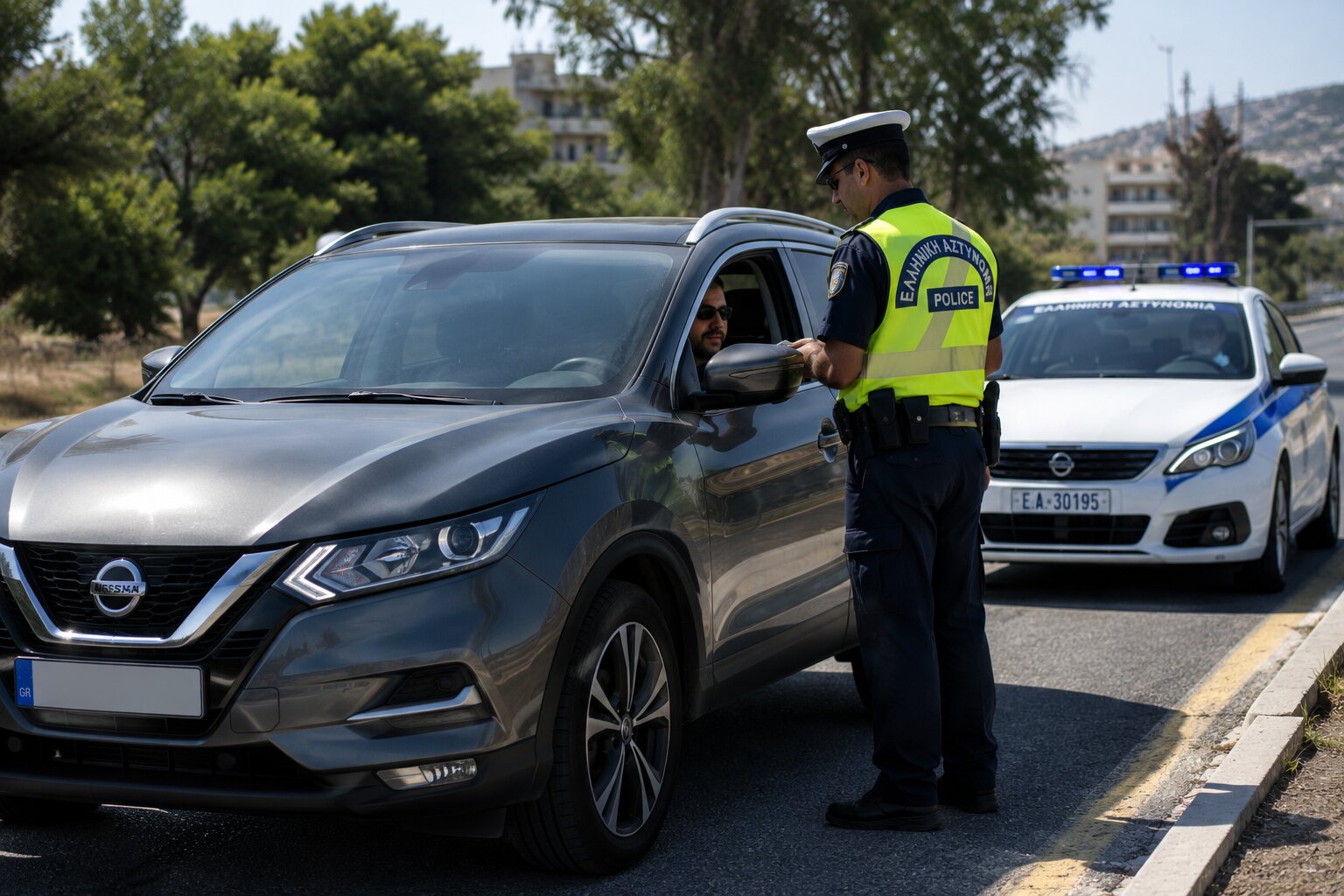
When a police officer signals you to stop:
- Reduce speed smoothly.
- Use the indicator.
- Stop in the safe location indicated.
- Remain calm and follow instructions.
- Present the requested documents.
You may be asked for your driving licence, identity document or passport, and vehicle documentation.
When collecting a rental car, make sure you know where the vehicle documents are kept and which number to call if a problem occurs.
Do not offer money or attempt to settle a violation informally. Follow the official process and inform the rental company when the incident concerns the vehicle or affects the continuation of the rental.
What to do after an accident
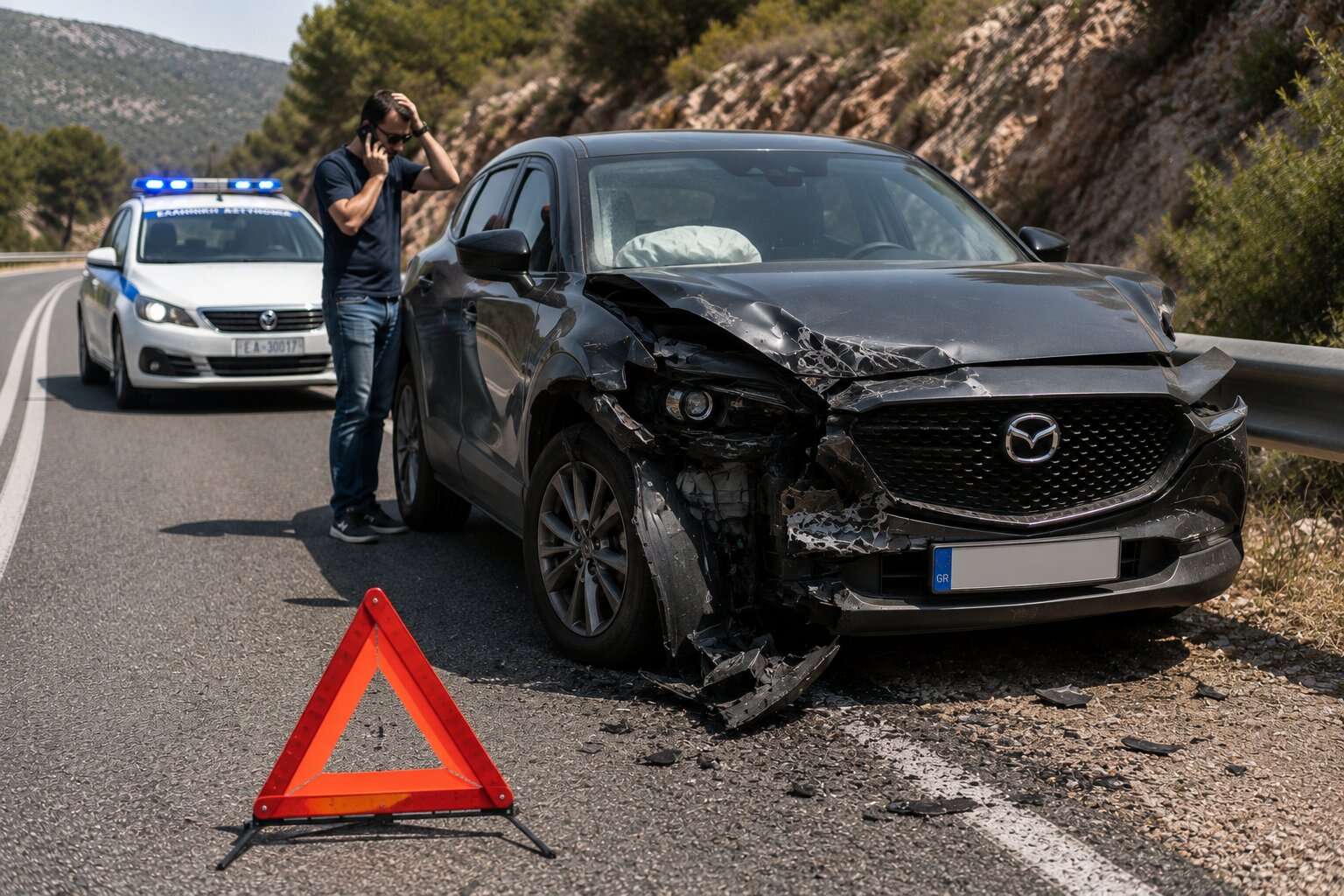
Following a collision:
- Stop immediately.
- Switch on the hazard lights.
- Check whether anyone is injured.
- Call 112 when there is an injury, serious danger or a need for immediate assistance.
- Contact the rental company without delay.
- Follow its instructions regarding the police, accident assistance and moving the vehicle.
- When safe, photograph the position of the vehicles, damage, registration plates and surroundings.
- Exchange details with the other people involved.
- Do not sign a document you do not understand.
Do not leave the scene or agree to an informal payment without informing the rental company.
Insurance protection, excesses and exclusions are explained in WheelDot’s separate guide to rental-car insurance in Greece.
The seven mistakes visitors make most often
Following the navigation app instead of the road
Navigation is a tool, not the final authority. When the suggested access looks unsuitable, stop safely and find an alternative.
Planning by kilometres alone
On an island or in the mountains, a short distance can require much more time than expected.
Matching a local driver’s speed
A local driver knows the bends, narrow points and exits. You do not. Choose your own safe pace.
Parking because “everyone else has”
Other parked vehicles are not proof that parking is legal.
Changing lanes without checking twice
A scooter or motorcycle may already be in the blind spot.
Stopping in a dangerous place for a photograph
Stop only where the car can move completely and safely away from traffic.
Leaving no time buffer
Traffic, tolls, fuel stops, parking and an unfamiliar road can easily add delays.
Checklist before you leave
- Set the route before moving.
- Check the required fuel or plan where you will charge.
- Place the phone in a secure mount.
- Make sure everyone wears a seat belt and children use an appropriate seat.
- Allow for tolls and keep a suitable payment method available.
- Leave sufficient extra time.
- Save the rental company’s number and 112.
- Check weather and official information before a mountain or remote journey.
Safe driving in Greece is about adapting
Driving in Greece does not need to be intimidating.
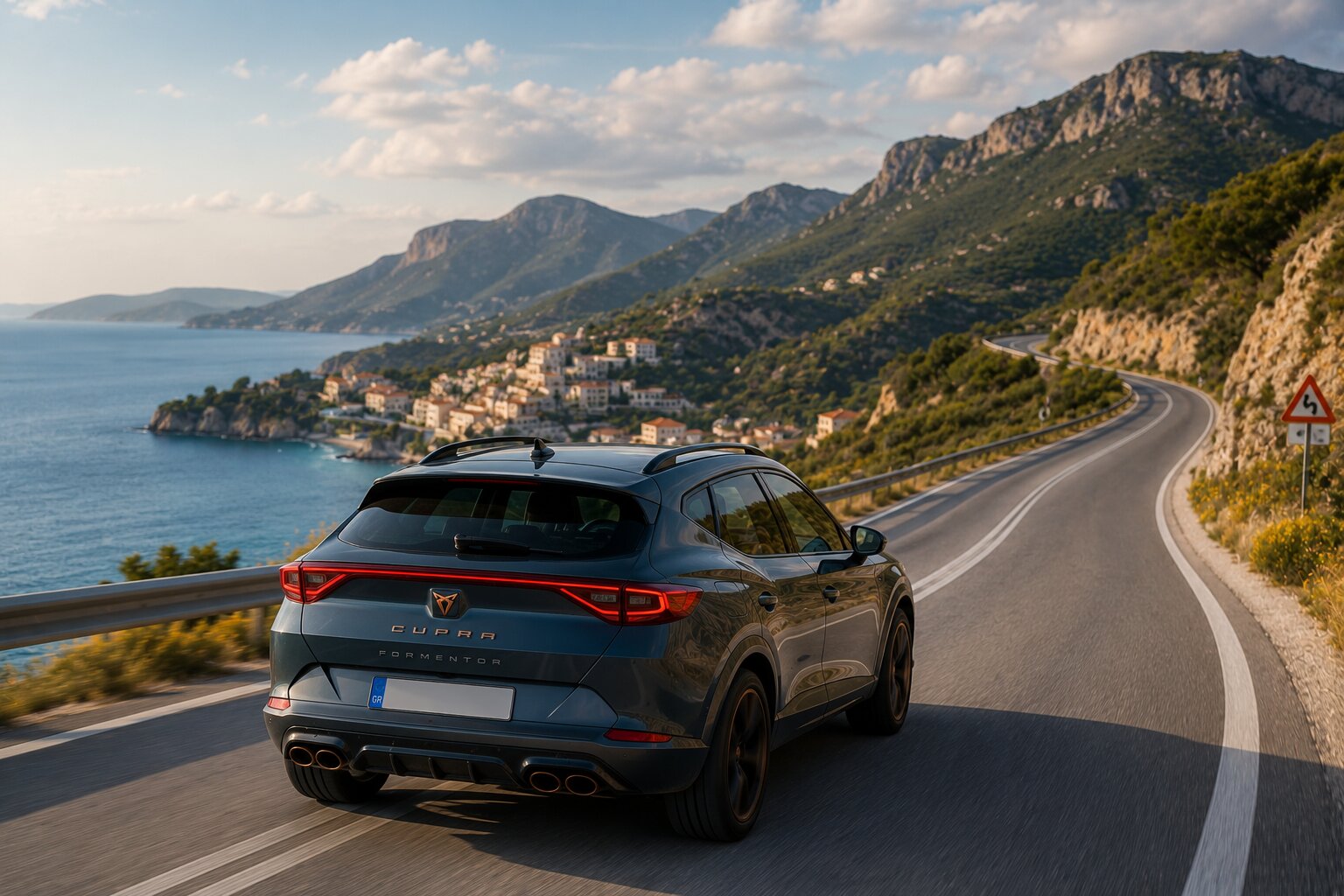
A car can take you, within the same day, from a major city to a modern motorway, from there to a mountain village and finally to an isolated beach.
This variety is one of the greatest advantages of a Greek road trip. It is also why drivers must remain flexible.
Do not try to drive like the fastest person on the road. Drive so that your actions are clear, predictable and appropriate for the environment.
Slow down when the road narrows. Hold your lane when the city becomes intense. Stop only in a safe place when the landscape draws your attention. When a journey requires more time, accept that this is part of the experience.
The best road trip in Greece is not the one in which you cover the greatest number of kilometres.
It is the one in which you arrive safely without missing everything that lies between the starting point and the destination.
WheelDot Editorial Team
This guide was created by the WheelDot Editorial Team following a review of official Greek and European sources.
Its purpose is to help international visitors understand not only the main legal rules, but also the real experience of driving in Greece.
Local traffic arrangements, road conditions, toll prices and weather-related restrictions may change. Drivers should always follow roadside signs, official instructions and the current terms of their rental company.