
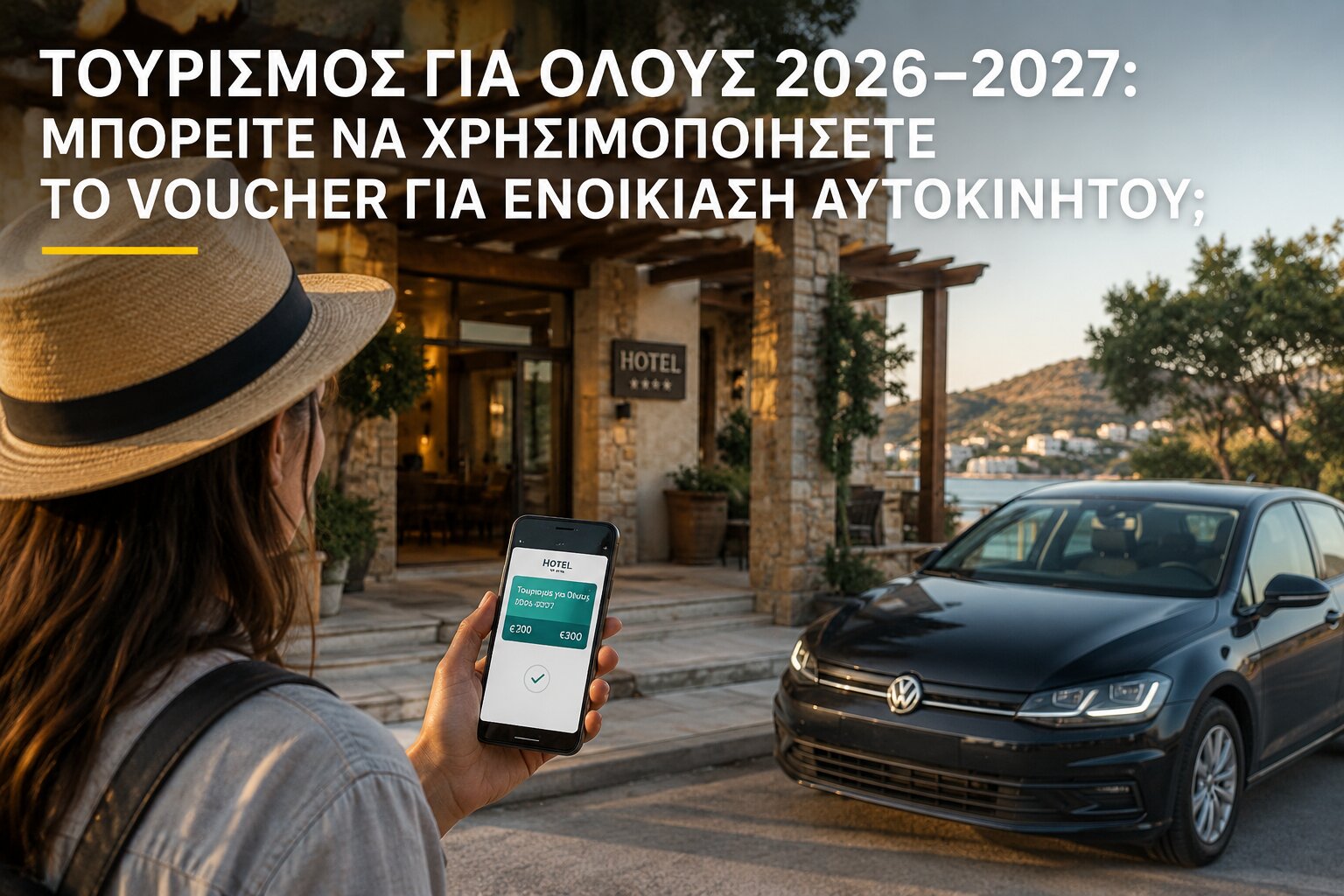
The Tourism for All 2026–2027 programme officially opened for applications on 5 August 2026, offering financial support of up to €600 to help eligible residents travel within Greece.
The subsidy is provided through a digital prepaid debit card, allowing successful applicants to reduce the cost of their holidays. As soon as the programme was announced, one practical question quickly emerged among travellers planning road trips around Greece:
Can the Tourism for All voucher be used to pay for a rental car?
The short answer is no.
While the programme offers valuable financial assistance, the digital card has a very specific purpose. Understanding exactly what it covers—and what it does not—can help travellers avoid unpleasant surprises when booking accommodation, transportation and other travel services.
What Is the Tourism for All 2026–2027 Programme?
Tourism for All is a government-funded initiative designed to encourage domestic tourism by helping eligible residents cover part of their accommodation costs.
Instead of receiving cash, successful applicants obtain a digital debit card that can be used during the selected travel period.
Unlike discount coupons that are limited to specific destinations, the programme allows travellers to choose accommodation anywhere in Greece, provided the business accepts eligible digital card payments under the programme’s rules.
The initiative also aims to extend tourism beyond the traditional summer season by offering higher financial support for trips taken during the low tourist season.
What Can the Voucher Be Used For?
According to the official programme guidelines, the digital card is intended exclusively for accommodation services.
Eligible payments include tourist accommodation providers such as hotels and other legally operating accommodation businesses participating in the payment system.
The available balance may be used:
- in a single transaction,
- across multiple accommodation payments,
- at one or more eligible accommodation providers,
- provided all transactions take place during the selected travel period.
The voucher is therefore not a general travel allowance that can be spent freely during a holiday.

Can You Use the Voucher to Rent a Car?
No.
This is one of the most common misunderstandings surrounding the programme.
Car rental companies are not accommodation providers, meaning the Tourism for All digital card cannot be used to pay for:
- vehicle rental charges,
- security deposits,
- additional insurance,
- theft protection,
- child seats,
- GPS devices,
- additional drivers,
- delivery or collection fees,
- fuel charges,
- or any other rental-related service.
Even if renting a car is essential for reaching your destination, the programme does not include vehicle hire among its eligible expenses.
Travellers planning to explore islands, mountain villages or remote areas should therefore budget separately for transportation.
What About Ferry Tickets or Flights?
The voucher also cannot be used for transportation services.
This means it cannot be used to purchase:
- ferry tickets,
- airline tickets,
- train tickets,
- intercity bus tickets,
- taxi services,
- airport transfers,
- or ride-sharing services.
Although transportation is a major part of any holiday budget, the Tourism for All programme focuses exclusively on supporting accommodation.
Does It Cover Fuel or Electric Vehicle Charging?
No.
The digital card cannot be used at:
- petrol stations,
- diesel stations,
- EV charging points,
- motorway tolls,
- parking facilities,
- car washes,
- roadside assistance,
- or vehicle repairs.
Travellers should therefore calculate these costs separately when planning their holidays.
This is particularly important for visitors intending to drive long distances across mainland Greece or between multiple destinations.
How Much Financial Support Can You Receive?
The value of the digital card depends on both the applicant category and the selected travel season.
For the high tourist season, the programme provides:
- €200 for the general category,
- €300 for single-parent families, pensioners and families with three or more children,
- €400 for people with disabilities and parents of children with disabilities.
Applicants choosing the low tourist season receive higher support:
- €300 for the general category,
- €400 for eligible family categories,
- €600 for people with disabilities and parents of children with disabilities.
Large families may also receive additional financial support for each child beyond the programme’s threshold.
The government’s objective is to encourage travel outside the busiest summer months and support tourism throughout the year.

Can the Voucher Be Used More Than Once?
Yes.
Unlike some travel subsidies that must be spent in a single payment, the Tourism for All card may be used across multiple eligible accommodation transactions until the available balance has been exhausted.
For example, a traveller could:
- use part of the balance for a weekend hotel stay,
- and the remaining amount during another trip later in the eligible period.
This flexibility allows beneficiaries to organise holidays according to their own travel plans rather than forcing them into a single booking.
What Happens If Your Hotel Costs More Than the Voucher?
The digital card simply covers part of the accommodation cost.
If the total hotel bill exceeds the available voucher balance, the traveller must pay the remaining amount using another accepted payment method.
Before confirming a reservation, it is advisable to ask the accommodation provider whether split payments are supported.
Many hotels allow guests to pay part of the reservation using the Tourism for All digital card and the remaining balance using a personal debit or credit card.
Confirming this in advance can help avoid payment issues during check-in.
Can You Book Through Online Travel Platforms?
This is where travellers should pay particular attention.
The important factor is who processes the payment.
If the payment is processed directly by the accommodation provider, the transaction is more likely to qualify under the programme rules.
However, if the payment is processed by an intermediary booking platform or another travel business, the transaction may not be recognised as an eligible accommodation payment.
For this reason, travellers should always contact the accommodation before booking and confirm:
- whether the Tourism for All card is accepted,
- who processes the payment,
- and whether direct payment to the accommodation is possible.
Making assumptions based solely on the booking website could lead to disappointment when attempting to use the voucher.

Who Can Apply?
The programme is available to eligible adult tax residents of Greece who meet the official income and participation requirements set by the Ministry of Tourism.
Applicants must:
- be tax residents of Greece,
- have submitted their income tax return for the required tax year,
- meet the programme’s income criteria,
- and not fall under one of the exclusion categories specified in the official regulations.
People with disabilities of at least 67% and parents of dependent children with disabilities may qualify under special provisions that provide increased financial support and different eligibility conditions.
As with previous editions of the programme, receiving the subsidy is not automatic. Eligible applicants enter an electronic selection process, after which the final beneficiaries are announced.
When Can You Apply?
Applications opened on 5 August 2026 through the official government platform.
To avoid excessive demand during the first few days, applications initially follow the last digit of each applicant’s Tax Identification Number (AFM).
After the first phase, all eligible applicants may submit their application until the official deadline.
Applications can be completed electronically using Taxisnet credentials, while Citizens’ Service Centres (KEP) also provide assistance for those who need help with the process.
How Does the Digital Card Work?
Unlike traditional reimbursement programmes, Tourism for All does not require travellers to collect invoices and submit claims after their holidays.
Instead, successful applicants receive a digital prepaid debit card issued through a participating financial institution.
The available balance appears directly on the card and is reduced every time an eligible accommodation payment is completed.
This approach offers several advantages:
- immediate use without reimbursement procedures,
- contactless payments,
- flexible spending across multiple accommodation bookings,
- and real-time balance tracking.
If the entire amount is not used before the end of the selected travel period, the remaining balance expires and cannot be transferred to another period.
Common Mistakes Travellers Should Avoid
Every year, many travellers incorrectly assume that a tourism voucher works like a general holiday budget.
The Tourism for All programme is much more specific.
Before making reservations, avoid these common mistakes:
Assuming the Voucher Covers the Entire Holiday
The programme reduces accommodation costs—not the total cost of travelling.
You should still budget for:
- transportation,
- car rental,
- fuel,
- ferry tickets,
- flights,
- meals,
- parking,
- tolls,
- travel insurance,
- and personal expenses.
Booking Without Confirming Payment Acceptance
Not every accommodation processes payments in exactly the same way.
Always contact the accommodation directly before booking and confirm:
- that Tourism for All payments are accepted,
- whether payment is made directly to the accommodation,
- and whether split payments are available if your stay costs more than the voucher balance.
Waiting Until the Last Minute
Accommodation availability can become limited during popular travel periods.
Making reservations early gives travellers more options and reduces the likelihood of payment complications.
Planning a Holiday That Includes a Rental Car
Many visitors exploring Greece choose to rent a car, especially when travelling to destinations where public transport is limited.
Although the Tourism for All voucher cannot pay for the rental vehicle itself, it can still reduce the overall holiday budget by lowering accommodation costs.
For example:
- use the voucher to pay for your hotel,
- reserve your rental car separately,
- compare insurance options before collection,
- and include fuel, parking and tolls in your travel budget.
Planning these expenses in advance helps avoid unexpected costs after arrival.
A Simple Example
Imagine a traveller receives a €300 Tourism for All voucher for the low tourist season.
Their holiday budget could look like this:
- Hotel: €420
- Rental car: €240
- Ferry tickets: €110
- Fuel: €70
The voucher can only reduce the hotel cost.
The traveller would therefore pay:
- €120 for the remaining accommodation balance,
- the full rental car cost,
- the ferry tickets,
- and the fuel separately.
Understanding this distinction before travelling makes budgeting significantly easier.
Final Thoughts
The Tourism for All 2026–2027 programme provides valuable financial support for domestic travel, but it is important to understand its purpose correctly.
The digital voucher is designed exclusively for accommodation services. It cannot be used for renting a car, buying ferry or airline tickets, paying for fuel or covering other transportation expenses.
For travellers planning a road trip across Greece, this simply means creating two separate budgets:
- one for accommodation, partially covered by the programme,
- and another for transportation and vehicle-related costs.
Knowing these rules before making reservations will help you organise your holiday with confidence and avoid payment surprises.