

Smartphones fundamentally changed the way we communicate, access information, take photos, navigate and use the internet. Today, however, the technology industry is searching for the next major computing platform — and AI glasses are emerging as one of the most serious candidates.
The idea is relatively simple. Instead of constantly taking a phone out of our pocket, a pair of glasses could use cameras, microphones, speakers, artificial intelligence and, in some cases, integrated displays to understand what we see and provide useful information at the right moment.
This is no longer just an experimental concept. Google is developing Android XR and has introduced smart-glasses concepts powered by Gemini, while Meta continues to invest heavily in AI wearables. Snap is also pursuing consumer augmented-reality glasses.
The question is becoming increasingly relevant: Could glasses eventually become more important than the smartphone?
What Exactly Are AI Glasses?
Not all smart glasses work in the same way.
The first category looks much like conventional eyewear and primarily relies on AI, cameras, microphones and audio. Users can ask questions, capture photos or video, listen to music and interact with an AI assistant without looking at a screen.
A more advanced category adds visual information directly into the user’s field of view.
This is potentially a much bigger change. Navigation instructions, translations, notifications and contextual information could appear in front of the wearer without requiring them to look down at a smartphone.
Google has already outlined this distinction through its Android XR strategy, including glasses without displays for AI assistance and models capable of displaying information to the wearer.
The company has demonstrated potential uses involving navigation, messaging, photography and assistance through Gemini.
Why Is Artificial Intelligence So Important?
Smart glasses are not a new idea. What has changed dramatically is the AI behind them.
Traditional wearable devices largely waited for users to give them specific commands. Modern AI systems can potentially combine voice, images and contextual information to understand what someone is trying to accomplish at a particular moment.
Imagine walking through an unfamiliar city.
Instead of taking out your phone, opening a maps application and repeatedly checking the screen, you could ask your glasses where to turn.
If you encounter a sign written in another language, AI could help translate it.
If you are looking at a landmark, you could potentially ask what it is and receive relevant information immediately.
This represents a fundamental change in the relationship between humans and computers.
With smartphones, the interaction usually begins with us: take out the device, unlock it, open an application and perform an action.
The ambition behind AI glasses is different.
The technology would already be available when we need it.

The Big Promise: Less Screen Time
There is an interesting paradox behind AI glasses.
They are highly sophisticated digital devices, yet one of their biggest potential advantages is that they could make us look at devices less often.
Navigation is a good example.
A traveller walking through an unfamiliar city currently has to divide attention between the physical environment and a smartphone screen. Smart glasses could potentially provide directions while allowing the person to continue looking ahead.
The same principle could apply to translations, messages, reminders, photography and AI assistance.
This transition away from the traditional screen is one reason technology companies see wearables as a potentially important new computing platform.
But reducing dependence on the smartphone screen is very different from eliminating the smartphone itself.
Can AI Glasses Really Replace Smartphones?
For now, the answer is no.
The modern smartphone is extraordinarily difficult to replace because it combines so many functions in a single compact device.
It offers a relatively large display, powerful processors, sophisticated cameras, touch input, communications, payments, navigation and access to a vast ecosystem of applications.
Glasses operate under much tighter physical constraints.
They must remain light enough to wear comfortably for hours. They need sufficient battery life without becoming bulky. They must manage heat while accommodating processors, microphones, speakers, sensors, wireless connectivity and potentially displays.
Advanced augmented-reality technology can also remain expensive compared with mainstream consumer electronics.
As a result, the more realistic near-term scenario is not the sudden disappearance of the smartphone.
Instead, glasses could gradually take over some of the small interactions for which we currently reach for our phones dozens of times each day.
Privacy Could Be the Biggest Challenge
Some of the most difficult obstacles may not be technological at all.
One of the largest is privacy.
A smartphone sitting inside someone’s pocket is relatively easy to ignore. A pair of glasses containing cameras and microphones is different because those sensors naturally point towards the people and places surrounding the wearer.
That creates difficult questions.
When is the camera operating?
Is audio being recorded?
Does information need to be sent to cloud servers for AI processing?
How does someone nearby know whether they are being recorded?
And what happens to the data afterwards?
European data-protection authorities have previously highlighted the particular privacy challenges associated with smart glasses and wearable technologies capable of collecting images, audio and other information about people surrounding the wearer.
As AI becomes more capable of interpreting what cameras and microphones capture, those questions become even more important.
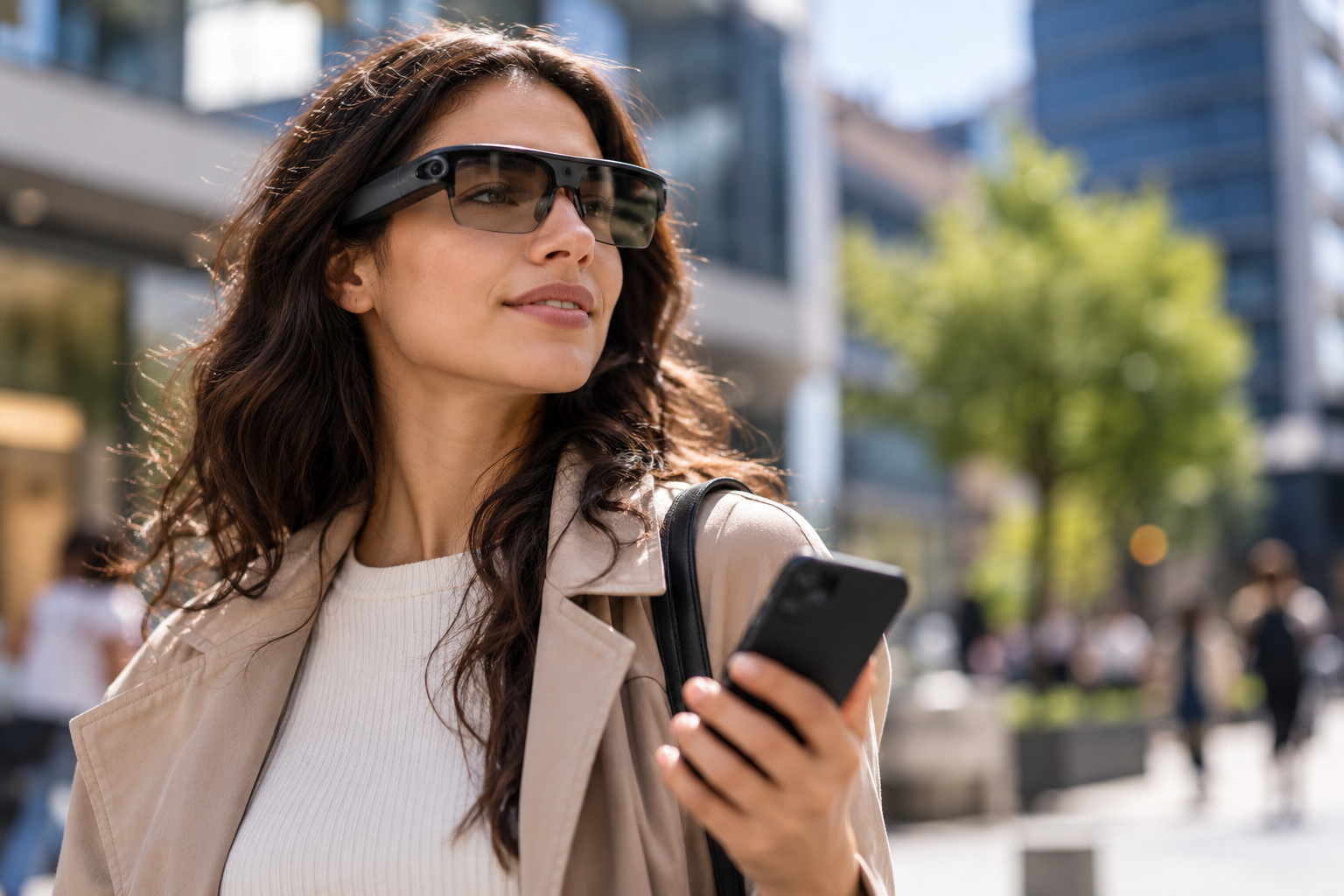
The Problem of the Almost Invisible Camera
When somebody takes a photograph with a smartphone, their behaviour is usually obvious.
They take out the device, raise it and point the camera.
Smart glasses change this social signal.
A person can simply be looking at someone while wearing a device capable of capturing images or video.
Manufacturers can use recording indicators and other safeguards, but those solutions depend on people nearby noticing the indicator and understanding what it means.
The issue becomes even more complicated when AI needs temporary access to visual or audio information simply to understand the user’s surroundings.
For manufacturers, therefore, the next major competition may not only concern who develops the most powerful AI assistant.
It may also concern which company can create enough trust for people to feel comfortable both wearing these devices and interacting with people who wear them.
Privacy, transparency and clear user controls could ultimately become just as important as battery life, camera quality and AI performance.
From “Mobile First” to “AI First”?
Perhaps the real question is not whether glasses will replace smartphones.
A more important question may be:
Which device will become the primary interface to our personal AI?
For more than a decade, the smartphone has been the centre of our digital lives.
AI creates the possibility of a different model.
Instead of organising everything around applications and touchscreens, the user could increasingly communicate with technology through natural language, images, sound and context.
Glasses have an important advantage in this environment: they sit at eye level.
With the user’s permission, they can potentially share the wearer’s perspective and provide AI with much more context than a conventional voice assistant receives.
A user would no longer always need to explain what they are looking at.
The AI could potentially see the relevant object or environment and understand the question within that context.
That could make the interaction significantly more natural.
What Happens to Apps?
Another interesting consequence concerns applications.
The smartphone era has trained us to think in terms of individual apps.
We open one application for maps, another for messages, another for translation and another for information.
AI assistants could gradually reduce some of those boundaries.
Instead of deciding which application to open, users may increasingly state what they want:
“Take me to the nearest train station.”
“Translate this.”
“Send a message saying I’ll arrive in ten minutes.”
“What building am I looking at?”
The AI could then determine which services are required.
That does not necessarily mean applications will disappear. But their role could become less visible to the user.
The shift would be significant: from choosing software to expressing intent.
Will the Smartphone Eventually Disappear?
Technology platforms rarely disappear overnight.
Desktop computers continued to exist after smartphones became dominant. Their role simply changed.
The same could happen with phones.
In the first stage, AI glasses are more likely to function as a companion to the smartphone. They can handle navigation, photography, translations, music, notifications and quick AI interactions while the phone continues to perform more demanding tasks in the background.
Over time, that balance could change.
If glasses become lighter, more affordable and more comfortable; if battery life improves; if displays become better; if AI can increasingly run locally rather than relying constantly on the cloud; and, crucially, if manufacturers solve major privacy and social-acceptance problems, the smartphone could gradually become less central.
It might remain in our pocket while another device becomes our primary interface with the digital world.

The Beginning of the Post-Smartphone Era?
It is still too early to declare the end of the smartphone.
Today’s AI glasses have significant limitations, and replacing a device as versatile as the modern phone is an extraordinarily difficult engineering and behavioural challenge.
But something important is changing.
The competition is no longer only about creating a better smartphone.
Technology companies are increasingly trying to build a computing experience that does not require us to constantly look at one.
That distinction may ultimately prove more important than whether smartphones technically disappear.
The beginning of their replacement might not be the day people stop buying phones.
It could be the day we stop needing to look at them all the time.