
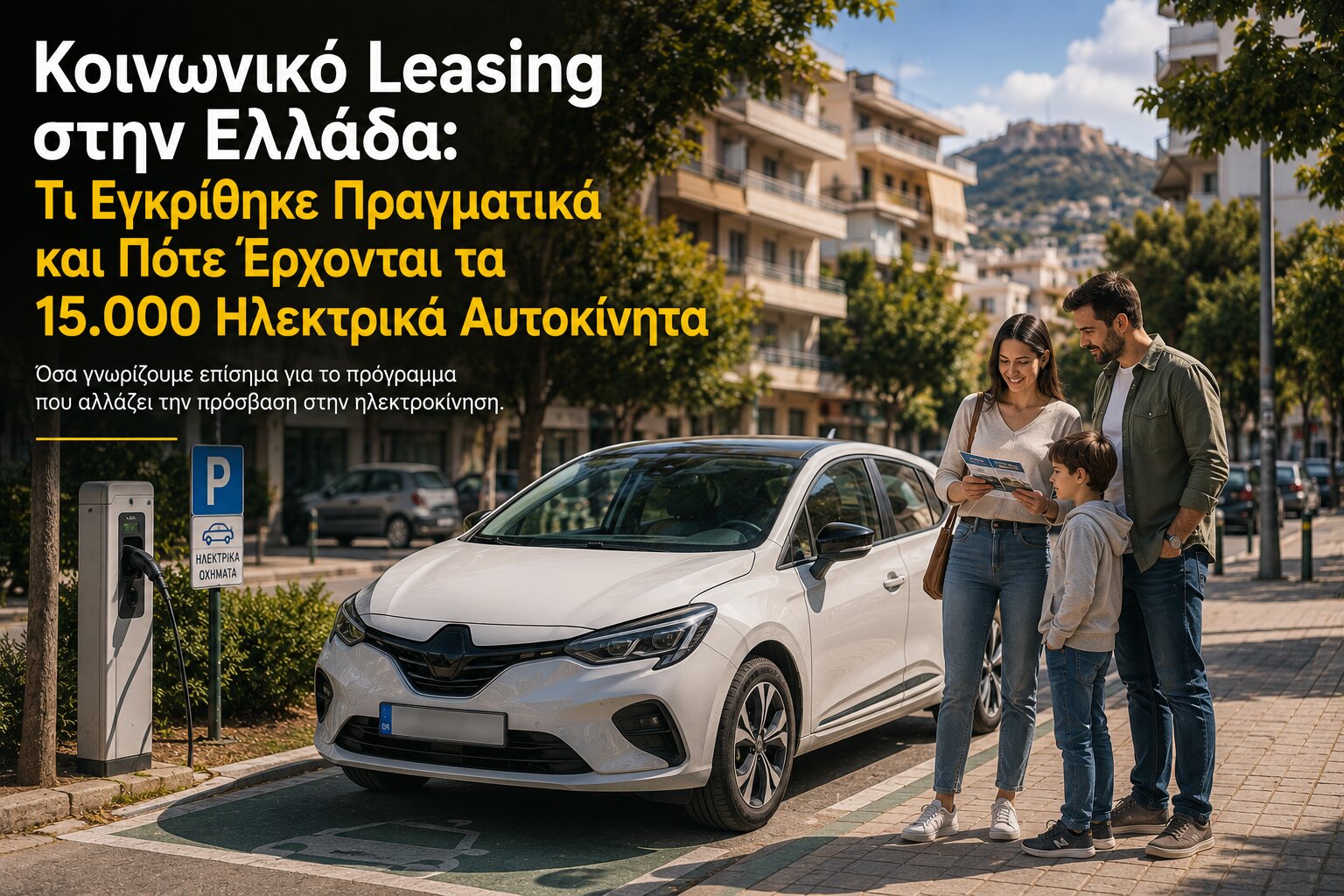
Social Leasing in Greece has moved an important step closer to becoming reality.
On 27 August 2026, the European Commission approved Greece’s €4.77 billion Social Climate Plan, which includes a Social Leasing scheme designed to provide 15,000 transport-vulnerable households with access to zero-emission vehicles.
The development is significant, particularly as Greece prepares for the wider transition towards cleaner transport.
But there is an important distinction to make.
The Social Leasing programme is not yet open for applications, and several figures circulating in headlines — particularly claims about electric cars costing exactly €150 per month — should not yet be treated as final programme conditions.
So, what has actually been approved, who is the programme intended for, and when could the first vehicles reach Greek roads?
What Is Social Leasing?
The idea differs from a conventional EV purchase subsidy.
Instead of simply helping consumers purchase an electric vehicle, the programme introduces social leasing of zero-emission vehicles for households considered vulnerable in terms of transport.
These are people for whom access to a car may be essential for everyday life but for whom replacing an older vehicle with a new EV could otherwise be financially difficult.
Greece’s approved Social Climate Plan allocates approximately €165.3 million to Social Leasing, targeting 15,000 car-dependent vulnerable households.
This makes the initiative more than another electric-car incentive.
It connects three areas that have traditionally been treated separately:
leasing, social policy and the transition to cleaner mobility.

Why Is Social Leasing Being Introduced?
The programme forms part of the European Union’s broader Social Climate Fund.
The fund was established to help vulnerable households, micro-enterprises and transport users manage the social and economic effects of the transition towards climate neutrality, particularly those associated with the new emissions trading system covering buildings and road transport, known as ETS2.
This is particularly relevant for Greece.
The European Commission estimates that approximately 1.47 million vulnerable transport users are addressed through measures in the Greek plan.
For many households, particularly those living in rural, island or remote areas with limited public transport, a private vehicle is not simply a matter of convenience.
It can be essential for reaching work, education, healthcare and basic services.
That creates a fundamental problem for the transition to electric mobility.
Increasing the cost of using older, more polluting vehicles cannot automatically make a new EV affordable to a lower-income household.
Social Leasing is intended to help bridge that gap.
Who Will Be Eligible?
The approved programme targets 15,000 transport-vulnerable households, particularly those that depend on a car.
However, this is where it becomes important to distinguish between what has been approved at European level and what still needs to be determined during implementation.
The final detailed eligibility criteria have not yet been published in an open programme guide.
Factors such as income, household circumstances, location, access to public transport and specific mobility needs are expected to play a role in determining transport vulnerability.
But the definitive criteria, required documentation and application process will become clear when the official Greek implementation guide and call for applications are published.
Until then, specific income thresholds reported elsewhere should not automatically be considered final.

Will an Electric Car Really Cost €150 per Month?
This has become perhaps the most recognisable headline surrounding the programme:
“An electric car for €150 a month.”
It is certainly attractive.
But it needs context.
The approved European framework does not establish €150 as a universal guaranteed monthly payment for every beneficiary.
The final cost could depend on several factors, including the vehicle, the amount of public support, the beneficiary’s circumstances, the structure and duration of the lease and the detailed rules of the programme.
The objective that has been officially established is broader: to make access to zero-emission vehicles affordable for vulnerable households that might otherwise be unable to make the transition.
So, until the final programme guide is published, €150 should be regarded as an indicative figure associated with the programme’s development — not as a confirmed fixed monthly price for every applicant.
What About Scrapping Older Cars and Additional Support?
The approved implementation framework contains another interesting detail.
At least 15% of the vehicles supported through the Social Leasing measure are expected to receive either increased assistance for specific beneficiary groups or additional support linked to the scrapping of an old vehicle.
That points to another objective behind the programme: not simply putting more EVs on Greek roads, but potentially accelerating the removal of older vehicles from the national fleet.
The exact financial incentives and conditions, however, will depend on the final implementation rules.
Social Leasing Is Not Only About Households
One of the most important aspects of Greece’s Social Climate Plan has received considerably less attention.
Alongside support for 15,000 households, approximately €373.7 million is planned to help around 15,550 vulnerable micro-enterprises acquire or lease low- and zero-emission vehicles.
This could have a significant effect on Greece’s professional vehicle fleet.
For a small business, replacing an ageing car or van can represent a substantial investment.
Providing access to public support for either purchasing or leasing cleaner vehicles creates another route towards fleet renewal without requiring businesses to absorb the entire upfront cost themselves.
It also demonstrates that leasing is becoming part of a much broader mobility strategy.
EVs Alone Are Not Enough
Putting thousands of electric vehicles on the road creates another obvious requirement:
they need somewhere to charge.
Greece’s Social Climate Plan therefore combines vehicle support with investment in charging infrastructure.
Approximately €135 million is allocated to the development of 4,400 publicly accessible charging points, including support for areas where private investment alone may not currently provide sufficient infrastructure.
This is especially important for Social Leasing.
Making an EV affordable to someone living outside a major urban centre solves only part of the problem if reliable charging is unavailable nearby.
The transition therefore needs to address both sides of the equation:
access to the vehicle and access to the infrastructure required to use it.

When Will Social Leasing Start in Greece?
The Commission’s approval does not mean applications are already open.
According to the approved implementation framework, the Social Leasing scheme is expected to be launched by the first quarter of 2027.
The rollout then continues progressively rather than delivering all 15,000 vehicles immediately.
The targets are:
3,000 vehicles by Q2 2028,
9,000 vehicles cumulatively by Q2 2029,
15,000 vehicles cumulatively by Q4 2031.
Greece is also expected to be able to request its first payment from the Social Climate Fund during the first quarter of 2027, following the beginning of implementation and achievement of the relevant milestones.
For consumers interested in the programme, the message today is therefore straightforward:
The programme has been approved. The application process has not yet opened.
The publication of the official implementation guide will be the crucial next step.
It Is Part of Something Much Bigger
Social Leasing represents only one component of Greece’s Social Climate Plan.
The entire plan is worth approximately €4.77 billion through 2032, with around €3.58 billion coming from the EU Social Climate Fund and approximately €1.19 billion from Greece’s national contribution.
Around €1.46 billion of the plan is directed towards transport measures.
Beyond Social Leasing, the strategy includes support for micro-enterprise vehicles, charging infrastructure, zero-emission buses, demand-responsive transport services for rural and remote areas and accessibility improvements across transport infrastructure.
The underlying philosophy is therefore broader than simply replacing every older petrol or diesel car with an EV.
The objective is to provide cleaner and more accessible mobility options, adapted to different communities and different transport needs.
Could Social Leasing Change the Greek Car Market?
This may ultimately prove to be the most interesting consequence of the programme.
For years, leasing in Greece has primarily been associated with companies and corporate fleets. More recently, it has increasingly become an alternative for private drivers who prefer vehicle usage over traditional ownership.
Social Leasing introduces another role:
leasing as an instrument of public policy.
If the programme operates as planned, thousands of drivers who might otherwise continue using older vehicles could gain access to electric mobility without having to finance the entire purchase price of a new EV.
At the same time, leasing providers and fleet operators could face a new operational environment involving electric vehicles, new driver profiles, public funding, maintenance, charging, contract management and eventually vehicle return and remarketing.
Managing vehicles efficiently throughout that lifecycle will therefore become increasingly important.
Digital fleet management, vehicle data and connected mobility systems could consequently become even more relevant as the Greek fleet gradually evolves.
So, What Should We Remember?
The biggest story is not simply:
“Electric cars are coming for €150 per month.”
That makes a good headline, but it oversimplifies a programme whose final consumer terms have not yet been published.
The real development is more substantial.
Greece now has an approved European framework to provide Social Leasing of zero-emission vehicles to 15,000 transport-vulnerable households, while simultaneously supporting thousands of micro-enterprises and expanding public charging infrastructure.
Leasing is therefore beginning to move beyond being simply an alternative method of acquiring a vehicle.
It is becoming part of the transition towards a new model of mobility.
And the next major milestone will be the publication of the official Social Leasing programme and its final eligibility and financial conditions.