
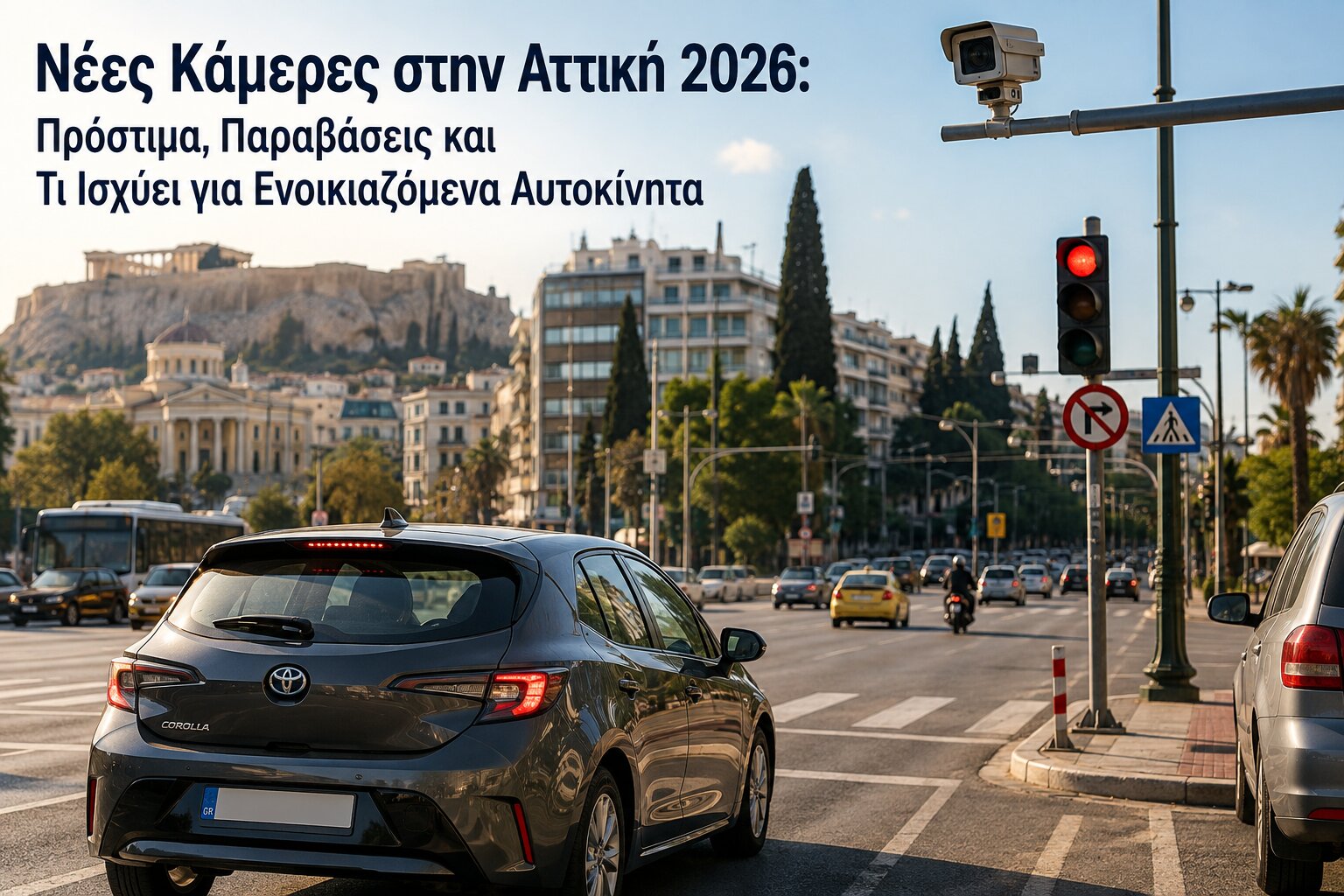
Driving in Athens and the wider Attica region is gradually entering a new era.
Traffic enforcement in Greece is no longer based exclusively on police officers being physically present on the road. Cameras, digital systems and automated notification procedures are becoming an increasingly important part of the way traffic violations are detected and processed.
For anyone driving a rental car — especially an international visitor — this raises an obvious question:
What happens if a traffic camera records a violation while you are driving a rental car in Greece?
The answer is more complicated than simply saying that “the fine goes to the rental company.”
Greece now has a more developed legal framework for electronically recorded traffic violations, while additional digital procedures are being planned specifically to make it easier to identify the person who was actually driving a rented vehicle.
Not All Traffic Cameras in Athens Are the Same
One of the most important things to understand is that Athens does not have just one type of traffic-camera system.
Several different systems are being deployed, and they do not all perform the same function.
The 388 cameras installed by the Region of Attica have been positioned at 100 selected high-risk junctions.
Their main purpose is very specific:
detecting vehicles that run red lights.
For each potential violation, the system is designed to produce high-resolution evidence that can include six photographs as well as video footage. This material is then transmitted to the Greek Police so that the violation can be reviewed and processed.
The Region of Attica has stated that the cameras are intended to operate around the clock.
The Greek government announced 5 August 2026 as the planned starting date for their operation.
However, official announcements also referred to the completion and integration of the necessary information systems. For that reason, it is more accurate to view the network as part of an expanding enforcement system rather than assume that every installed camera necessarily became fully operational at exactly the same moment.
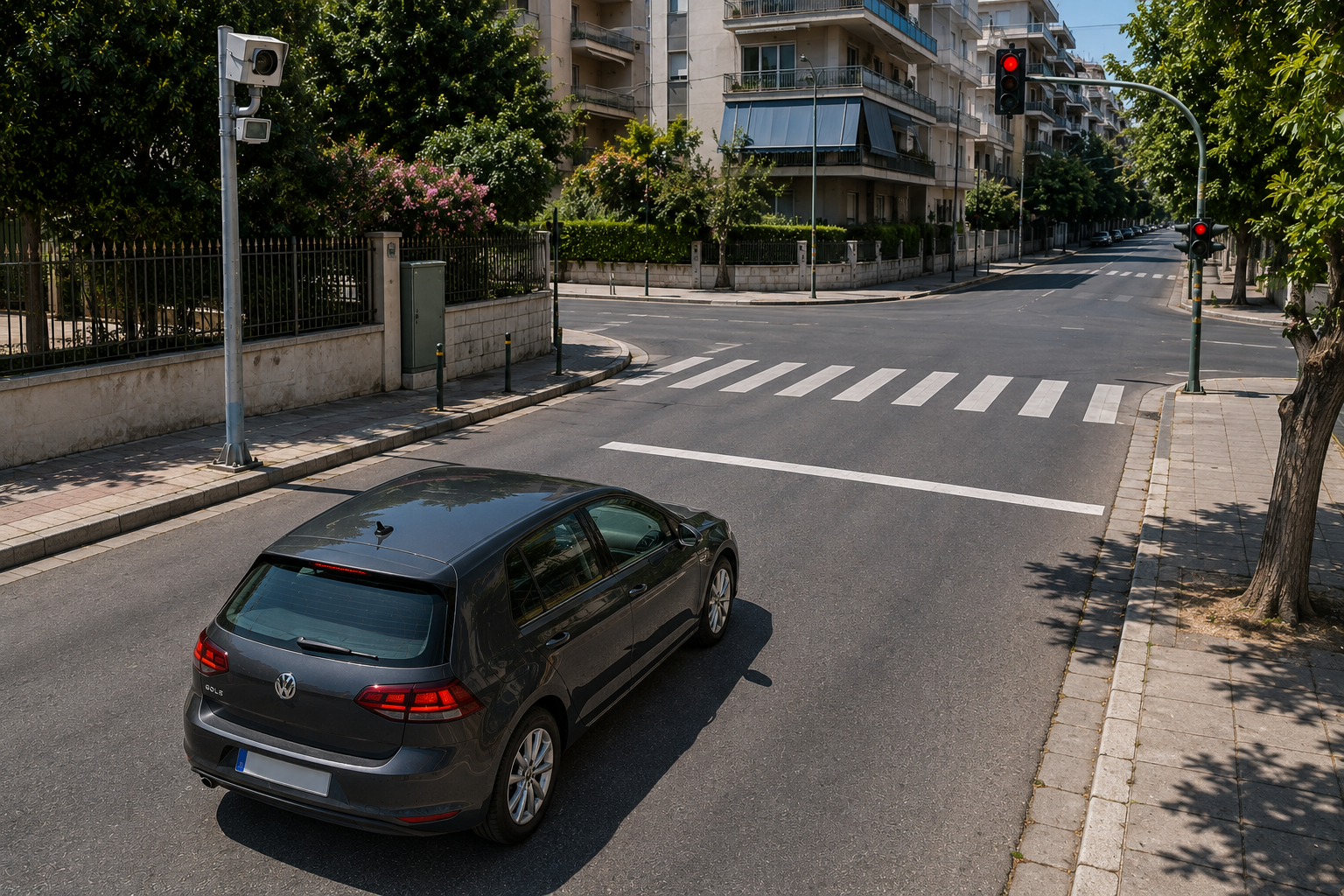
What Is Different About the AI Traffic Cameras?
Alongside the Attica red-light camera network, Greece has also been testing a separate system using cameras with artificial-intelligence-assisted detection capabilities.
These cameras can identify a wider range of potentially dangerous driving behaviour.
Depending on the system and location, they may be used to detect offences including:
- running a red light,
- speeding,
- illegal use or obstruction of bus lanes,
- failure to wear a seat belt,
- failure to wear a motorcycle helmet,
- and mobile-phone use while driving.
This distinction is important.
The 388 Attica cameras should not simply be described as 388 AI cameras monitoring every possible offence. They are part of a different system primarily intended for red-light enforcement.
The AI-assisted cameras have broader detection capabilities.
Does AI Automatically Issue the Fine?
No.
The use of artificial intelligence does not mean that a computer simply decides that a driver is guilty and automatically issues a penalty without human involvement.
The system can identify a possible violation and collect the relevant evidence, but the material is then reviewed by an authorised operator before the offence is officially confirmed.
The legal framework also provides for the protection of people who are not involved in the violation.
This includes measures designed to obscure or protect information relating to pedestrians, passengers or unrelated vehicles appearing in the recorded material.
The camera system may process information necessary to identify the incident, including the vehicle registration number, vehicle characteristics and other relevant visual data.

The Cameras Are Already Producing Real Traffic Fines
This is no longer simply a future project or an experimental system without consequences for drivers.
Electronic confirmation and notification of offences recorded by pilot AI cameras and cameras installed on buses began operating in March 2026.
For drivers registered with the relevant Greek digital services, notifications can be delivered electronically through the citizen’s digital inbox and the Gov.gr Wallet.
Official figures released by the Greek government showed that by 22 July 2026, 4,127 traffic violations had already been served through the AI-camera system.
Of those:
- approximately 41% involved red-light violations, and
- approximately 33% involved failure to wear a seat belt.
The government also reported a technical error rate of approximately 1%.
The important conclusion for drivers is simple:
camera-based traffic enforcement in Greece is already producing real penalties.
How Expensive Can a Traffic Violation Be?
Greece’s revised Road Traffic Code introduced tougher penalties for a number of dangerous driving behaviours.
Running a red light can, depending on the applicable provision, result in an administrative fine of €700 together with a 60-day driving licence suspension.
Other offences that can be detected through modern traffic-camera systems also carry significant penalties.
These include:
- using a mobile phone while driving,
- failing to wear a seat belt,
- failing to wear a motorcycle helmet,
- and serious speeding offences.
For certain Category E3-B offences, the Greek Road Traffic Code provides for a €350 fine together with administrative measures that may include a temporary suspension of driving privileges and vehicle documents.
Repeat offences can also lead to substantially more serious consequences.
The newer framework places particular emphasis on repeated dangerous behaviour, including repeated mobile-phone use, red-light violations and failure to use safety equipment.
Drivers should therefore not think only about the amount of the first fine.
Repeated violations may carry significantly greater consequences.

What Happens If the Vehicle Is a Rental Car?
This is where things become particularly relevant to international travellers.
When a camera detects a violation based on the vehicle’s registration number, the authorities will initially identify the registered owner of that vehicle.
With a privately owned car, that is relatively straightforward.
With a rental vehicle, however, the registered owner is normally the rental company rather than the person who was actually driving.
Greek legislation provides a procedure allowing the registered owner to identify the actual driver.
The law also explicitly covers vehicles rented by car-rental companies and leasing companies.
In practical terms, this means that simply because the rental company owns the car does not automatically make the rental company responsible for the driver’s traffic offence.
The rental agreement and booking records can be used to determine who had possession of the vehicle at the relevant date and time.
Can the Rental Company Identify the Driver?
Yes.
Rental companies normally maintain the information necessary to determine who rented a particular vehicle during a specific period.
If the authorities contact the company regarding a traffic violation, the rental provider may therefore be required to identify the person who had rented or was using the vehicle.
Under the current legal framework, there are specific procedures and deadlines for declaring the actual driver when the registered owner was not driving the vehicle.
This means that returning the rental car and leaving Greece does not necessarily end the matter.
A traffic-camera violation may be processed after your rental period has already ended.
A New Digital Procedure Is Being Planned for Rental Cars
The Greek government has recognised that identifying the actual driver can become complicated when rental cars are involved, particularly during short-term rentals and when the driver is an international visitor.
For this reason, the government announced in July 2026 a proposal for a new digital procedure specifically aimed at rental-car companies.
The planned system would allow rental companies to electronically declare the renter or actual user of the vehicle at the time an offence was recorded.
The objective is to make identification faster and reduce delays in processing violations involving rental and leasing vehicles.
There is, however, an important distinction.
As of 31 August 2026, this should be described as a planned or proposed digital procedure, rather than as a fully operational service available for every rental company and every traffic violation.
That distinction matters, particularly for travellers searching online for information about what happens after a camera records their rental vehicle.
Can a Tourist Ignore the Fine After Leaving Greece?
That would be a risky assumption.
A traffic offence does not necessarily disappear simply because the visitor has returned home.
There can be a delay between:
- the moment the camera records the vehicle,
- the review of the evidence,
- confirmation of the violation,
- identification of the registered owner,
- identification of the renter or actual driver,
- and notification of the person concerned.
By the time this process is completed, the traveller may already have left Greece.
The rental company may also contact the renter after the rental has finished.
The Rental Company’s Administration Fee Is Not Necessarily the Fine
Another point that frequently causes confusion is the difference between the government penalty and a rental company’s own administrative fee.
A rental contract may allow the company to charge an administration or handling fee when it must process a request from the authorities relating to:
- a traffic fine,
- a parking offence,
- a toll violation,
- or another legal request involving the rental vehicle.
This administrative charge is not necessarily the traffic fine itself.
The two should be treated separately.
If you receive a charge after your trip, check exactly what it relates to.
What Should You Do If You Receive a Traffic Fine?
If you are contacted about a violation involving a rental vehicle, do not ignore the notification.
First, verify the basic details:
- vehicle registration number,
- date and time,
- location,
- type of offence,
- and the authority that issued the notice.
If the rental company contacted you, ask for information or documentation explaining the underlying violation.
You should also determine whether the amount being charged is:
- the official traffic fine,
- a rental-company administration fee,
- or both.
If you believe the violation is incorrect, act quickly.
Greek procedures provide mechanisms for challenging certain traffic violations, but deadlines can be short.
Greek residents with access to the necessary digital identification services may be able to submit certain objections electronically through gov.gr.
Foreign visitors who do not have Greek Taxisnet credentials or access to the relevant Greek digital services should not assume that exactly the same online process will be available to them.
In those circumstances, contacting both the rental company and the authority named on the official notice is particularly important.
What Has Really Changed for Drivers in Greece?
The most important development is not simply that Greece has installed more cameras.
The real change is the creation of an increasingly connected digital enforcement system.
That system can connect:
detection → evidence → human verification → confirmation of the offence → electronic notification → objection procedures → collection of the penalty.
For rental vehicles, another important element is being added:
identification of the person who was actually using the car.
As these systems become more integrated, drivers should expect it to become increasingly difficult for serious traffic violations to go unidentified simply because the vehicle was rented or the driver later left the country.
The Best Advice for Rental Car Drivers
For visitors driving in Athens or elsewhere in Greece, the safest approach remains very simple:
Respect the speed limit.
Stop completely at red lights.
Always wear a seat belt.
Wear an approved helmet when riding a motorcycle or scooter.
And do not use a handheld mobile phone while driving.
Traffic cameras do not fundamentally change the rules of the road.
What they change is the likelihood that a dangerous violation will be detected.